Driven by fast medical progress and an aging world, the market for medical implants and devices is growing faster than ever. Among so many medical metals, titanium and titanium alloys stand out because of their light weight, high strength, excellent biocompatibility, corrosion resistance, and chemical stability, making them one of the most ideal metal materials for orthopedics, dentistry, and cardiovascular applications. At the same time, new technologies such as 3D printing, porous structure design, and biomaterials are opening up even more possibilities for titanium in the medical field.
Common Titanium Grades for Medical Applications
Not all titanium materials used in medical devices are the same. We choose different grades based on how strong or safe they need to be for a specific use. Both pure titanium and titanium alloys are common, but each has its own pros and best uses.
| Titanium Grade |
Main Features |
Typical Medical Applications |
| Commercially Pure Titanium (Grade 1 / Grade 2) |
Excellent biocompatibility and corrosion resistance, but lower strength than titanium alloys |
Dental components, non-load-bearing medical parts, corrosion-resistant components |
| Ti-6Al-4V (Grade 5) |
High strength, light weight, and good corrosion resistance |
Surgical instruments, structural medical parts, high-strength precision components |
| Ti-6Al-4V ELI (Grade 23) |
Higher purity and better toughness than Grade 5, widely used in medical applications |
Implant-related parts, orthopedic components, high-performance medical devices |
In practice, the right titanium grade depends on the function of the part, the required mechanical performance, the manufacturing process, and the medical application itself.
Titanium in Medicine: From Material Advantages To Clinical Value
Titanium and titanium alloys are widely seen as ideal medical metals for repairing and replacing human tissues because they offer excellent biocompatibility, high strength, a relatively low elastic modulus, and strong corrosion resistance. Unlike stainless steel, titanium works better for things like dental implants and bone repairs. That’s why it’s the top choice for modern medicine today.
Strong Biocompatibilty: A Great Match For The Human Body
One of titanium’s biggest advantages in medicine is its excellent biocompatibility, which is also the main reason it can be used as a long-term implant material.
Once titanium touches body fluids, it quickly forms a dense and stable titanium dioxide passive film on its surface to stop metal ions from leaking. This film can even heal itself if it’s scratched. Plus, titanium helps bone cells attach and grow, making it easy for the bone to bond perfectly with the implant.
Titanium also works well with surrounding tissues. After implantation, it usually causes only mild inflammation, and the surrounding tissue can form a thin fibrous layer, helping the implant stay stable over the long term.
Strong Osseointegration Ability
The oxide layer on titanium has good chemical stability and surface activity, which helps bone cells attach and grow. Bone tissue can form a stable mechanical connection with the titanium surface, and bone cells can gradually grow into the microscopic pores on the surface, making the interface even more stable.
This direct bone-to-metal bonding allows titanium implants to stay firmly fixed in bone for a long time. That is why titanium and titanium alloys are widely used in dental implants, bone plates, bone screws, joint prostheses, and more.
Blood Compatibility
Titanium’s oxide layer also has good blood compatibility. It can reduce platelet adhesion and aggregation, which helps lower the risk of blood clots. Because of this, titanium is useful in medical applications that may come into contact with blood, especially for device housings, structural parts, and some implantable components.
That said, when it comes to parts that stay in direct contact with blood for a long time, the final performance still depends on the full design, surface treatment, and material combination, so the material alone is not enough to make the final judgment.
Mechanical Performance: Strength And Flexibility
Titanium is a great fit for bones and joints because it’s strong but not too stiff. Unlike some metals that are too rigid and cause bone loss (stress shielding), titanium acts more like real bone. This is why it’s now the top choice for dental and bone implants.
In terms of elastic modulus, titanium alloys clock in around 110 GPa—lower than stainless steel or cobalt-chromium alloys. New β-type versions drop even further, better matching human bone's mechanics. This improves load-sharing, cuts stress shielding, and reduces bone loss around implants.
Titanium is also lighter, so patients feel less 'extra weight' inside them. Plus, it’s tough enough to handle screws and joints without breaking.
Now, with 3D printing, we can even make custom titanium parts that fit a patient’s body perfectly. This means better healing and a more stable result after surgery.
Chemical Performance: A Corrosion-Resistant Metal Shield
Our bodies are naturally salty and harsh, but titanium is built for it. It has a stable film that stops rust and keeps the metal safe. Unlike other materials, it doesn’t release harmful ions, even after years inside the body.
Titanium also handles professional cleaning and sterilization with ease. It is so stable that it won't corrode or break down easily, making it the most trusted metal in modern medicine.
Processing Performance: A Highly Flexible Metal
Beyond its basic strengths, titanium allows for custom and precise medical products. It is highly flexible and works well with new processes like porous design and 3D printing.
While forging and machining produce standard screws and plates, 3D printing allows us to create patient-specific implants that fit perfectly. By designing titanium with a porous structure, we also encourage real bone to grow into the device, leading to much better healing results
Surface Modification And Functionalization
One of titanium’s biggest strengths is how easily its surface can be improved through treatment. Methods such as sandblasting, acid etching, anodizing, and hydroxyapatite coating can enhance bone bonding, antibacterial performance, and tissue compatibility. These surface changes can also support faster osseointegration, better cell attachment, and lower infection risk.
Non-Magnetic: Better For Imaging
One big plus is that titanium isn’t magnetic, so it won’t mess up MRI scans. This makes it much easier for doctors to check on patients after surgery. It also shows up clearly on X-rays without causing too much glare, which is perfect for routine check-ups.
To sum up, titanium is the top choice for medicine because it’s safe, strong, and stable. It’s moving beyond just standard dental and bone parts into the world of smart, custom-made implants.
Of course, it’s not perfect—it can be expensive and wears down over time. But with new designs and 3D printing, titanium is only going to get better and more affordable in the future.
Titanium Medical Devices In Practice
Titanium and titanium alloys are widely used in human implants, medical instruments, medical device structural parts, and some pharmaceutical equipment because of their excellent biocompatibility, high specific strength, low elastic modulus, and strong corrosion resistance. As one of the most important metal material systems in modern medicine, titanium plays a key role in long-term implants, high-stability applications, and high-precision medical environments.
Implants
Implants are medical devices made from one or more biomaterials that are fully or partially placed inside the human body to replace, repair, or support tissue and organ function. For titanium and titanium alloys, implants are the most important and mature application area, especially in orthopedics, dentistry, and cranio-maxillofacial repair.
Common applications:
-
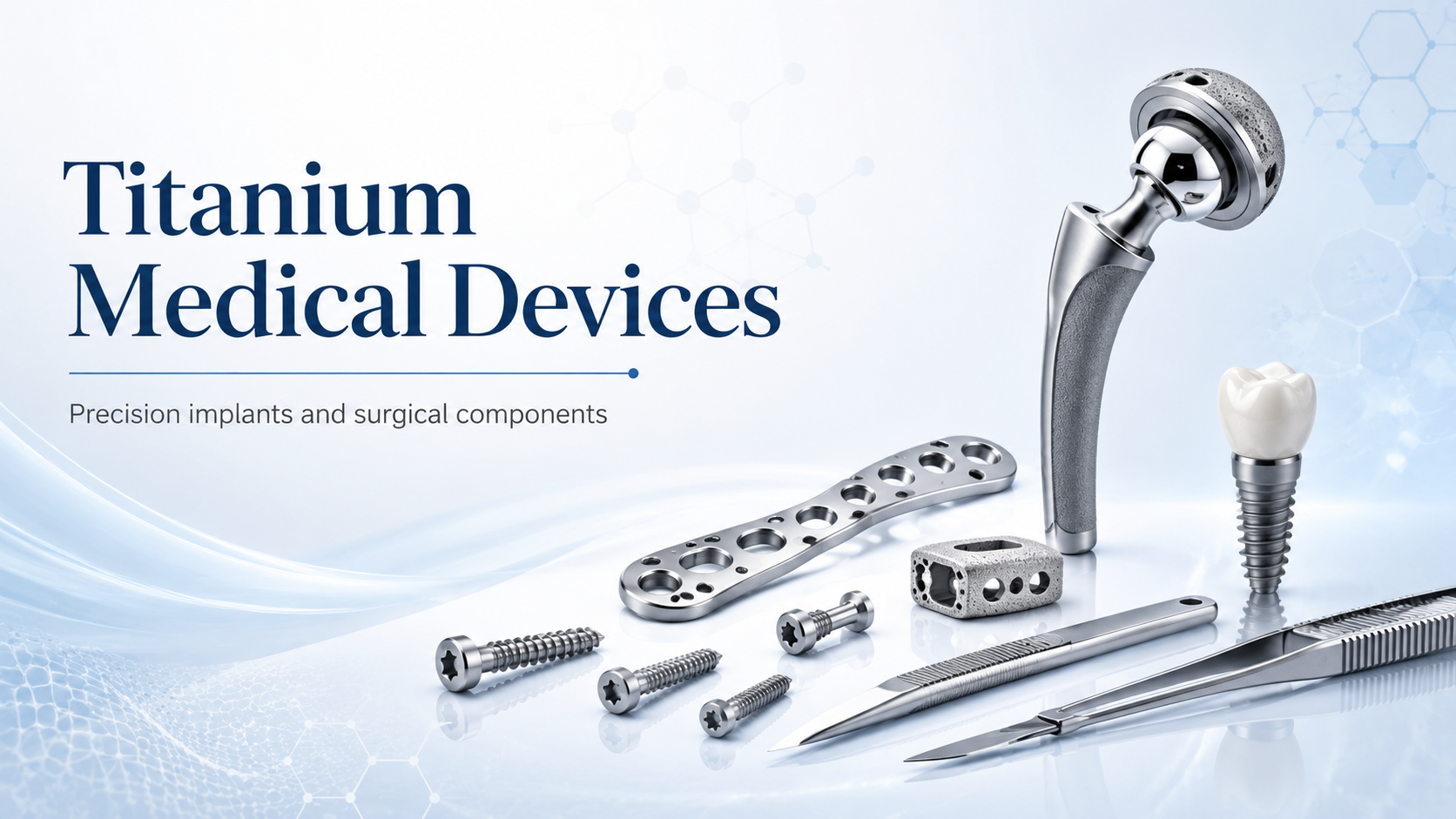
Orthopedic implants, such as femoral stems, acetabular cups, tibial trays, shoulder components, and humeral heads.
-
Trauma fixation devices, such as titanium plates, intramedullary nails, and bone screws.
-
Spinal fixation systems, such as pedicle screws, rods, interbody cages, spinal fixation rods, vertebral bodies, and growing rods.
-
Bone defect repair materials, such as porous titanium scaffolds, bone fillers, and titanium mesh.
Titanium implants are widely used because of their biocompatibility, osseointegration ability, and good mechanical matching. After implantation, they can remain in the body for a long time with relatively low inflammatory response, which makes them suitable for both permanent and some short-term implant applications.
Orthopedic Implants
Titanium is used most widely in orthopedics, and it also has the largest clinical volume. It is mainly used to repair or replace damaged bones and joints.
Common applications:
-
Artificial joint components such as femoral stems, acetabular cups, tibial trays, shoulder components, and humeral heads.
-
Trauma fixation devices such as titanium plates, intramedullary nails, and bone screws.
-
Spinal fixation systems such as pedicle screws, rods, interbody cages, spinal fixation rods, vertebral bodies, and growing rods.
-
Bone defect repair materials such as porous titanium scaffolds, bone fillers, and titanium mesh.
In orthopedic implants, Ti-6Al-4V and Ti-6Al-7Nb are common materials. Their lower elastic modulus helps reduce stress shielding, which is the problem of the implant being too stiff and causing the surrounding bone to weaken over time. Pure titanium and some titanium alloys are also widely used for bone plates, screws, and intramedullary nails because they offer good strength, toughness, and long-term stability.
Dental Implants
Dentistry is one of the most mature areas for titanium use, especially in dental implants and oral restoration.
Common applications:
-
Dental implants, such as root-shaped implants, abutments, denture frameworks, restorations, transzygomatic implants, and more.
-
Orthodontic devices, such as titanium alloy archwires, orthodontic anchorage screws, and miniscrews.
-
Maxillofacial repair materials, such as titanium plates, jaw reconstruction plates, temporomandibular joint prostheses, cranio-maxillofacial plates, and skull repair meshes.
Common dental materials include pure titanium grades 1–4, Ti-6Al-4V ELI, and Ti-6Al-4V. Their surfaces are often treated with sandblasting and acid etching (SLA) or anodizing to improve osseointegration and implant stability.
Cranio-Maxillofacial And Other Implants
Beyond orthopedics and dentistry, titanium is also widely used in cranio-maxillofacial reconstruction, neuromodulation, hearing restoration, and some urology and plastic surgery applications.
Common applications:
-
Cranio-maxillofacial repair, such as skull repair plates, PEEK-titanium hybrid skull plates, orbital reconstruction implants, titanium mesh, and titanium plates.
-
Neuromodulation, such as housings or support parts for deep brain stimulation devices and vagus nerve stimulators.
-
Hearing and vision restoration, such as cochlear implant shells, ossicle repair components, and bone-anchored hearing aid parts.
-
Some support and fixation materials in urology and plastic surgery.
In these products, titanium usually serves as a structural support, protective shell, or long-term implant material, rather than being the only material used in the full device.
Medical Instruments
Medical instruments are tools, devices, and consumables used in surgery, diagnosis, treatment, and rehabilitation, and most of them do not stay in the body long-term. Titanium and titanium alloys are valued in this area mainly because they are lightweight, corrosion-resistant, sterilization-friendly, and non-magnetic. They are often considered the third generation of surgical instruments after carbon steel and stainless steel.
Common applications:
-
Surgical instruments such as scalpel handles, forceps, scissors, needle holders, retractors, tweezers, and tissue spreaders.
-
Orthopedic instruments such as osteotomes, bone hammers, drills, burrs, saw blades, and reamers.
-
Minimally invasive tools such as laparoscopic and thoracoscopic rods, graspers, dissectors, trocars, and handles.
-
Microsurgical tools such as fine scissors, tweezers, and vessel clips used in neurosurgery and ophthalmology.
-
Diagnostic support tools such as some endoscope housings, puncture needles, probe mounts, instrument channels, and operating parts.
The advantage of titanium instruments is that they are lighter, can withstand repeated high-temperature steam sterilization, resist corrosion, and do not attract magnets, making them ideal for high-frequency and precision work.
Treatment And Rehabilitation Devices
Titanium is also used in some treatment and rehabilitation devices, where it mainly provides strength, fatigue resistance, comfort, and corrosion resistance.
Common applications:
-
Dental treatment tools such as implant insertion tools, bone expanders, and sinus lift instruments.
-
Orthodontic and oral treatment tools such as root canal files and reamers, some of which use nickel-titanium memory alloys.
-
Rehabilitation devices such as titanium alloy prosthetics, orthoses, some walkers, and rehabilitation training equipment.
In these applications, titanium is usually not the part that “treats” directly. Instead, it supports the treatment process by making the device more durable, comfortable, and safe.
Medical Equipment
Medical equipment refers to large or complex mechanical, electrical, or electronic systems used for diagnosis, treatment, or support. Titanium and titanium alloys are mainly used here for core structural parts, functional components, and high-stability connectors.
Common applications:
-
MRI equipment, such as supports, bed structures, positioning devices, and coil mounts.
-
CT and X-ray equipment, such as load-bearing parts, rotating components, brackets, and shielding structures.
-
High-end surgical bed frames, anesthesia equipment parts, robotic arm joints, and connectors.
-
Structural parts for proton and heavy-ion therapy systems, gamma knives, and linear accelerators.
In these applications, titanium is used more as a high-reliability structural material, with an emphasis on stability, corrosion resistance, non-magnetic behavior, and light weight.
Biomedical Materials
At the biomedical materials level, the focus is on designing titanium surfaces and structures to improve how they interact with the human body.
Common applications:
-
3D-printed porous titanium scaffolds, titanium mesh composites, and titanium foam materials.
-
Surface modification such as hydroxyapatite coating, micro-arc oxidation, anodizing, and sandblasting/acid etching.
-
Antibacterial surfaces such as silver-ion or copper-ion modified titanium, and TiO₂ photocatalytic antibacterial coatings.
-
Titanium-ceramic, titanium-polymer, and titanium-bioactive material composite systems.
This area is no longer just about “making titanium into a device.” It is about using titanium as a material platform for regenerative medicine, tissue engineering, and precision healthcare.
Pharmaceutical Applications
Titanium and titanium alloys are generally not used directly in drugs themselves. Instead, they are used in pharmaceutical equipment and accessories, especially in environments that require high purity, sterilization, and resistance to strong acids and alkalis.
Common applications:
-
Reactors, fermenters, crystallizers, drying equipment, and heat exchangers.
-
Pipes, valves, pumps, connectors, and seals.
-
Filters, filter elements, membrane module supports, chromatography parts, and centrifuge rotors.
It is worth noting that many pharmaceutical applications still belong to equipment materials or special-use scenarios, so it would not be accurate to say titanium has fully entered drug formulation itself.
Overall, titanium in medicine covers a wide range, from clinical end-use products to upstream industrial applications, from mature implants to cutting-edge material research. The most mature and core applications are still concentrated in implants and high-end medical instruments, especially in orthopedics, dentistry, and cranio-maxillofacial repair.
Titanium Medical Devices Manufacturing Challenges
Manufacturing titanium medical devices is not just about choosing the right material. It also requires careful control of machining, inspection, and process stability.
-
Heat Concentration During Machining: Titanium doesn’t spread heat well, so it stays right at the cutting edge. This wears down tools fast and makes it tough to keep quality stable.
-
Burr Control: Medical parts have tiny holes and slots. If burrs aren't handled, they can ruin the assembly and keep the surface from being perfectly clean.
-
Thin-Wall Deformation: Many parts are thin to keep them lightweight. Without the right clamping or cutting plan, these walls can easily bend or warp during machining.
-
Surface Finish Consistency: Whether it’s a tool or an implant, the finish must be flawless. Any tiny mark or scratch can affect how the part looks and works.
-
Traceability And Process Stability: Getting one sample right isn't enough. You must keep quality stable from the first prototype to repeat orders, with clear records of every step.
Titanium Medical Devices Market Outlook And Future Trends
Medical titanium has come a long way. It’s no longer just about 'staying safe' in the body; it’s now about 'working together' with bone. Early designs just tried to avoid rejection, but today’s tech focuses on helping implants and bones bond perfectly.
The new generation of titanium is softer and more flexible, making it feel much more like real human bone. By using smart surface treatments—like special coatings and textures—we can now make implants that fight off infections and stay stable for a lifetime.
The future of titanium is personal and smart. With 3D printing and digital design, we can create custom parts for any patient. In the end, the winners in this market will be the ones who can make these high-tech implants better, faster, and more affordable.
XY-GLOBAL: Your Reliable Titanium Medical Devices Partner
For over 15 years, XY-GLOBAL with ISO 13485 and ISO 9001 cerfications has specialized in high-precision medical metal parts for customers across the world. Our titanium medical components include orthopedic implants, dental implants, surgical instruments, endoscope parts, and precision structural parts for medical equipment.
We support miniaturized and highly consistent medical parts with wall thicknesses as thin as 0.05 mm and hole diameters as small as 0.01 mm. We understand both medical part requirements and the machining challenges of titanium. For thin walls, micro-holes, complex surfaces, and precision mating features, we review drawings and analyze the process before machining to reduce risks such as deformation, burrs, dimensional variation, and assembly issues.
From prototyping to low-volume production, we support stable machining, fine surface quality, critical dimension inspection, and project-based traceability support. Send us your drawings, and let XY-GLOBAL help you evaluate manufacturability and move your titanium medical project forward with confidence.
Titanium Medical Devices FAQs
1. Why is titanium widely used in medical devices?
Titanium is widely used in medical devices because it is biocompatible, corrosion-resistant, strong, and lightweight. It also performs well under repeated sterilization.
2. What titanium grade is used for medical devices?
The most commonly used titanium grades for medical devices include commercially pure titanium, Ti-6Al-4V, and Ti-6Al-4V ELI. Commercially pure titanium is often selected for its corrosion resistance and biocompatibility, while Ti-6Al-4V and Ti-6Al-4V ELI are preferred for applications that require higher strength and better mechanical performance.
3. Is titanium difficult to machine for medical applications?
Yes. Titanium is difficult to machine because heat builds up easily during cutting, which increases tool wear and makes burr control, surface finish, and tight tolerances harder to manage.
4. Can titanium medical components be custom machined?
Yes. Titanium medical components are often custom machined for prototypes, low-volume production, and precision parts with special shapes or tight requirements.
5. What should you look for in a titanium medical parts supplier?
Look for a supplier with titanium machining experience, stable quality control, inspection capability, material traceability, and support for both prototyping and production.






Share:
Precision Machined Metal Parts: What Buyers Actually Need to Know
Medical Parts Manufacturing: What Buyers Should Know Before Starting a Project