


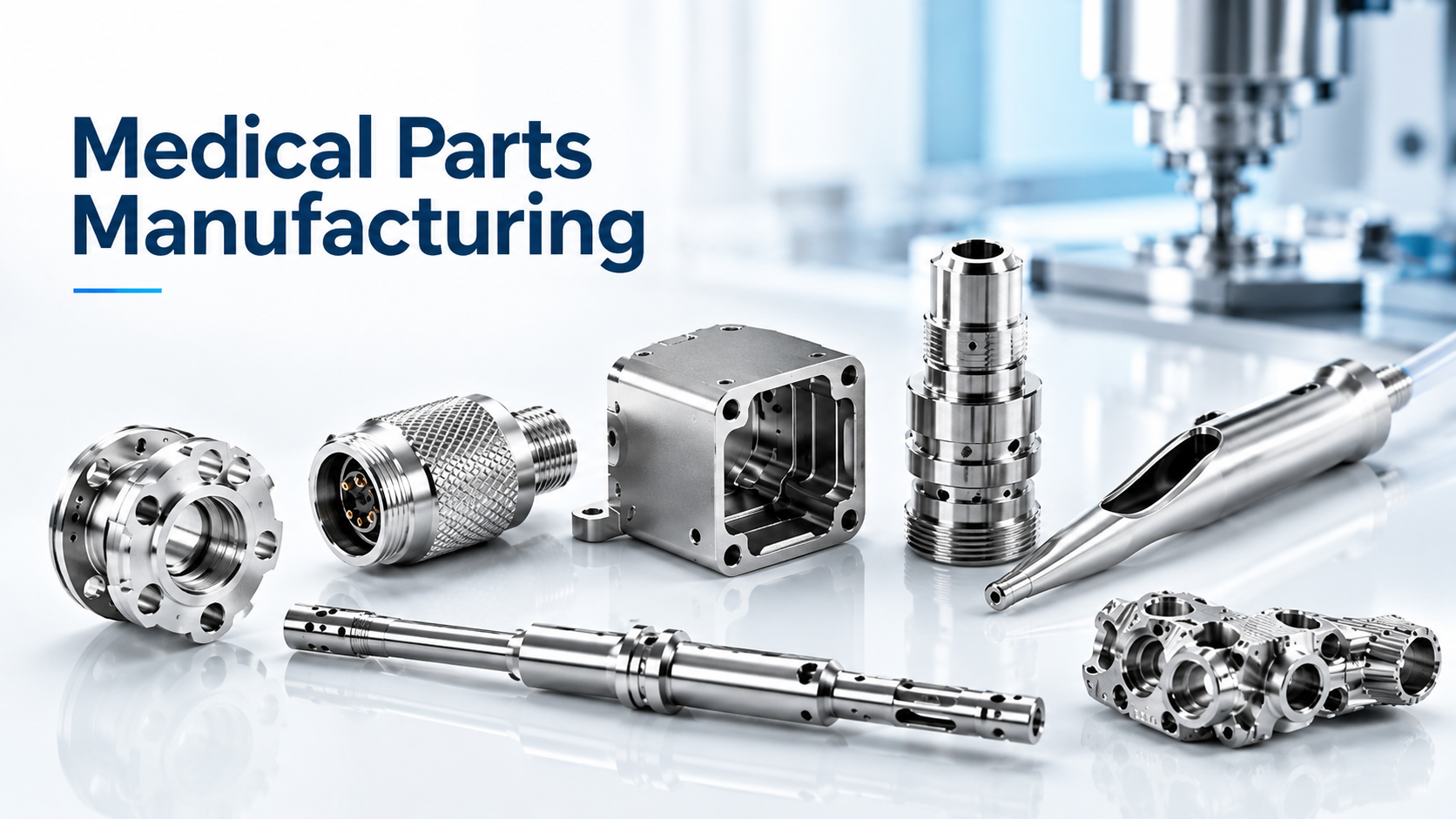
Medical parts manufacturing is not only about making a metal or plastic component. For most buyers, the real concern is whether the part can fit correctly, work safely, pass inspection, and remain consistent from prototype to production.
A medical part may look simple on a drawing, but small details can affect the final result. A hole that is slightly off, a burr left on an edge, a surface that is too rough, or a material that is not suitable for cleaning and sterilization can all create problems later.
This article explains what buyers should consider before choosing a supplier for medical parts manufacturing, including materials, manufacturing processes, tolerances, inspection, and design communication.
What Is Medical Parts Manufacturing?
Medical parts manufacturing refers to the production of components used in medical devices, surgical tools, diagnostic equipment, imaging systems, implants, laboratory devices, and other healthcare-related products.
These parts may include:
- Surgical instrument components
- Endoscope and imaging device parts
- Orthopedic and implant-related components
- Medical device housings
- Diagnostic equipment parts
- Wearable medical device components
- Fluid control and connector parts
- Precision metal parts for medical assemblies
Unlike general industrial parts, medical components often have stricter requirements for accuracy, cleanliness, surface finish, material traceability, and repeatability.
For buyers, the goal is not simply to find a factory that can “make the part.” The better question is:
Can this supplier understand the function of the part and control the details that affect medical device performance?

Why Medical Parts Are Difficult to Manufacture
Many medical parts are small, precise, and function-critical. They may need to connect with other components, guide a tool, hold an optical element, seal a fluid path, or support repeated use.
Common challenges include:
| Challenge | Why It Matters |
|---|---|
| Tight tolerances | Poor fit can affect assembly and device performance |
| Small features | Micro holes, thin walls, and small threads are hard to control |
| Burr control | Burrs can affect safety, cleaning, and assembly |
| Surface finish | Rough surfaces may affect movement, sealing, or cleanliness |
| Material choice | The wrong material may fail in use or during cleaning |
| Batch consistency | A prototype may pass, but production must stay stable |
This is why medical parts manufacturing needs more than machining equipment. It also needs process planning, inspection methods, and clear communication between the buyer and manufacturer.

Common Materials Used in Medical Parts Manufacturing
Material selection is one of the first decisions in a medical manufacturing project. The right material depends on strength, corrosion resistance, weight, biocompatibility needs, cleaning method, and cost.
Stainless Steel
Stainless steel is widely used for surgical instruments, medical device parts, and structural components. Common grades include 304, 316L, 420, and 17-4PH.
It is often selected because it offers:
- Good strength
- Corrosion resistance
- Good machinability depending on grade
- Suitable performance for many reusable medical tools
316L is often used where corrosion resistance is important. 17-4PH may be selected when higher strength is needed.
Titanium
Titanium is often used in medical applications where lightweight, strength, and biocompatibility are important. It is common in orthopedic, dental, and implant-related components.
Titanium is valuable, but it is also more difficult to machine than aluminum or some stainless steels. Heat control, tool wear, and surface quality need careful attention.

Aluminum
Aluminum is often used for medical device housings, imaging equipment, handheld instruments, and non-implant structural parts.
It is lightweight and easy to machine. With anodizing or other surface treatments, aluminum can also provide better corrosion resistance and improved appearance.
Engineering Plastics
Some medical components use materials such as PEEK, POM, PPSU, or other engineering plastics. These are often chosen for insulation, weight reduction, chemical resistance, or specific performance needs.
The key point is simple:
The material should match the real working condition of the part, not just the drawing requirement.
Choosing the Right Manufacturing Process
Different medical parts need different manufacturing methods. A good supplier should not push one process for every project. The process should be selected based on part geometry, volume, tolerance, material, and cost target.
CNC Machining for Medical Parts
CNC machining is one of the most common methods for precision medical parts manufacturing. It is especially suitable for prototypes, low-volume production, and parts with tight dimensional requirements.
CNC machining is often used for:
- Surgical instrument parts
- Medical device housings
- Optical and imaging equipment components
- Titanium and stainless steel parts
- Small precision metal components
- Custom prototype parts
The main advantage of CNC machining is flexibility. Buyers can test a design without investing in a mold. If the part needs changes after the first trial, the drawing and machining program can be adjusted more quickly.
CNC machining is a good choice when:
- The design is still being tested
- The order quantity is low or medium
- Tight tolerance is required
- Material strength is important
- Mold cost is not suitable at the early stage
For medical projects, CNC machining is often the first step before moving into larger production.

Metal Injection Molding for Small Complex Medical Parts
Metal injection molding, also called MIM, can be a good option for small, complex metal parts produced in higher volumes.
MIM is suitable for parts that are:
- Small in size
- Complex in shape
- Difficult to machine efficiently
- Needed in larger quantities
- Made from stainless steel or other suitable metal powders

Compared with CNC machining, MIM usually requires tooling. This means the initial cost is higher, but the unit cost can become more attractive when the volume increases.
MIM may be suitable for:
- Small surgical tool components
- Dental or orthodontic parts
- Medical connectors
- Small stainless steel parts
- Complex components with repeated production demand
However, MIM is not always the right choice. If the part needs very tight tolerances on certain features, secondary machining may still be required after molding and sintering.
CNC Machining vs. MIM: Which One Should You Choose?
For many buyers, the decision between CNC machining and MIM depends on project stage and order volume.
| Factor | CNC Machining | Metal Injection Molding |
|---|---|---|
| Best for | Prototypes, low volume, tight tolerance parts | Small complex parts in higher volume |
| Tooling cost | No mold required | Mold required |
| Design change | Easier to modify | More difficult after tooling |
| Unit cost | Higher for complex high-volume parts | Lower when volume is high |
| Tolerance control | Strong for precision features | May need secondary machining |
| Lead time | Faster for prototypes | Longer at tooling stage |
A practical approach is:
Use CNC machining for early prototypes and design validation. Consider MIM when the design is stable and volume is high enough.
This helps reduce risk before investing in tooling.
Tolerances: Do Not Make Everything Tight
In medical parts manufacturing, tight tolerances are important, but not every dimension needs to be extremely tight.
Overly tight tolerances can increase cost, machining time, inspection time, and scrap rate. The better approach is to identify which features are truly critical.
For example:
- Which holes control assembly alignment?
- Which surfaces contact another part?
- Which threads affect sealing or locking?
- Which dimensions affect movement?
- Which areas are cosmetic only?
A good manufacturer should help buyers separate critical dimensions from non-critical dimensions.

This is where DFM, or design for manufacturability, becomes useful. DFM can help check whether the drawing is practical for production and whether some dimensions can be adjusted without affecting function.
Surface Finish and Burr Control
Surface finish is not only about appearance. In medical parts, surface quality can affect cleaning, assembly, movement, and user safety.
Important surface concerns include:
- Sharp edges
- Burrs inside holes or threads
- Tool marks on functional surfaces
- Scratches on visible surfaces
- Surface roughness on sealing or sliding areas
- Particles left after machining
Burr control is especially important for small medical parts. A small burr may block assembly, affect movement, or create safety concerns.
Buyers should clearly define:
- Which edges need deburring
- Which surfaces are cosmetic
- Which surfaces are functional
- Whether polishing, passivation, anodizing, or other finishing is needed
- Whether cleaning or special packaging is required
The more clearly these requirements are defined, the lower the risk during production.
Inspection Is Part of Manufacturing, Not an Extra Step
For medical parts, inspection should not be treated as something done only at the end. It should be part of the whole production process.
Common inspection methods include:
- Dimensional inspection
- CMM inspection
- Surface roughness measurement
- Thread gauge inspection
- Visual inspection
- First Article Inspection
- Material certificate review
- Batch inspection reports
For critical parts, buyers may request FAI reports, CMM reports, material certificates, or other quality documents.

Before production starts, both sides should confirm:
- Which dimensions need 100% inspection
- Which dimensions can use sampling inspection
- Which gauges or tools will be used
- What acceptance standard will be followed
- What documents should be provided with shipment
This avoids confusion after the parts are finished.
What Buyers Should Prepare Before Requesting a Quote
A clear RFQ can save time and reduce misunderstandings. Before sending a medical parts manufacturing inquiry, buyers should prepare as much information as possible.
Useful information includes:
| Information | Why It Helps |
|---|---|
| 2D drawing | Shows tolerances, surface finish, and critical dimensions |
| 3D model | Helps with machining analysis and programming |
| Material requirement | Confirms strength, corrosion resistance, and application needs |
| Quantity | Affects process selection and pricing |
| Surface treatment | Impacts final size, appearance, and function |
| Application background | Helps the supplier understand key risks |
| Inspection requirements | Avoids disputes after production |
| Target delivery time | Helps supplier plan material and capacity |
If the project is still in development, it is also helpful to explain the stage:
- Prototype
- Engineering validation
- Clinical or functional testing
- Pilot production
- Mass production
Different stages may need different pricing, inspection, and lead time strategies.
How XY-GLOBAL Supports Medical Parts Manufacturing
At XY-GLOBAL, we support medical parts manufacturing through precision CNC machining, metal injection molding, and custom metal part production. Our work focuses on helping customers move from prototype samples to stable production with practical engineering support.
We can support parts such as:
- Surgical instrument components
- Medical device metal housings
- Optical and imaging equipment parts
- Small stainless steel and titanium components
- Custom precision medical metal parts
- MIM parts for small complex medical applications
Our team can also help review drawings before production. If a design has difficult features, tight tolerance risks, thin walls, deep holes, or surface treatment concerns, we can provide manufacturing feedback before machining or tooling starts.
This is important because many medical part problems can be avoided before production if the supplier reviews the design carefully.

What Makes a Medical Parts Supplier Reliable?
A reliable supplier should not only quote a price. They should help buyers reduce risk.
When choosing a medical parts manufacturing supplier, buyers should look for:
- Experience with precision parts
- Ability to handle medical-related materials
- Clear tolerance and inspection control
- Good communication before production
- Support for prototypes and small batches
- Stable quality for repeated orders
- Ability to provide inspection documents when needed
- Understanding of surface finish, burr control, and assembly fit
The best supplier is not always the cheapest one. For medical projects, a low price can become expensive if parts fail inspection, delay testing, or require repeated rework.
Final Thoughts
Medical parts manufacturing requires more than basic production capacity. Buyers need a supplier who can understand the function of the part, choose the right process, control key dimensions, manage surface quality, and provide reliable inspection.
For early-stage projects, CNC machining is often a flexible way to test and improve the design. For small and complex metal parts with stable demand, MIM may help reduce unit cost in higher-volume production.
The most important step is to discuss the real application, critical dimensions, material needs, and inspection requirements before production starts.
If you need custom medical metal parts, XY-GLOBAL can support your project from prototype machining to production planning. Send us your drawings and requirements, and our team will help review the best manufacturing solution for your medical parts.


Share:
Titanium Medical Devices: From Implants To Instruments, Their Advantages And Prospects
Custom Aluminum Die Casting Parts for Industrial Applications