


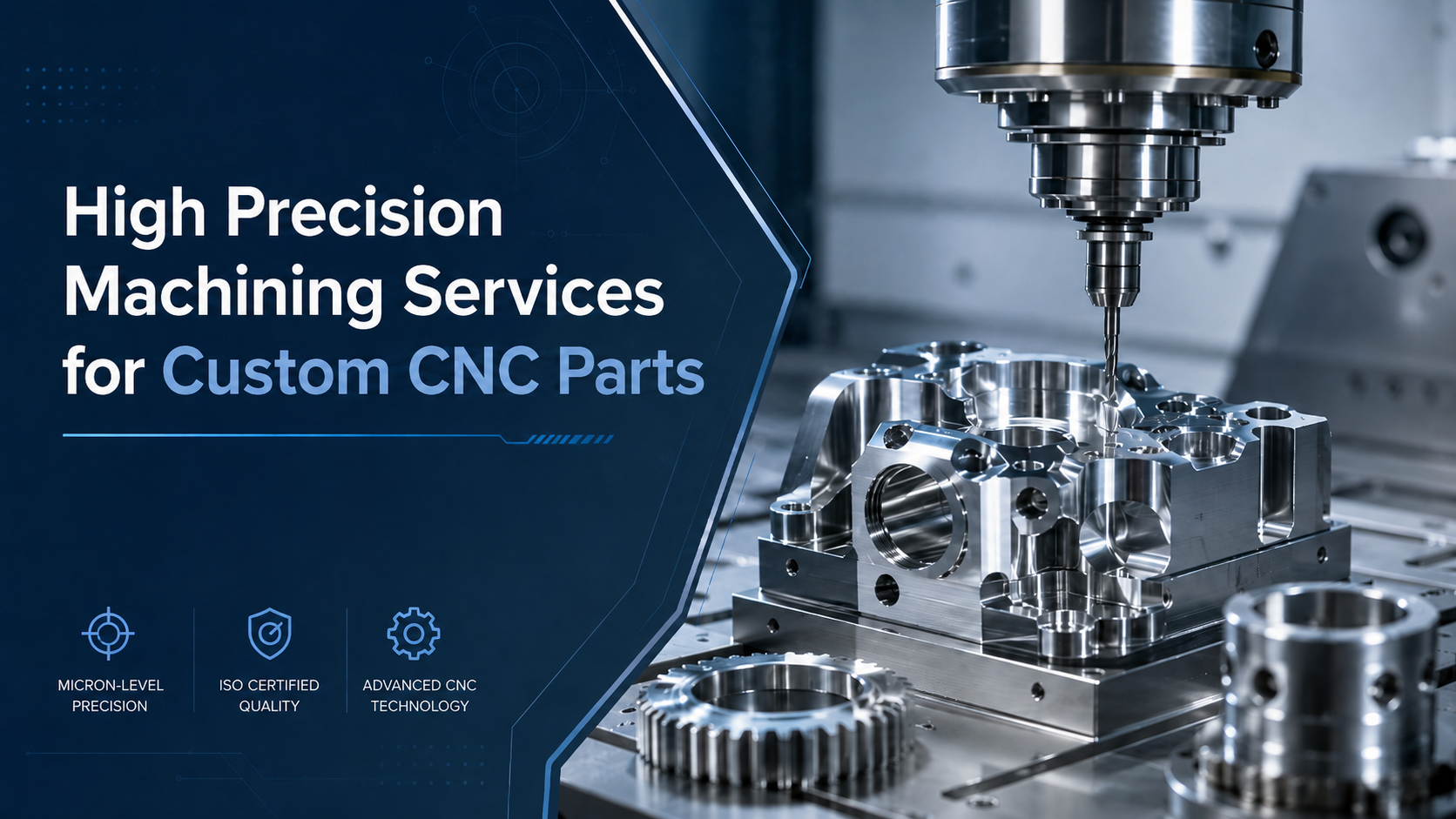
In many custom CNC projects, the challenge is not only making a part that matches the drawing. The real challenge is keeping critical dimensions stable, controlling functional surfaces, reducing manufacturing risks, and ensuring that each part can perform reliably in its final assembly.
This is where high precision machining services become essential.
For industries such as medical devices, optical systems, robotics, automation equipment, electronics, and aerospace, even small dimensional errors can lead to assembly problems, unstable performance, longer debugging time, or product failure. A precision-machined component may look simple from the outside, but its accuracy often depends on the relationship between material behavior, machining strategy, fixture design, surface finish, inspection method, and production consistency.
At XY-GLOBAL, we support customers with custom CNC machining services for high precision metal and plastic parts, from early DFM review to prototype machining, low-volume production, surface finishing, and final inspection.
High Precision Machining for Functional Custom Parts
High precision machining is not only about achieving a tight tolerance on one feature. For custom CNC parts, precision usually means the entire part must meet its functional requirements.
A machined housing may need stable mounting surfaces. A shaft may require good concentricity. An optical component may need controlled flatness and alignment accuracy. A medical device part may need smooth edges, clean surfaces, and repeatable dimensions. A robotic component may need accurate hole positions to support stable movement and assembly.
In real projects, the most important dimensions are not always the smallest ones. They are the dimensions that affect how the part fits, moves, seals, aligns, or supports another component. That is why high precision CNC machining should begin with understanding the application, not only reading the drawing.
For custom parts, this often includes reviewing critical dimensions, identifying difficult features, checking tolerance stack-up risks, and confirming whether the required accuracy is practical for the selected material, part structure, and production quantity.

Why Precision Matters in Custom CNC Components
A small machining deviation can create a large problem after assembly.
For example, if mounting holes are slightly off-position, the part may be difficult to install. If a sealing surface is not flat enough, leakage may occur. If a rotating component has poor concentricity, vibration or uneven wear may appear. If an optical housing cannot maintain alignment, the final device may fail performance testing even though the part appears acceptable visually.
This is why high precision machining is especially important for components used in demanding applications.
| Application Area | Why Precision Matters |
|---|---|
| Medical devices | Stable assembly, clean surfaces, reliable part function |
| Optical systems | Alignment accuracy, flatness, coaxiality, stray light control |
| Robotics | Motion stability, accurate positioning, repeatable assembly |
| Aerospace | Lightweight structures, strength, reliability, traceability |
| Automation equipment | Positioning accuracy, fixture stability, long-term repeatability |
| Electronics | Heat dissipation, enclosure fit, connector alignment |
For these applications, a good machined part is not only one that passes dimensional inspection. It should also support the customer’s assembly process, testing process, and long-term product performance.
CNC Milling, Turning, and Multi-Process Machining Capability
Custom high precision CNC parts often require more than one machining method. The best process depends on the part geometry, tolerance requirements, material, surface finish, and inspection standard.
CNC milling is commonly used for housings, brackets, plates, mounting blocks, optical structures, heat sinks, and complex mechanical components. It is suitable for parts with pockets, holes, slots, datum surfaces, and multi-side machining requirements.
CNC turning is suitable for shafts, sleeves, bushings, pins, threaded components, round connectors, and parts with strict diameter or concentricity requirements. For some components, turning may be combined with milling to complete cross holes, flats, keyways, or side features.
5-axis CNC machining is useful when a part has complex geometry, angled features, deep cavities, or multiple surfaces that must be machined with fewer setups. Reducing the number of setups can help improve positional accuracy and reduce accumulated error.
For some high precision parts, CNC machining alone may not be enough. Additional processes such as grinding, EDM, wire EDM, or special finishing may be required to achieve critical dimensions, sharp internal features, fine surfaces, or difficult profiles.
At XY-GLOBAL, we evaluate each project based on the actual drawing and application requirements, then select a practical manufacturing route instead of treating every part as a standard CNC job.
Tolerance Control Starts Before Machining
Tolerance control does not begin after the part is finished. It begins before production starts.
During the early review stage, engineers need to understand which dimensions are truly critical, which surfaces are used as datums, which features are difficult to inspect, and which tolerances may increase machining risk or cost. This is especially important for custom CNC parts with thin walls, deep pockets, tight hole positions, fine threads, complex curves, or multiple precision surfaces.
A reliable tolerance control process usually includes drawing review, DFM feedback, fixture planning, tool selection, machining sequence design, in-process inspection, and final verification.
For example, a tight flatness requirement may be affected by material stress and clamping method. A thin-walled part may deform during machining or after surface treatment. A precision bore may require special tooling or secondary finishing. A surface that looks simple on the drawing may become difficult if it must remain accurate after anodizing, coating, or painting.
That is why high precision machining is not only a production capability. It is also an engineering decision-making process.
Surface Finish, Burr Control, and Appearance Requirements
For high precision machined parts, surface quality can be as important as dimensional accuracy.
Surface finish may affect sealing, sliding, friction, cleaning, coating adhesion, optical performance, or customer appearance standards. In some projects, machining marks are acceptable if the part is used internally. In other projects, even minor scratches, burrs, sharp edges, or inconsistent texture may cause rejection.
Surface requirements should be reviewed together with the part function. A visible cosmetic surface may need different machining parameters from an internal functional surface. A sealing surface may require controlled roughness. A medical or optical part may require careful deburring and cleaning. A painted or anodized part may require allowance planning to keep final dimensions within tolerance after surface treatment.
Common finishing options for precision CNC components may include anodizing, bead blasting, passivation, chemical conversion coating, painting, polishing, or plating, depending on the material and application.
For parts with strict appearance or coating requirements, it is better to confirm the final surface standard before production. This can help avoid problems such as coating build-up, color variation, masking issues, or dimensional change after finishing.

DFM Review for High Precision CNC Parts
DFM review is one of the most valuable steps in a high precision machining project.
A drawing may be technically complete, but still contain features that are difficult, risky, or expensive to manufacture. DFM feedback helps identify these issues before machining begins. This can reduce rework, shorten lead time, and improve production stability.
For custom CNC parts, DFM review may include checking whether deep holes are practical, whether inside corners require special tooling, whether wall thickness is too thin, whether tolerance requirements match the part function, whether surface treatment will affect dimensions, and whether certain features need additional inspection methods.
A good DFM process does not mean changing the customer’s design freely. It means helping the customer understand the manufacturing risks and possible options.
Sometimes the drawing can remain unchanged, but the machining process needs to be adjusted. Sometimes a small design modification can make the part easier to manufacture without affecting function. In other cases, the supplier may need to explain why a specific tolerance or surface requirement will increase cost or lead time.
For precision custom parts, early communication often prevents bigger problems later.
Quality Control for Precision Machined Components
High precision machining depends on both process control and final inspection.
Final inspection is important, but it should not be the only quality control step. If a critical dimension is only checked after all machining and surface treatment are completed, the project risk is already high. For demanding parts, quality should be controlled throughout the full production process.
At XY-GLOBAL, quality control can include material verification, in-process dimensional checks, first article inspection, CMM inspection, surface roughness testing, visual inspection, thread inspection, and final inspection reports based on project requirements.
For parts with CTQ dimensions, the inspection plan should be confirmed clearly. This includes which dimensions need to be measured, what inspection tools should be used, how many parts should be checked, and whether a formal inspection report is required.
In many B2B projects, customers do not only need the parts. They also need confidence that the parts are manufactured under a controlled and repeatable process.
From Prototype Machining to Production
Many custom CNC projects begin with prototypes, but the final goal is often stable production.
Prototype machining is mainly used to verify design, function, assembly, and appearance. At this stage, flexibility and speed are important. Customers may still adjust the design, change material, modify tolerance requirements, or test different surface finishes.
Production machining has a different focus. Once the design is confirmed, the supplier needs to maintain repeatable quality, stable delivery, cost control, and consistent inspection standards.
The transition from prototype to production is not automatic. A part that can be made successfully once may still need process optimization before batch production. Fixture design, machining sequence, tool life, inspection frequency, packaging method, and surface finishing control may all need to be adjusted.
For this reason, a high precision machining supplier should not only be able to make samples. It should also understand how to prepare the project for small-batch and long-term production.
How to Choose a High Precision Machining Supplier
Choosing a high precision machining supplier should not be based only on whether the supplier has CNC machines. The more important question is whether the supplier understands the relationship between design, process, tolerance, inspection, and final application.
A good supplier should be able to read the drawing carefully, identify key features, provide useful DFM feedback, select suitable machining methods, control critical dimensions, support surface finishing, and provide inspection documents when needed.
For demanding custom CNC parts, communication ability is also important. If a tolerance is difficult to achieve, the supplier should explain the reason clearly. If a surface treatment may affect dimensions, it should be discussed before production. If a feature is difficult to inspect, the inspection method should be confirmed early.
The right supplier does not simply say “yes” to every requirement. The right supplier helps the customer reduce risk before the parts are made.
Why Work with XY-GLOBAL
XY-GLOBAL provides custom CNC machining services for customers who need high precision metal and plastic parts. We support projects from early DFM review to prototype machining, low-volume production, surface finishing, inspection, and delivery.
Our machining services include CNC milling, CNC turning, 5-axis machining support, and multi-process manufacturing solutions for complex custom components. We also support finishing processes such as anodizing, passivation, chemical conversion coating, bead blasting, painting, and other surface treatments depending on project requirements.
For critical parts, our focus is not only machining to the drawing. We also help customers review manufacturing feasibility, identify tolerance risks, control important dimensions, and improve production stability.
Whether your project requires a functional prototype, a small batch of precision components, or a reliable production solution, XY-GLOBAL can support your custom CNC machining needs with engineering review, process planning, and quality control.
FAQ
How can I get an accurate quotation for a high precision CNC part?
To receive an accurate quotation, it is best to provide 2D drawings, 3D CAD files, material requirements, quantity, surface treatment, tolerance requirements, and any inspection or packaging standards. If some details are not finalized, XY-GLOBAL can review the available information first and provide DFM feedback before confirming the final quotation.
Can XY-GLOBAL support projects without complete drawings?
Yes. If the drawing is not complete, we can start with a preliminary review based on your 3D model, sample photos, application description, or key dimensions. However, for final production and accurate inspection, a complete technical drawing is strongly recommended.
What is the typical lead time for custom precision machined parts?
Lead time depends on part complexity, material availability, quantity, tolerance requirements, surface treatment, and inspection needs. Simple prototypes may move faster, while complex precision parts with finishing and inspection reports usually require more time. XY-GLOBAL can evaluate the schedule after reviewing the drawing and project requirements.
Can you provide inspection reports with the parts?
Yes. Inspection reports can be provided based on customer requirements. For critical parts, this may include dimensional inspection reports, CMM reports, surface roughness reports, or first article inspection documents. The required inspection scope should be confirmed before production.
How are surface-treated dimensions controlled?
Surface treatment may add thickness, change surface texture, or affect final dimensions. For parts with tight tolerances after anodizing, painting, plating, or coating, the finishing allowance should be considered before machining. Critical dimensions and masking areas should be confirmed early to reduce
Conclusion
High precision machining is essential for custom CNC parts that require reliable fit, stable performance, and repeatable quality. From tolerance control and machining strategy to surface finish, inspection, and production consistency, every detail can affect the final result.
For customers in medical, optical, robotics, aerospace, electronics, automation, and industrial applications, working with a capable machining supplier can reduce project risk and improve product reliability.
If you need custom high precision machined parts, XY-GLOBAL can support your project from DFM review and prototype machining to production, surface finishing, and final inspection.


Share:
Optical Precision Machined Components for High-Accuracy Optical Systems
Optical Assemblies: Precision Manufacturing for High-Performance Optical Systems