


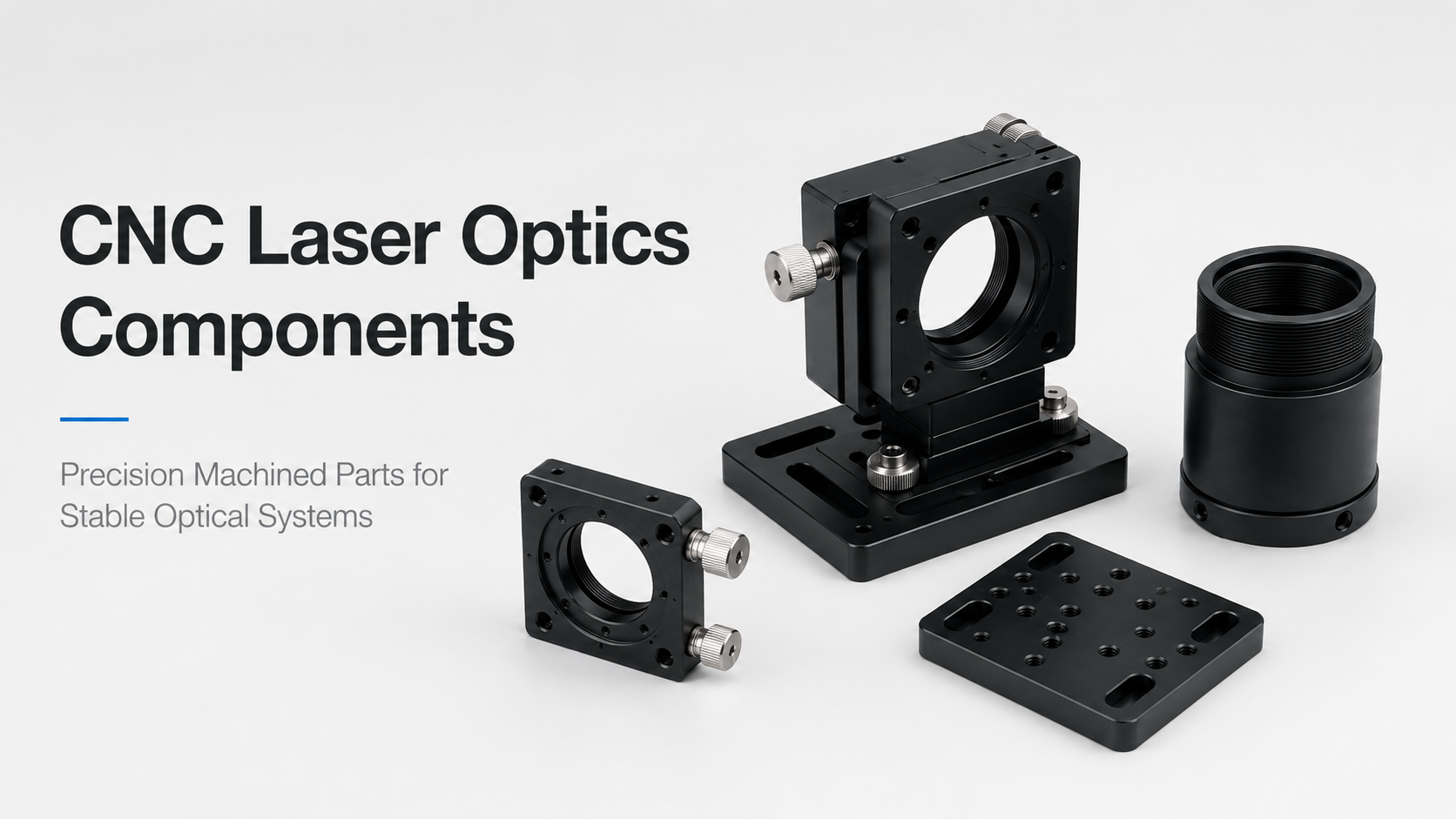
CNC laser optics components are precision-machined parts used to hold, align, and protect lenses, mirrors, and laser modules. They are widely used in optical systems and semiconductor equipment where stable alignment, clean assembly, and long-term reliability are critical.
For custom projects, CNC machining provides the flexibility to produce optical housings, lens mounts, mirror brackets, and laser module parts according to specific design requirements.
What Are CNC Laser Optics Components?
CNC laser optics components are precision-machined mechanical parts used to support, align, protect, and assemble optical elements in laser and optical systems. They are not usually the glass lenses or mirrors themselves, but the metal structures around them, such as lens barrels, mirror mounts, optical housings, spacer rings, aperture rings, and laser module enclosures.
In many laser systems, the performance of the optical path depends not only on the lens or laser source, but also on the accuracy and stability of the mechanical components. A small machining error in the bore, thread, mounting surface, or alignment feature may affect beam direction, focus position, or long-term system stability.

Common CNC-Machined Parts
Typical CNC laser optics components include lens barrels, lens mounts, mirror holders, optical housings, aperture components, spacer rings, mounting bases, and laser module housings. These parts are often made from aluminum, stainless steel, brass, or copper, depending on the requirements for weight, strength, thermal performance, surface finish, and assembly structure.
| Component | Function |
|---|---|
| Lens Barrel | Holds and protects lenses while maintaining optical alignment |
| Lens Mount | Fixes lenses, filters, or optical windows in position |
| Mirror Mount | Supports mirrors and helps control reflection angle |
| Optical Housing | Protects internal optical paths and components |
| Spacer Ring | Controls the distance between optical elements |
| Aperture Ring | Defines or limits the beam opening |
| Mounting Base | Provides a stable installation surface |
| Laser Module Housing | Supports laser modules and may assist heat dissipation |
Why Precision CNC Machining Matters
Laser and optical systems are sensitive to alignment errors. When a component is used to hold a lens, mirror, sensor, or laser module, its machining accuracy directly affects how well the optical path can be assembled and maintained.
This is why CNC laser optics components often require precise bore machining, stable thread quality, accurate hole positions, and controlled flatness or perpendicularity.
For example, a lens barrel may need good coaxiality between internal bores and external mounting features. A mirror mount may require stable threaded holes and adjustment surfaces. An optical housing may need precise assembly interfaces to ensure that multiple components fit together without stress or misalignment.
Good CNC machining also helps reduce assembly difficulty. When the machined features are consistent, optical engineers can spend less time compensating for mechanical errors during alignment, calibration, and testing.
Materials and Surface Finishes
Aluminum is widely used for CNC optical components because it is lightweight, easy to machine, and suitable for black anodizing. Stainless steel is often selected when higher strength, wear resistance, or dimensional stability is required. Brass and copper may be used in certain applications that require specific conductivity, thermal behavior, or assembly characteristics.
Black anodizing is especially common in optical mechanical parts. It provides a clean appearance and can help reduce unwanted reflections inside optical systems. For some parts, additional finishes such as hard anodizing, nickel plating, bead blasting, or precision cleaning may also be considered depending on the final working environment.
Applications of CNC Laser Optics Components
Optical Systems and Laser-Based Inspection Equipment
In optical systems, CNC laser optics components are often used to hold, align, and protect lenses, mirrors, filters, and laser modules. Parts such as lens barrels, lens mounts, mirror holders, aperture rings, and optical housings help keep the optical path stable during assembly and operation.
For laser-based inspection equipment, even a small deviation in the mechanical structure may affect beam direction, focus position, or measurement accuracy. This is why these components usually require precise bore machining, accurate thread control, stable mounting surfaces, and good coaxiality between optical features.
For custom optical assemblies, CNC machining allows different structures, mounting holes, adjustment features, and surface finishes to be designed around the customer’s optical layout. This makes CNC machining suitable for prototype development, small-batch production, and high-precision customized optical equipment.
Semiconductor Equipment and Photonics Modules
In semiconductor equipment, laser and optical modules are widely used in wafer inspection, alignment, positioning, metrology, and photonics-related systems. CNC-machined laser optics components are not usually the wafer-processing parts themselves, but they play an important role in supporting the optical path, fixing laser modules, and maintaining mechanical stability.
Typical parts include optical module housings, precision mounting bases, laser module enclosures, spacer rings, aperture components, and customized brackets. These components need to maintain stable positioning during long-term equipment operation, especially when the system is sensitive to vibration, temperature change, or repeated calibration.
For semiconductor and photonics applications, CNC machining is valuable because it can support tight dimensional control, complex small-batch customization, clean surface finishing, and consistent assembly accuracy. A well-machined optical housing or mounting base can help reduce alignment difficulty and improve the repeatability of the final equipment assembly.

How XY-GLOBAL Supports Custom Parts
XY-GLOBAL supports custom CNC machining for precision mechanical parts used in laser, optical, and semiconductor-related equipment. Based on customer drawings, 3D models, and assembly requirements, we can help manufacture components such as optical housings, lens mounts, mirror brackets, laser module enclosures, and precision mounting bases.
For optical-related parts, we pay close attention to machining details such as bore accuracy, thread quality, hole position, surface finish, burr control, and assembly interfaces. These details are important because the final part is often used in systems where stability, alignment, and repeatability matter.
Our CNC machining capabilities can support prototype testing, small-batch production, and customized precision components for different optical equipment layouts. For projects involving black anodizing, precision fitting, or multiple assembled parts, early DFM review can also help reduce machining risks and improve production consistency.
Conclusion
CNC laser optics components are the precision mechanical foundation behind many optical and laser systems. Although they may not be the optical glass itself, they directly affect how lenses, mirrors, laser modules, and optical assemblies are fixed, aligned, and protected.
For optical equipment and semiconductor-related applications, stable mechanical parts can help improve optical alignment, assembly repeatability, and long-term system reliability. With precision CNC machining, suitable materials, and controlled surface finishing, custom laser optics components can be manufactured to meet demanding application requirements.
If you need custom CNC laser optics components for optical or semiconductor equipment, XY-GLOBAL can support your project from prototype machining to small-batch production.


Share:
Precision CNC Machined Housings for Custom Components
Custom Aluminum Die Casting Parts for Industrial Applications