


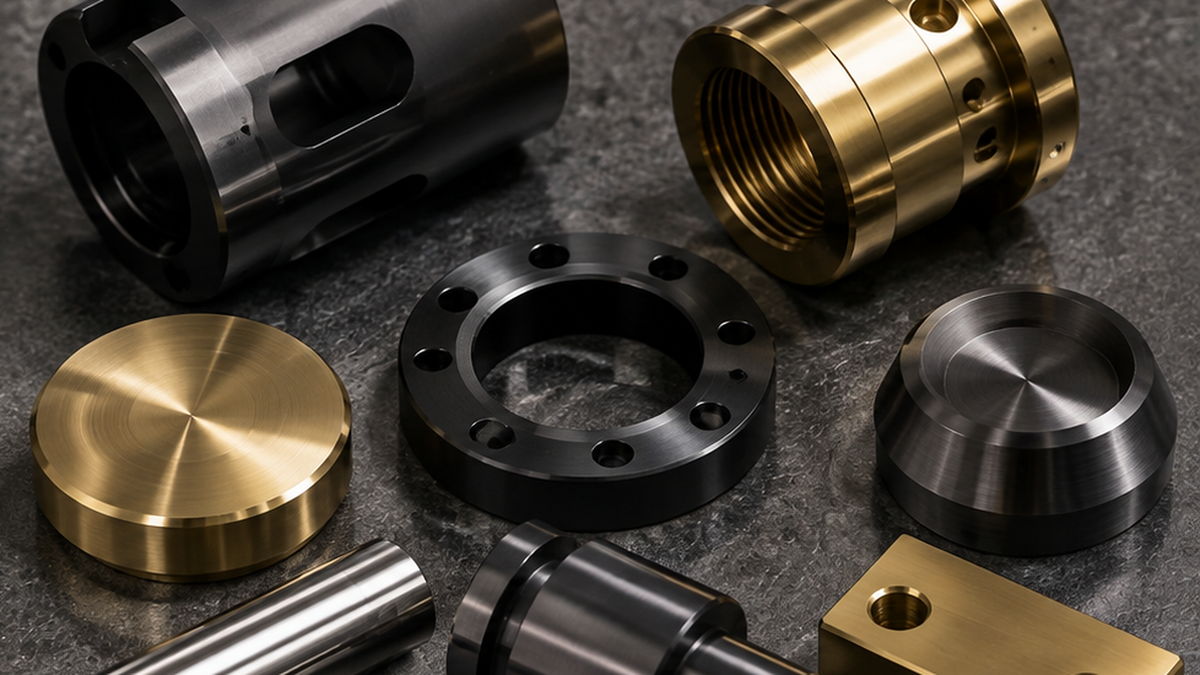
PVD coating (Physical Vapor Deposition) is a vacuum-based surface treatment process that deposits an extremely thin layer of metal or ceramic material onto a component. It improves surface hardness, wear resistance, and appearance without significantly changing the part's dimensions.
PVD coating is widely used on stainless steel components, CNC machined parts, cutting tools, medical instruments, and decorative metal products.
Unlike conventional paint or powder coating, PVD creates a thin film through the physical deposition of atoms or ions. Depending on the coating material, the finished surface can offer better resistance to wear, friction, and certain corrosive environments.
How Does PVD Coating Work?
The PVD coating process takes place inside a vacuum chamber. A solid coating material, such as titanium or chromium, is converted into vapor and deposited onto the surface of a component.
The process generally involves four stages:
-
Surface preparation: Parts are cleaned to remove oil, oxidation, and other contaminants that could affect coating adhesion.
-
Vacuum preparation: The components are placed inside a vacuum chamber, where the pressure is reduced to create a controlled deposition environment.
-
Coating deposition: The coating material is vaporized through techniques such as magnetron sputtering or cathodic arc evaporation. Reactive gases, including nitrogen, may be introduced to form ceramic compounds.
-
Film formation: The coating material deposits onto the component surface, creating a thin, functional layer. Parts are often rotated to improve coating coverage.
The selected deposition method affects the coating's hardness, surface finish, adhesion, and thickness uniformity.

PVD Coating Thickness and Temperature
One of the main advantages of PVD coating is its extremely thin coating layer.
Industrial PVD coatings are commonly around 1–5 μm thick, although the broader range is often approximately 1–10 μm, depending on the coating system and application.
| Parameter | Typical Value |
|---|---|
| Coating thickness | 1–5 μm for many industrial applications |
| Process temperature | Approximately 200–500°C for conventional hard PVD coatings |
| Common coating materials | TiN, CrN, ZrN, AlTiN |
| Substrate materials | Stainless steel, tool steel, titanium alloys, selected aluminum alloys |
| Surface appearance | Gold, silver-gray, black, bronze, or other colors depending on coating chemistry |
Actual coating conditions vary significantly between processes. Low-temperature PVD technologies are also available for temperature-sensitive materials.
Does PVD Coating Affect Part Dimensions?
Yes, but the dimensional change is usually small.
For example, applying a 2 μm coating to both sides of a cylindrical component can theoretically increase its external diameter by approximately 4 μm.
This may be negligible for decorative components, but it becomes important for precision parts with tight dimensional tolerances.
For CNC machined components, coating thickness should be considered when specifying shaft diameters, bearing fits, threads, and mating surfaces.
PVD coating also follows the underlying surface condition. It cannot remove machining marks, correct poor surface roughness, or compensate for dimensional defects.
Since PVD coatings cannot hide underlying surface imperfections, understanding CNC machining surface finish is essential before coating.
Common Types of PVD Coatings
Different PVD coating materials provide different mechanical and decorative properties.
| Coating | Typical Appearance | Main Applications |
|---|---|---|
| TiN (Titanium Nitride) | Gold | Cutting tools, wear-resistant components |
| CrN (Chromium Nitride) | Silver-gray | Mechanical parts, molds, wear and corrosion protection |
| ZrN (Zirconium Nitride) | Gold tones | Decorative metal products, selected tooling |
| AlTiN (Aluminum Titanium Nitride) | Dark gray or violet | High-temperature cutting tools |
Coating color is not a reliable way to identify chemical composition. The final appearance also depends on the deposition parameters and the substrate's original surface finish.
Advantages and Limitations of PVD Coating
Improved Wear Resistance
Hard PVD coatings reduce surface wear caused by sliding contact, abrasion, and repeated mechanical movement.
For example, TiN and CrN coatings can improve the service life of tools and mechanical components when properly matched to their operating conditions.
High Surface Hardness
Many ceramic PVD coatings are substantially harder than the underlying metal substrate.
This makes PVD useful for components exposed to repeated contact, although coating performance also depends on substrate hardness and load-bearing capacity.

Corrosion Protection
Certain PVD coatings can improve corrosion resistance, particularly when used with a suitable substrate and surface preparation process.
However, PVD coating is not automatically corrosion-proof. Pinholes, coating defects, and exposed substrate areas can still allow corrosion under aggressive conditions.
Decorative Surface Finishes
PVD is also used to produce black, gold, bronze, and metallic finishes on stainless steel components.
These finishes are common in consumer electronics, hardware, and decorative products where appearance and durability are both important.
Limitations to Consider
PVD is not suitable for every component.
Deep holes, narrow cavities, and recessed surfaces may receive less coating because many PVD processes have directional deposition characteristics.
In addition, poorly prepared surfaces, unsuitable substrate materials, and excessive contact loads can cause premature coating failure.
PVD Coating on Stainless Steel, Aluminum, and MIM Parts
PVD coating is frequently specified for precision metal components, but the substrate material must be considered before selecting a coating.
Stainless Steel
Grades such as 304, 316L, and 17-4PH can be candidates for PVD coating. Applications include decorative housings, mechanical components, and selected medical instruments.
The coating can improve appearance and wear resistance, but the required surface preparation and processing temperature must be compatible with the stainless steel grade and its condition.
Aluminum Alloys
PVD coating can also be applied to selected aluminum components. However, aluminum's relatively low hardness and temperature sensitivity require careful process selection.
A hard coating on a soft aluminum substrate may crack or fail under concentrated mechanical loading. Low-temperature deposition and appropriate surface engineering are therefore important.

Metal Injection Molding (MIM) Parts
PVD coating can be applied to suitable MIM components after debinding, sintering, and any required surface finishing.
It is particularly useful for small precision metal parts requiring a decorative finish or improved surface wear performance.
Before coating, manufacturers should verify surface density, porosity, cleanliness, and dimensional tolerances, since these factors can affect the final coating quality.
PVD Coating vs Electroplating vs Anodizing
PVD, electroplating, and anodizing all modify a component's surface, but they use different processes.
| Feature | PVD Coating | Electroplating | Anodizing |
|---|---|---|---|
| Process | Vacuum deposition | Electrochemical metal deposition | Electrochemical oxide formation |
| Typical substrate | Metals and selected other materials | Conductive or pretreated substrates | Mainly aluminum and certain other metals |
| Coating type | Thin metallic or ceramic film | Deposited metal layer | Converted oxide layer |
| Main benefits | Hardness, wear resistance, appearance | Corrosion protection, appearance, functional metal layers | Corrosion resistance, appearance, surface protection |
| Common applications | Tools, precision components, decorative hardware | Connectors, fasteners, decorative parts | Aluminum housings, machined parts |
Which surface treatment is better?
There is no single best option.
PVD coating is often selected when high surface hardness and low coating thickness are important. Electroplating may be preferable for specific electrical, corrosion, or metal-deposition requirements.
Anodizing is generally a more established option for aluminum components requiring an engineered oxide surface.
The correct choice depends on substrate material, operating environment, dimensional tolerances, appearance, and cost.
How to Specify PVD Coating for Precision Machined Parts
For custom CNC machined or MIM parts, specifying only "PVD coating" on a drawing is usually insufficient.
A complete coating requirement should identify the coating material, target thickness, coated surfaces, and functional requirements.
For example, a drawing note might specify:
PVD Coating: CrN, nominal thickness 2–4 μm, applied to indicated surfaces. Mask critical threads and sealing faces. Final dimensions to be verified after coating.
The coating supplier should also confirm requirements for adhesion, color consistency, thickness measurement, and surface condition.
For tight-tolerance components, the machining allowance and coating thickness should be evaluated together before production.
Frequently Asked Questions About PVD Coating
How Long Does PVD Coating Last?
The service life of a PVD coating depends on the coating composition, substrate material, thickness, operating environment, and mechanical loading.
A properly selected coating can provide long-lasting performance, but no universal service-life guarantee applies to all PVD-coated components.
Is PVD Coating Scratch-Resistant?
Many hard PVD coatings offer excellent scratch and abrasion resistance compared with untreated surfaces. However, scratch resistance is not the same as being scratch-proof.
Heavy impact or concentrated loads can still damage the coating or deform the substrate.
Can PVD Coating Peel Off?
Yes. PVD coatings can experience adhesion failure if the substrate is contaminated, surface preparation is inadequate, or the coating system is incompatible with the application.
Proper cleaning, substrate preparation, and adhesion testing help reduce this risk.
Is PVD Coating Suitable for Medical Components?
PVD coatings are used on certain medical instruments and components, particularly where wear resistance or specific surface properties are required.
However, medical suitability depends on the coating chemistry, substrate, intended use, and applicable biocompatibility and regulatory requirements. PVD coating alone does not establish medical-device compliance.
Custom Precision Metal Parts With PVD Coating Requirements
Choosing the correct PVD coating starts with understanding the component's material, geometry, tolerances, and operating conditions.
At XY-GLOBAL, we manufacture custom precision metal components using CNC machining and metal injection molding (MIM).
If your project requires PVD-coated stainless steel parts, precision machined components, or small MIM metal parts, our engineering team can review your drawings and evaluate the manufacturing and surface finishing requirements.
Send us your 2D drawings, 3D CAD files, and coating specifications to request a manufacturing evaluation and quotation.


Aktie:
Rapid CNC Prototyping Services: Process, Materials, Cost and Production Guide