


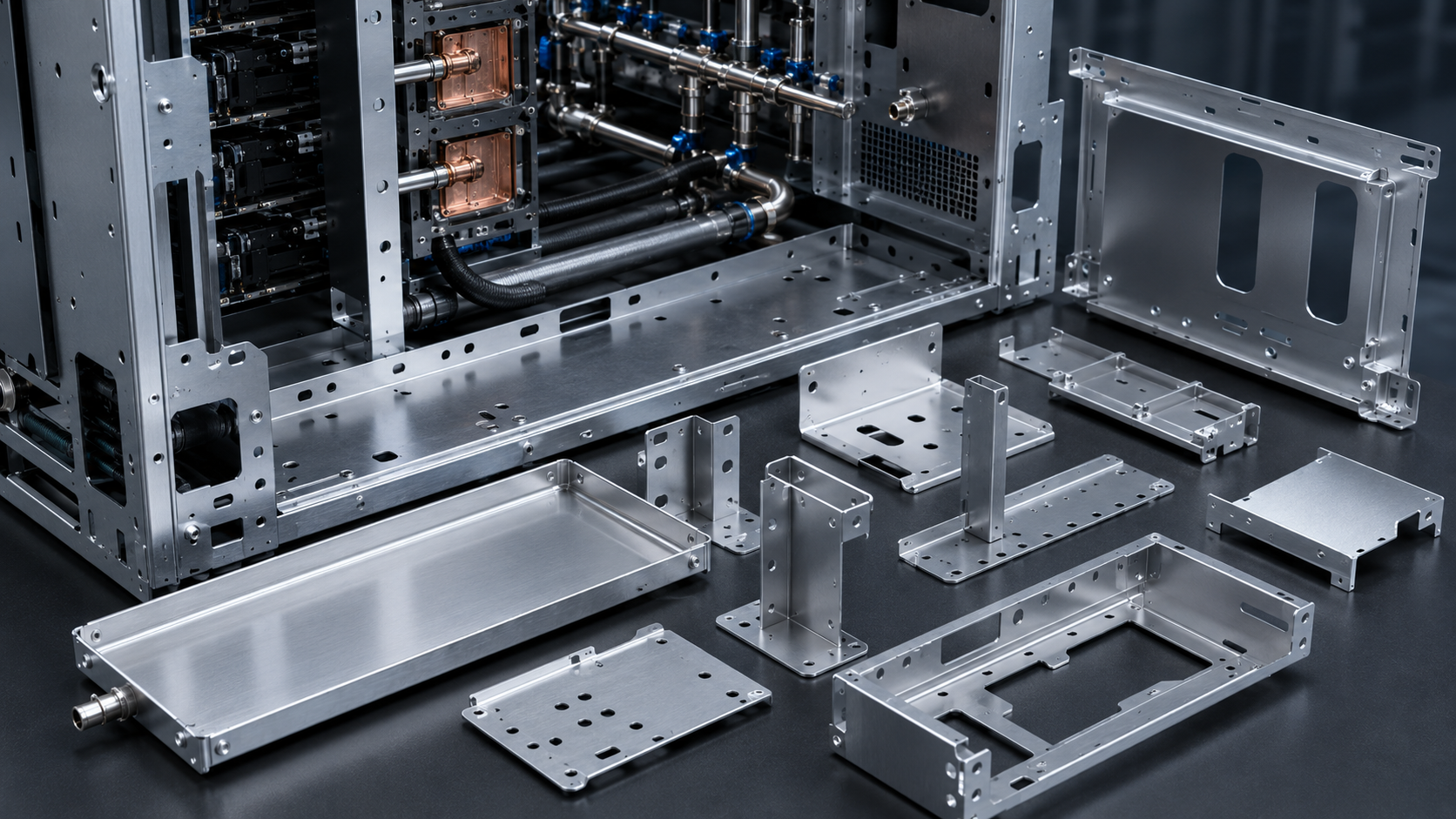
Mit dem schnellen Wachstum der KI-Rechenleistung wird die Flüssigkeitskühlung zu einer kritischen Konstruktionsrichtung für Hochleistungsserver und Rechenzentren. In diesen Systemen sind maßgefertigte Blechteile nicht nur Abdeckungen, Paneele oder einfache Halterungen. Sie unterstützen Kühlmodule, leiten Rohr- und Schlauchführungen, schützen interne Baugruppen, handhaben Leckagerisiken und ermöglichen den Zugang für Wartungsarbeiten.
Für Ingenieure, die an KI-Server-Racks, GPU-Server-Kühlmodulen, CDU-Schränken, Kaltplattenbaugruppen oder Flüssigkeitskühlungsgeräten für Rechenzentren arbeiten, können kleine Blechdetails die Montageeffizienz, die Rohrausrichtung, den Wartungszugang und die langfristige Systemzuverlässigkeit beeinflussen.
Bei XY-GLOBAL unterstützen wir maßgefertigte Blechteile für Flüssigkeitskühlsysteme auf der Grundlage von Kundenzeichnungen, 3D-CAD-Dateien, Mustern und Projektanforderungen. Vor der Angebotserstellung kann unser Team Ihre Konstruktion aus Fertigungs- und Montagesicht überprüfen, um das Risiko einer Neukonstruktion vor der Produktion zu reduzieren.

Warum Blechteile in Flüssigkeitskühlsystemen wichtig sind
In KI-Servern und Flüssigkeitskühlsystemen von Rechenzentren arbeiten Blechteile oft eng mit kritischen Flüssigkeits- und Elektronikkomponenten zusammen. Sie dienen nicht nur dem Schutz oder der Montage, sondern helfen auch bei der Organisation der internen Struktur des Kühlsystems.
Da diese Systeme in der Regel in hochdichten Racks gebaut werden, können kleine Blechdetails die Montageeffizienz und die langfristige Zuverlässigkeit direkt beeinflussen. Wenn die genaue Positioniergenauigkeit von Befestigungsbohrungen nicht richtig kontrolliert wird, kann die Installation von passenden Unterbaugruppen schwierig werden. Selbst eine kleine Verschiebung der Lochposition kann zu Spannungen an starren Rohren, Armaturen oder Montageschnittstellen führen.
Die Rohr- und Schlauchfreigabe muss ebenfalls sorgfältig überprüft werden. In KI-Servern und Flüssigkeitskühlgehäusen ist der interne Raum oft begrenzt. Halterungen, Abdeckungen, Ablagen und Paneele müssen Kollisionen mit Kühlmittelleitungen, Kabeln, Anschlüssen, Leistungsmodulen und Wartungsbereichen vermeiden. Werden diese Freigaben nicht frühzeitig geprüft, kann das Projekt nach der Probemontage eine Neukonstruktion erfordern.
Das Leckagemanagement ist eine weitere wichtige Designüberlegung. Obwohl Blechteile allein nicht darüber entscheiden, ob ein Flüssigkeitskühlsystem leckagefrei ist, können sie die Leckageerfassung, -ableitung, den Schutz und den Wartungszugang unterstützen. Ablagen, erhöhte Kanten, abnehmbare Abdeckungen und Entwässerungswege sollten entsprechend dem Systemlayout und dem Serviceplan konzipiert werden.
Verzug und Schweißverformung sollten ebenfalls vor der Produktion berücksichtigt werden. Große Platten, dünne Abdeckungen und geschweißte Rahmen können sich während des Biegens, Schweißens oder der Oberflächenbehandlung verformen. Bei Servergehäusen, CDU-Schränken und Gehäusen von Flüssigkeitskühlmodulen kann dies die Passform der Module, Dichtungsbereiche, Montageflächen und die Montageausrichtung beeinträchtigen.
Deshalb ist eine frühzeitige Fertigungsprüfung wichtig. Ein Blechteil mag auf einer Zeichnung einfach aussehen, aber sobald es gebogen, geschweißt, beschichtet, geprüft und in ein Flüssigkeitskühlsystem eingebaut ist, können kleine Konstruktionsrisiken zu echten Montageproblemen werden.
Maßgefertigte Blechteile, die wir unterstützen können
XY-GLOBAL kann maßgefertigte Blechteile herstellen, die in Flüssigkeitskühlsystemen für KI-Server, Rechenzentren, industrielle Computergeräte und Kühlmodule verwendet werden. Diese Teile werden in der Regel nach dem Systemlayout des Kunden, der Montagemethode, der Richtung der Kühlmittelleitungen, der Montagereihenfolge und den Wartungsanforderungen angepasst.
Gehäuse und Einschlüsse: Flüssigkeitskühlserver-Chassis, CDU-Schrankblechteile, Kühlmodulgehäuse, Rackmount-Paneele, Schutzabdeckungen und Servergehäuseteile.
Verlegung und Unterstützung: Halterungen für Kühlmittelverteiler, Rohr- und Schlauchhalterungen, Halterungen für Kaltplatten, Kabelmanagementplatten, Schlauchführungplatten und interne Stützstrukturen.
Sicherheit und Wartung: Leckage-Auffangwannen, Ablaufwannen, Pumpen- und Ventilgehäuse, Wartungszugangsklappen, Schutzschilde und abnehmbare Wartungsabdeckungen.
Bei vielen Projekten funktionieren diese Teile nicht allein. Eine Halterung muss möglicherweise zu einem Verteiler passen, eine Ablage muss möglicherweise unter ein Kühlmodul passen, und eine Abdeckung muss möglicherweise genügend Platz für Schläuche, Armaturen, Kabel und zukünftige Wartungsarbeiten lassen. Deshalb ist der Montagekontext vor der Produktion sehr wichtig.

Herstellungsprozess und DFM-Überprüfung
Vor der Produktion kann XY-GLOBAL die Blechkonstruktion aus fertigungstechnischer Sicht überprüfen. Diese DFM-Überprüfung hilft, potenzielle Fertigungs- und Montagerisiken zu identifizieren, bevor sie zu kostspieligen Neukonstruktionen werden.
Bei Flüssigkeitskühlungs-Blechprojekten kann unsere Überprüfung den Biegeablauf, den Loch-zu-Biege-Abstand, die Positionsgenauigkeit, Schweißverzug, die Platzierung von PEM-Befestigungselementen, Steifigkeit, Ebenheit, Beschichtungsdicke, Oberflächenbeschaffenheit und Inspektionsanforderungen umfassen.
Je nach Konstruktion kann der Prozess Laserschneiden, CNC-Stanzen, Biegen, Schweißen, Nieten, die Installation von PEM-Befestigungselementen, CNC-Bearbeitungsunterstützung, Oberflächenbearbeitung und Inspektion umfassen.
Für Teile, die mit Kühlmodulen, Rohrschellen, Verteilern oder Rack-Systemen verbunden sind, können wir auch kritische Abmessungen und Inspektionsmethoden vor der Produktion überprüfen. Dies ist besonders nützlich während der Prototypen- und Designprüfung, wenn Kunden die Passform, den Freiraum, die Strukturfestigkeit und den Servicezugang vor der Serienproduktion bestätigen müssen.
Material- und Oberflächenfinish-Optionen
Die Materialauswahl hängt von der Funktion des Blechteils im Flüssigkeitskühlsystem ab. Aluminium wird oft für leichte Abdeckungen, Halterungen, Paneele und Kühlmodulstrukturen verwendet, wo Korrosionsbeständigkeit und Gewichtsreduzierung wichtig sind. Edelstahl kann für Teile gewählt werden, die in der Nähe von Kühlmittelleitungen, Leckage-Sammelbereichen oder Strukturen verwendet werden, die eine stärkere Korrosionsbeständigkeit erfordern. Kohlenstoffstahl, SECC oder SPCC können für Rackstrukturen, Schrankpaneele, Tragrahmen und kostensensitive Komponenten in Betracht gezogen werden.
Bei Aluminiumblechteilen wird 5052 häufig wegen seiner Biege- und Korrosionsbeständigkeit in Betracht gezogen, während 6061 gewählt werden kann, wenn höhere Festigkeit oder CNC-Bearbeitungsunterstützung erforderlich ist. Bei Edelstahlteilen ist 304 für viele allgemeine korrosionsbeständige Strukturen geeignet, während 316 in Betracht gezogen werden kann, wenn die Arbeitsumgebung eine stärkere Korrosionsbeständigkeit erfordert.
Die Oberflächenbehandlung kann Pulverbeschichtung, Eloxierung, Plattierung, Passivierung, Bürsten oder andere Oberflächenbehandlungen je nach Anwendungsumgebung umfassen. Für Teile, die in der Nähe von Kühlmittelleitungen, elektronischen Baugruppen oder Rack-Systemen verwendet werden, sollten Korrosionsbeständigkeit, Erdungskontakt, Isolationsanforderungen, Erscheinungsstandards und Beschichtungsdicke vor der Produktion bestätigt werden.
Vor der Produktion können wir überprüfen, ob das gewählte Material für Biegungen, Schweißungen, die Installation von PEM-Befestigungselementen, die Oberflächenbehandlung, den Erdungskontakt, die Beschichtungsdicke und die endgültigen Montageanforderungen geeignet ist.
Was für ein Angebot zu senden ist
Um maßgefertigte Blechteile für Flüssigkeitskühlsysteme genau anbieten zu können, senden Sie uns bitte 2D-Zeichnungen, 3D-CAD-Dateien, Materialanforderungen, Hinweise zur Oberflächengüte, Menge, Toleranzanforderungen und alle kritischen Inspektionsanforderungen.
Wenn Ihre Komponenten mit Verteilern, Kaltplatten, Pumpen, Ventilen, Kühlmittelleitungen oder Hochdicht racks verbunden sind, geben Sie bitte auch den Montagekontext, die passenden Grundrisse, die Rohrführungsrichtung und kritische Freiraumbereiche an. Dies hilft XY-GLOBAL, eine genauere DFM-Überprüfung vor der Angebotserstellung durchzuführen.
Für Projekte im Frühstadium können Referenzfotos, Musterteile oder grobe Montagepläne uns auch helfen, die Designabsicht zu verstehen. Für Produktionsprojekte sind Montagezeichnungen und wichtige Inspektionspunkte hilfreich, um Passgenauigkeit, Konsistenz und Lieferqualität zu kontrollieren.
Warum XY-GLOBAL für Flüssigkeitskühlungsblechteile wählen?
XY-GLOBAL unterstützt kundenspezifische Blech- und Präzisionsstrukturteile für Kunden, die eine zeichnungsbasierte Fertigung anstelle von Standard-Off-the-Shelf-Teilen benötigen.
Für Flüssigkeitskühlsysteme in KI-Servern und Rechenzentren können wir sowohl Prototypen- als auch Serienproduktionsprojekte unterstützen. Im Frühstadium kann die Kleinserienfertigung Kunden helfen, die Passform der Baugruppe, den Rohrabstand, die Halterungsposition, das Wannendesign und den Wartungszugang zu überprüfen. Für die Serienproduktion können wir die Herstellbarkeit und Konsistenzanforderungen überprüfen, um eine stabilere Lieferung zu unterstützen.
Unser Ziel ist es nicht nur, Blechteile nach Zeichnungen herzustellen, sondern auch Kunden dabei zu helfen, Risiken bei der Neukonstruktion zu reduzieren, die Montageeffizienz zu verbessern und reibungsloser vom Prototyp zur Produktion überzugehen.


Aktie:
Fortschrittliche CNC-Bearbeitung: Wo Komplexität auf Präzision trifft
Optische Präzisionsfertigung für kundenspezifische optomechanische Komponenten