


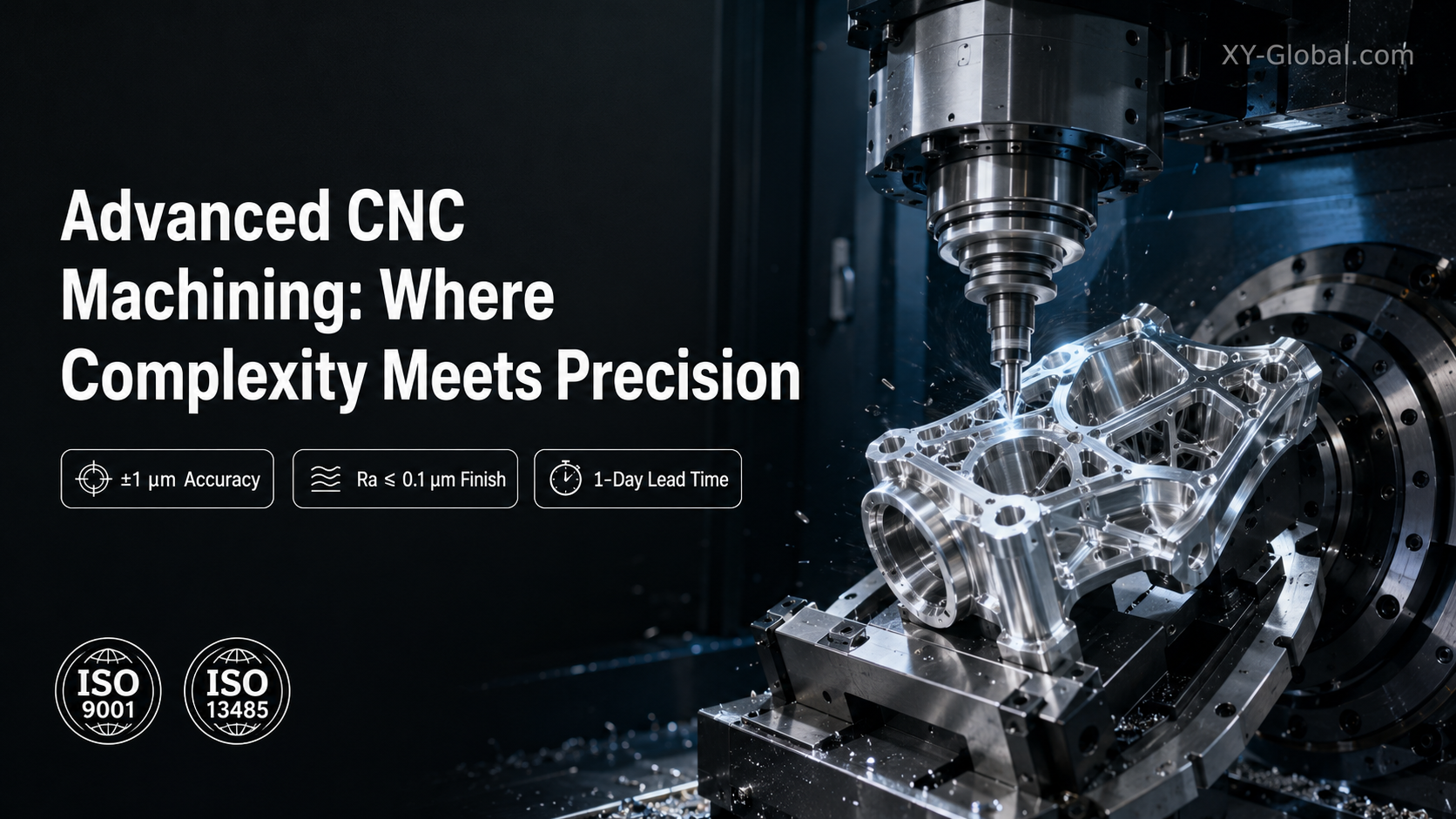
Fortschrittliche CNC-Bearbeitung wird nicht allein durch die Ausrüstung definiert. Sie wird durch die Kombination aus Mehrachsenfähigkeit, Prozess-Engineering-Wissen, Werkzeugstrategie und Qualitätskontrolle definiert, die erforderlich ist, um Teile herzustellen, die mit Standardbearbeitung nicht zuverlässig geliefert werden können.
Für Industrien wie Optik, Medizintechnik, Luft- und Raumfahrt, Robotik und Halbleiterausrüstung beeinflusst der Unterschied zwischen Standard- und fortschrittlicher Bearbeitung direkt, ob ein Teil wie konstruiert funktioniert – vom ersten Prototyp bis zur vollständigen Produktion.
Dieser Artikel erläutert, was fortschrittliche CNC-Bearbeitung von konventionellen Prozessen unterscheidet, welche Technologien und Materialien involviert sind und worauf bei der Auswahl eines Fertigungspartners für komplexe, hochpräzise kundenspezifische Komponenten zu achten ist.

Was macht die CNC-Bearbeitung „fortschrittlich“?
Das Wort „fortschrittlich“ kann im Fertigungsmarketing locker angewendet werden. Eine nützlichere Definition ist die durch die spezifischen Fähigkeiten, die einen hochkomplexen Bearbeitungsvorgang von einem Allzweckvorgang unterscheiden.
Fortschrittliche CNC-Bearbeitung umfasst typischerweise eines oder mehrere der folgenden Merkmale: Mehrachsenbearbeitung jenseits von 3 Achsen, enge Toleranzen im Bereich von ±1–10 μm, komplexe Teilegeometrie, die mehrere Bezugsflächen oder gleichzeitige Schneidvorgänge erfordert, kontrollierte Oberflächengüte für funktionale oder optische Oberflächen, schwer zu bearbeitende Materialien wie Titan, Invar oder gehärteter Stahl und robuste In-Prozess-Prüfung zur Verifizierung kritischer Abmessungen, bevor das Teil fertiggestellt ist.
In der Praxis muss ein Betrieb, der fortschrittliche CNC-Bearbeitung durchführt, über entsprechende Mehrachsenausrüstung, erfahrene Programmierer und Maschinisten, stabile Spannvorrichtungen, qualifizierte Werkzeuge, gegebenenfalls kontrollierte Umgebungsbedingungen und kalibrierte Prüfmittel verfügen, die in der Lage sind, das Ergebnis des Bearbeitungsprozesses zu verifizieren.
Die Kombination dieser Elemente – nicht ein einzelnes – definiert eine fortschrittliche CNC-Bearbeitungsfähigkeit.
5-Achsen-CNC-Bearbeitung: Komplexe Geometrien mit weniger Aufspannung
Die Fünf-Achsen-CNC-Bearbeitung ist eine der wichtigsten Fähigkeiten, die fortschrittliche von standardmäßiger CNC-Arbeit unterscheidet. Bei einer Standard-3-Achsen-Maschine kann sich das Schneidwerkzeug nur in drei linearen Richtungen bewegen: X, Y und Z. Eine 5-Achsen-Maschine fügt zwei Rotationsachsen hinzu, wodurch das Werkzeug – oder das Teil – während des Schneidens kontinuierlich neu positioniert werden kann.
Dies ist aus mehreren Gründen wichtig. Erstens ermöglicht es die Bearbeitung komplexer Oberflächen, Hinterschneidungen, schräger Bohrungen und komplexer Kurven ohne mehrere manuelle Einrichtvorgänge. Weniger Einrichtvorgänge bedeuten weniger akkumulierte Positionsfehler, was die Maßgenauigkeit für Teile, bei denen mehrere Oberflächen präzise zueinander stehen müssen, direkt verbessert.
Zweitens ermöglicht die 5-Achsen-Bearbeitung dem Werkzeug, sich dem Werkstück in optimalen Winkeln zu nähern. Dies verbessert die Schneidleistung auf schwierigen Oberflächen, reduziert die Werkzeugablenkung und kann eine bessere Oberflächengüte als die 3-Achsen-Bearbeitung bei gleicher Geometrie erzielen.
Für präzise optische Gehäuse, Luft- und Raumfahrtklammern, Turbinenkomponenten, medizinische Implantatstrukturen und komplexe Industrieteile ist die 5-Achsen-Bearbeitung oft der einzige praktikable Weg, die erforderliche Genauigkeit und Oberflächenqualität innerhalb einer angemessenen Lieferzeit zu erreichen.
Multi-Prozess-Fertigung für komplexe kundenspezifische Teile
Viele fortschrittliche CNC-Teile können nicht durch einen einzigen Bearbeitungsvorgang fertiggestellt werden. Sie erfordern eine geplante Abfolge von Prozessen – Drehen, Fräsen, Bohren, Gewindeschneiden, Schleifen, Erodieren und Oberflächenbearbeitung – die in einer bestimmten Reihenfolge angewendet werden, um Abmessungen zu kontrollieren, Verformungen zu vermeiden und das gewünschte Endergebnis zu erzielen.
CNC-Drehen ist der primäre Prozess für runde oder zylindrische Merkmale: Wellen, Bohrungen, Gewinde und Außendurchmesser. CNC-Fräsen bearbeitet prismatische Geometrien, Taschen, ebene Flächen und komplexe Konturen. EDM (Funkenerosion) und Drahterodieren werden für feine Details, scharfe Innenkanten und Merkmale verwendet, die mit einem rotierenden Schneidwerkzeug nicht erreicht werden können. Schleifen wird für extrem enge Toleranzen und kontrollierte Oberflächenrauheit bei gehärteten Materialien oder hochpräzisen Passflächen eingesetzt.
Die Verwaltung eines Multi-Prozess-Pfads erfordert mehr als nur Zugang zu Ausrüstung. Es erfordert das Verständnis, wie jeder Schritt das Teil beeinflusst – wie Bearbeitungsspannungen Verformungen verursachen können, wie ein Vorgang Freiraum für den nächsten lassen sollte und wie die Reihenfolge der Vorgänge das endgültige Maßhaltigkeitsergebnis beeinflusst.
Bei fortschrittlichen CNC-Bearbeitungsprojekten ist der Prozessplan selbst Teil des Qualitätskontrollsystems. Eine schlecht geplante Prozesssequenz kann ein Teil produzieren, das korrekt aussieht, bis es in der letzten Phase gemessen wird – und nicht mehr korrigiert werden kann.
Fortschrittliche Werkzeug- und Schnittstrategie
Auf dem Niveau der fortschrittlichen CNC-Bearbeitung werden Werkzeugauswahl und Schnittstrategie zu technischen Entscheidungen, nicht nur zu operativen.
Werkzeuggeometrie, Beschichtung und Material beeinflussen, wie der Schneidprozess mit dem Werkstückmaterial interagiert. Das falsche Werkzeug an einer Titanlegierung kann beispielsweise Wärme erzeugen, die die Oberfläche beschädigt und zum Werkzeugversagen innerhalb eines einzigen Durchgangs führt. Bei dünnwandigen optischen Strukturen können Schnittkräfte aus aggressiven Parametern eine Ablenkung verursachen, die kritische Abmessungen verfälscht.
Fortschrittliche Schneidstrategien umfassen Hochgeschwindigkeitsbearbeitung (HSM) für verbesserte Oberflächengüte und reduzierte Schnittkräfte, Trochoidalfräsen für tiefe Taschen und schwierige Materialien sowie adaptive Schruppwege, die eine konstante Spanbelastung aufrechterhalten, um die Werkzeugstandzeit und Maßhaltigkeit zu verlängern.
Die Spannstrategie ist ebenso wichtig. Ein Präzisionsteil kann auf der besten 5-Achsen-Maschine der Welt bearbeitet werden und trotzdem außerhalb der Toleranz liegen, wenn die Spannvorrichtung durch Klemmkraft Verformungen einführt oder wenn Bezugsflächen nicht richtig unterstützt werden. Fortschrittliche CNC-Bearbeitung erfordert ein Spannvorrichtungsdesign, das zur Teilegeometrie und den Toleranzanforderungen passt – nicht nur eine generische Schraubstockeinrichtung.

Materialien, die fortschrittliche CNC-Fähigkeiten erfordern
Einige Materialien liegen technisch im Bereich der Fähigkeiten jeder CNC-Maschine, erfordern aber fortgeschrittenes Prozesswissen, um sie korrekt und konsistent zu bearbeiten.
Titanlegierungen bieten ein ausgezeichnetes Verhältnis von Festigkeit zu Gewicht und Korrosionsbeständigkeit, sind aber notorisch schwer zu bearbeiten. Sie erzeugen hohe Schneidtemperaturen, verfestigen sich an der Oberfläche und haben eine geringe Wärmeleitfähigkeit, die die Wärme an der Werkzeugspitze konzentriert. Korrekte Geschwindigkeiten, Vorschübe, Werkzeugauswahl und Kühlmittelstrategie sind unerlässlich.
Gehärtete Stähle erfordern CBN- (kubisches Bornitrid) oder Keramikwerkzeuge und sorgfältig kontrollierte Schneidparameter, um eine akzeptable Oberflächengüte zu erzielen und thermische Schäden oder Maßabweichungen zu vermeiden.
Invar und Super Invar werden in Präzisionsoptik- und Luft- und Raumfahrtstrukturen eingesetzt, wo die Wärmeausdehnung minimiert werden muss. Diese Materialien lassen sich relativ sauber bearbeiten, erfordern aber eine sorgfältige Handhabung, um die Einführung von Spannungen zu vermeiden, die nach der Bearbeitung Maßänderungen verursachen können.
PEEK und technische Kunststoffe erfordern scharfe Werkzeuge, kontrollierte Spanabfuhr und sorgfältiges Temperaturmanagement, um Verformungen oder schlechte Oberflächenqualität zu vermeiden.
Aluminiumlegierungen sind im Allgemeinen leicht zu bearbeiten, aber für optische Komponenten erfordern sie dennoch feine Bearbeitungsparameter, um eine Oberflächenrauheit von Ra ≤ 0,1 μm zu erreichen.
Für jedes dieser Materialien bedeutet fortschrittliche CNC-Bearbeitung spezifisches Prozesswissen, nicht nur das Bearbeiten des Materials auf einer fähigen Maschine.
Oberflächenveredelung in der fortschrittlichen CNC-Bearbeitung
Die Oberflächenbeschaffenheit ist bei der fortschrittlichen CNC-Bearbeitung nicht nur eine ästhetische Frage. Bei optischen Komponenten beeinflusst die Oberflächenrauheit die Reflexion, Streuung und die Qualität des Linsensitzes. Bei medizinischen Teilen beeinflusst der Oberflächenzustand die Reinigung, Sterilisation und Biokompatibilität. Bei Dichtflächen beeinflusst die Oberfläche die funktionelle Leistung.
Das Erreichen einer konstanten Oberflächengüte im Bereich von Ra ≤ 0,1–0,4 μm erfordert kontrollierte Schnittparameter, eine geeignete Werkzeuggeometrie und in einigen Fällen sekundäre Bearbeitungsvorgänge wie Läppen, Superfinishen oder Diamantdrehen.
Oberflächenbehandlungen nach der Bearbeitung – Eloxieren, Passivieren, Hartbeschichten, Elektropolieren, Glasstrahlen oder spezielle Beschichtungen – verändern die Oberflächentextur, fügen funktionelle Eigenschaften hinzu oder modifizieren die Endabmessungen. Bei fortschrittlichen Präzisionsarbeiten muss der Einfluss der Oberflächenbehandlung auf die Maßtoleranz vor Beginn der Bearbeitung geplant werden. Eloxieren beispielsweise fügt jeder Oberfläche eine messbare Dicke hinzu; eng tolerierte Bohrungen müssen unter Berücksichtigung dieser Zugabe bearbeitet werden.
Für Teile mit mehreren Oberflächen, die unterschiedliche Oberflächengüten erfordern – eine optisch glatte Bohrung neben einem glasperlengestrahlten Äußeren oder ein passiviertes medizinisches Bauteil mit maskierten Gewinden – wird die Oberflächenbearbeitung zu einer eigenständigen Ingenieurdisziplin innerhalb des Fertigungsprozesses.
Fortschrittliche Prüfung und Qualitätskontrolle
Das Bearbeiten von fortschrittlichen Toleranzen erfordert fortschrittliche Prüfmöglichkeiten. Wenn die Prüfmethode die zu verifizierende Toleranz nicht zuverlässig auflösen kann, ist das Messergebnis bedeutungslos.
Für fortschrittliche CNC-gefertigte Teile werden häufig Koordinatenmessgeräte (KMG) eingesetzt, um geometrische Merkmale wie Durchmesser, Ebenheit, Rundheit, Koaxialität und Lochposition zu überprüfen. Für Merkmale, die eine Submikron-Verifizierung erfordern, können Luftmessgeräte, Laserinterferometrie oder spezielle Metrologieausrüstung erforderlich sein.
Die Oberflächenrauheitsmessung verwendet Kontaktprofilometer für Standardmerkmale und optische Profilometer für empfindliche oder berührungslose Anwendungen. Bei Gewinden in hochpräzisen Baugruppen verifizieren Gewindelehren mit Vollform oder KMG-Tastkopfabtastungen den Flankendurchmesser und die Steigungsgenauigkeit.
Die In-Prozess-Prüfung – das Überprüfen von Abmessungen während der Produktion und nicht nur am Ende – ist entscheidend für fortschrittliche CNC-Teile. Wenn eine kritische Bohrung erst nach Abschluss aller Operationen überprüft wird, kann eine zu diesem Zeitpunkt entdeckte Abweichung das Verschrottung des Teils erfordern. Das Überprüfen in wichtigen Zwischenstufen ermöglicht Korrekturen, bevor das Teil für den nächsten Vorgang freigegeben wird.
Für ISO 13485-Medizinprodukteprojekte muss der Prüfplan dokumentiert, die Messmethoden qualifiziert und die Ergebnisse auf kalibrierte Geräte rückführbar sein. Dieses Maß an Qualitätsdisziplin ist Teil dessen, was fortschrittliche CNC-Bearbeitung in regulierten Industrien definiert.
Branchen und Anwendungen, die fortschrittliche CNC-Bearbeitung erfordern
Der Bedarf an fortschrittlicher CNC-Bearbeitung wird durch die Anwendungsanforderungen bestimmt. Mehrere Branchen produzieren konstant Teile, die mit Standard-Bearbeitungskapazitäten nicht hergestellt werden können.
Optische Systeme erfordern Präzisionsbohrungen, kontrollierte Koaxialität und eine feine Oberflächengüte, um die Linsenausrichtung zu gewährleisten und Streulicht zu minimieren. Lasergerätekomponenten müssen unter thermischer Belastung und mechanischer Beanspruchung ihre Ausrichtung beibehalten. Medizinprodukte erfordern saubere Oberflächen, biokompatible Materialien und eine Prüfdokumentation. Luft- und Raumfahrtstrukturen erfordern geringes Gewicht, komplexe Geometrie und Dimensionsstabilität unter Last und Temperaturschwankungen. Halbleiterausrüstung erfordert extreme Positionsgenauigkeit und Reinraumkompatibilität. Roboter- und Automatisierungskomponenten benötigen präzise Lochbilder und wiederholbare Montageschnittstellen.
Für jede dieser Anwendungen übersteigen die Kosten eines fehlerhaften Teils oder einer falsch ausgerichteten Baugruppe bei weitem die Kosten für die Investition in fortschrittliche Bearbeitungsfähigkeiten auf Lieferantenebene.

Auswahl eines fortschrittlichen CNC-Bearbeitungslieferanten
Die Bewertung eines Lieferanten für fortschrittliche CNC-Bearbeitung erfordert einen Blick über die Ausrüstungslisten hinaus. Die Maschinen in einem Betrieb garantieren nicht von selbst, dass komplexe Teile korrekt hergestellt werden.
Wichtige Überlegungen sind: ob der Lieferant nachweislich Erfahrung mit Teilen hat, die in Komplexität und Toleranz Ihrem Projekt ähneln; ob eine DFM-Überprüfung Teil seines Prozesses ist; wie er die Multi-Prozess-Route handhabt; welche Prüfgeräte er betreibt und ob diese kalibriert und in der Lage sind, Ihre kritischen Merkmale zu verifizieren; und ob sein Qualitätssystem den Anforderungen Ihrer Branche entspricht (ISO 9001 für allgemeine Präzisionsarbeiten, ISO 13485 für Medizinprodukte).
Auch die Kommunikation ist relevant. Ein Lieferant, der fortschrittliche CNC-Bearbeitung durchführt, sollte in der Lage sein, potenzielle Probleme in einer Zeichnung zu erkennen, den Prozessplan für ein komplexes Teil zu erklären und Feedback zu geben, wenn eine Toleranz oder ein Merkmal ein Fertigungsrisiko darstellt. Ein Lieferant, der einfach zu jeder Anforderung Ja sagt und Probleme erst nach Beginn der Bearbeitung meldet, ist ein Risiko, kein Partner.
Warum XY-GLOBAL für fortschrittliche CNC-Bearbeitung
XY-GLOBAL bietet fortschrittliche CNC-Bearbeitungsdienstleistungen für komplexe kundenspezifische Teile in den Bereichen Optik, Medizin, Luft- und Raumfahrt, Robotik und Industrieanwendungen. Unsere Bearbeitungskapazität umfasst 5-Achsen-CNC-Bearbeitung, CNC-Drehen, CNC-Fräsen und Multi-Prozess-Fertigungslösungen für Teile, die Präzision, komplexe Geometrie und kontrollierte Oberflächengüte erfordern.
Wir sind nach ISO 9001 und ISO 13485 zertifiziert und gewährleisten eine Maßgenauigkeit von ±1 μm mit einer Oberflächengüte von Ra ≤ 0,1 μm bei optischen Komponenten. Unser Prozess umfasst DFM-Überprüfung, In-Prozess-Dimensionsprüfung, KMG-Verifizierung und abschließende Prüfdokumentation gemäß den Projektanforderungen.
Oberflächenveredelungsdienste wie Eloxieren, Hartbeschichten, Passivieren, Glasstrahlen und andere Behandlungen sind im eigenen Haus oder über qualifizierte Partner verfügbar. Wir unterstützen Projekte vom ersten Prototyp bis zur Kleinserien- und Serienproduktion, wobei die Produktionsaufnahme innerhalb eines Tages nach Zeichnungsbestätigung erfolgt.
FAQ
Was ist der Unterschied zwischen fortschrittlicher CNC-Bearbeitung und Standard-CNC-Bearbeitung?
Standard-CNC-Bearbeitung bezieht sich typischerweise auf 3-Achsen-Fräsen und -Drehen für Teile mit moderater Komplexität und Toleranzen im Bereich von ±0,05–0,1 mm. Fortschrittliche CNC-Bearbeitung umfasst Mehrachsenfähigkeit (insbesondere 5-Achsen), engere Toleranzen (±1–20 μm), komplexere Geometrien, schwierigere Materialien, kontrollierte Oberflächengüte und robuste In-Prozess-Prüfung. Der Unterschied liegt nicht in den Maschinenkosten, sondern im technischen Wissen und der Prozessdisziplin, die bei jedem Projekt angewendet werden.
Welche Toleranzen sind mit fortschrittlicher CNC-Bearbeitung erreichbar?
Für kritische Merkmale kann XY-GLOBAL auf geeigneten Materialien und Geometrien Maßtoleranzen von ±1 μm und eine Oberflächenrauheit von Ra ≤ 0,1 μm erreichen. Die erreichbaren Toleranzen hängen von der Teilegeometrie, dem Merkmalstyp, dem Material und dem Prozessweg ab. Jedes Projekt wird individuell geprüft, um die Machbarkeit vor Produktionsbeginn zu bestätigen.
Welche Materialien können mit fortschrittlichen CNC-Verfahren bearbeitet werden?
XY-GLOBAL bearbeitet eine breite Palette von Materialien, darunter Aluminiumlegierungen (6061, 7075), Edelstahl (303, 304, 316L), Titanlegierungen (Grade 5 / Ti-6Al-4V), Invar und Super Invar, gehärtete Stähle, PEEK und andere technische Kunststoffe. Beratung zur Materialauswahl ist während der DFM-Überprüfung verfügbar.
Kann XY-GLOBAL sowohl Prototypen als auch die Produktion mit fortschrittlicher CNC-Bearbeitung unterstützen?
Ja. Wir unterstützen Einzelprototypen über Kleinserien- bis hin zur Serienproduktion. Der Übergang vom Prototyp zur Produktion wird durch Prozessoptimierung, Vorrichtungsverbesserung und Produktionsinspektionsplanung gesteuert, um eine wiederholbare Qualität im großen Maßstab zu gewährleisten.
Welche Dokumentation ist für fortschrittliche CNC-bearbeitete Teile verfügbar?
Die Inspektionsdokumentation kann Maßberichte, CMM-Messprotokolle, Oberflächenrauheitsdaten, Materialzertifikate und Erstprüfberichte umfassen. Für ISO 13485-Medizinprodukteprojekte sind vollständige Rückverfolgbarkeits- und Qualitätsdokumente verfügbar.
Fazit
Fortschrittliche CNC-Bearbeitung zeichnet sich durch die Kombination von Mehrachsenfähigkeit, prozesstechnischem Wissen, Werkzeugstrategie und Inspektionsdisziplin aus, die erforderlich ist, um komplexe, hochpräzise Teile zuverlässig herzustellen. Es ist nicht einfach nur eine Frage der richtigen Maschine – es erfordert ein Verständnis dafür, wie jede Phase des Prozesses das Endergebnis beeinflusst.
Für Ingenieure und Einkäufer in den Bereichen Optik, Medizin, Luft- und Raumfahrt, Robotik und Industrieautomation reduziert die Zusammenarbeit mit einem Lieferanten, der tatsächlich auf einem fortgeschrittenen Niveau arbeitet, das Projektrisiko, verbessert die Erfolgsquote des Erstmusters und unterstützt einen reibungsloseren Weg vom Prototyp zur Produktion.
Wenn Ihr Projekt Teile erfordert, die durch Standardbearbeitung nicht zuverlässig geliefert werden können, kann XY-GLOBAL die technische Überprüfung, Prozessfähigkeit und das Qualitätssystem bereitstellen, um es vom Design bis zu den fertigen Komponenten zu unterstützen.


Aktie:
Metallteile-Hersteller: Wie man den richtigen Lieferanten auswählt
Kundenspezifische Blechteile für Flüssigkeitskühlsysteme in KI-Servern und Rechenzentren