Let's admit it: you can't tell what a part is made of just by looking at it or checking the paperwork—even if the dimensions and surface finish are spot on.
But here is the real question: How do you know the parts were actually made from the material specified on the drawing?
That is where material traceability comes in.
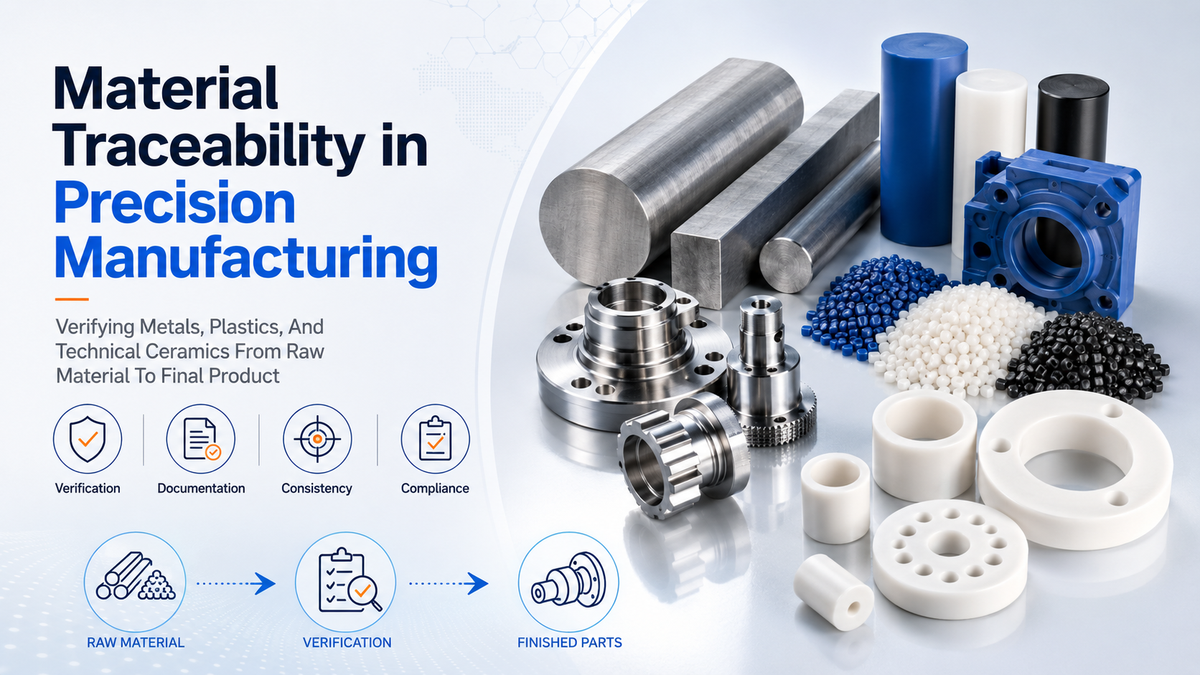
Material traceability is the ability to track materials from the supplier, through production, and all the way to final delivery. In practical terms, it creates a complete history of material flow, showing where each material batch came from, how it moved through production, and which finished products it eventually became.
For precision manufacturing, this is not simply a documentation requirement. Material traceability is part of manufacturing quality itself.
A certificate, batch number, incoming inspection record, and production record all serve the same purpose: making sure the material requested by the customer is the material that actually goes into the finished product.
Why Material Traceability Matters in Precision Manufacturing
The correct material is just as important as the correct dimensions.
Material selection is tied directly to how a product is expected to perform. Strength, corrosion resistance, temperature resistance, electrical properties, wear resistance, and other functional requirements may all depend on choosing the correct material. If the wrong material is used, the product may perform very differently from what was intended.
That is why material traceability in precision manufacturing is part of quality control.
Helps Prevent Cost-Cutting From Becoming a Quality Problem
Material problems often start before production. Raw materials can be mislabeled, mixed up, or even replaced with lower-cost alternatives by unreliable suppliers.
At XY-GLOBAL, we are especially careful about this because we have experienced cases where supplied material did not fully match what had been represented.
That is why we do not simply take a supplier's word for it.
Reduces the Risk of Expensive Mistakes
A wrong material becomes much more expensive once it has already been machined, finished, inspected, packed, or shipped.
Good material traceability helps identify material issues earlier, reducing the risk of scrap, rework, production delays, and unnecessary manufacturing costs.
It is always better to catch a material problem before production than after hundreds of parts have been completed.
Makes Quality Problems Easier to Investigate
Material questions do not always appear during production. Sometimes a customer may come back months later with a failure or simply ask which material was used for a previous order.
With reliable manufacturing material traceability, the available material records can help investigate the issue more quickly instead of relying on memory or assumptions.
When something goes wrong, traceability makes it easier to find where to start looking.
Gives Customers Evidence, Not Just a Promise
Customers do not just want to hear that the correct material was used. They want supporting information they can review.
Good material traceability provides clear material documentation for internal quality records, customer approvals, compliance requirements, or special applications.
It turns “we used the correct material” into something the customer can actually verify.
In short, material traceability helps confirm that the material used matches the drawing, makes material-related issues easier to investigate, supports compliance requirements, and provides customers with clear, reliable documentation.
It also helps manufacturers track materials through the production process, identify problems more quickly, and maintain better control over product quality, performance, compliance, and safety.
A Material Certificate Alone Is Not Enough
Paperwork matters. But paperwork alone is not traceability.
A material certificate may state the correct grade, chemical composition, mechanical properties, heat number, or batch number.
That is useful. But one question still needs to be answered:
Does this certificate actually belong to the material used for this customer's parts?
This is the point that really matters.
If a bar of stainless steel is cut into smaller sections, a plastic sheet is divided between different orders, or a ceramic raw material batch enters production, the identity of that material still needs to follow it.
The connection should remain clear between: Raw material → material document → batch identification → production order → finished product.
If that connection is lost, having a certificate stored somewhere in a folder does not provide true traceability.
The goal is not simply to collect documents.
The goal is to make sure the right material goes into the right parts—and that we can prove it.
How XY-GLOBAL Maintains Material Traceability
At XY-GLOBAL, the goal of material traceability is simple:
The material specified on the customer drawing should be consistent with the material documentation and the material actually used to manufacture the product.
Different materials need different ways of proving that, so we check the relevant information according to the material type.
We also use material inspection equipment to help verify material consistency.
Metal Material Traceability
For metals, composition matters.
Metal grades are determined by different elemental compositions. For metal projects, XY-GLOBAL can provide material composition information or SGS reports according to customer requirements to help verify that the material used matches the specified grade.
Common materials include 6061-T6, 7075-T6, 304/304L, 316L, 17-4PH, 420, 440C, copper and copper alloys.
The principle is simple: if the drawing specifies a particular metal, the material data should support it.
Plastic Material Traceability
Plastics work differently.
For plastic materials, physical properties are important because the selected grade must meet the functional requirements of the product.
That is why XY-GLOBAL can provide the physical property sheet from the actual raw material manufacturer, rather than relying only on a generic material description.
For materials such as POM, PEEK, PI, PA and PC, this helps customers confirm that the selected material is suitable for the intended application.
Material Traceability for Technical Ceramics
Technical ceramics also require the material information to match the drawing requirements.
XY-GLOBAL works with materials such as Al₂O₃, ZrO₂, AlN, Si₃N₄, SiC and cordierite. Depending on the ceramic material, relevant composition and physical-property information can be provided to support the specified material requirement.
For example, if a drawing specifies a particular alumina grade or purity, simply calling the material “alumina” is not enough.
Different materials require different evidence, but the goal remains the same: making sure the material used matches what the customer specified.
Special Material and Compliance Requirements Should Be Confirmed Early
Some projects require additional material documentation or compliance, such as SGS testing, RoHS, medical-grade materials, or food-contact materials.
If your project has these requirements, please let us know before material purchasing and production.
When we understand these requirements at the beginning of the project, we can prepare the corresponding material and supporting information accordingly.
Waiting until the parts are already finished and then asking for additional material requirements can make the process much more difficult.
So if material compliance is important to your project, it should be discussed early.
Conclusion
Material traceability is more than a documentation requirement. It is an important part of ensuring product quality, material consistency, compliance, and customer confidence in precision manufacturing.
As a reliable precision machined parts manufacturer, XY-GLOBAL places material traceability throughout the manufacturing process, from raw material verification and production to quality inspection and final delivery. We work to keep the material specified on the drawing, the supporting documentation, and the material actually used in production consistent. This gives customers clearer visibility into the material history of their parts and makes it easier to investigate and identify any suspected nonconforming products.
Have a precision manufacturing project? Contact us today to discuss your requirements. XY-GLOBAL can also provide material traceability support to help verify that the materials used meet your specifications.




Share:
Precision Machining Parts Shops for High-Tolerance Custom Parts