


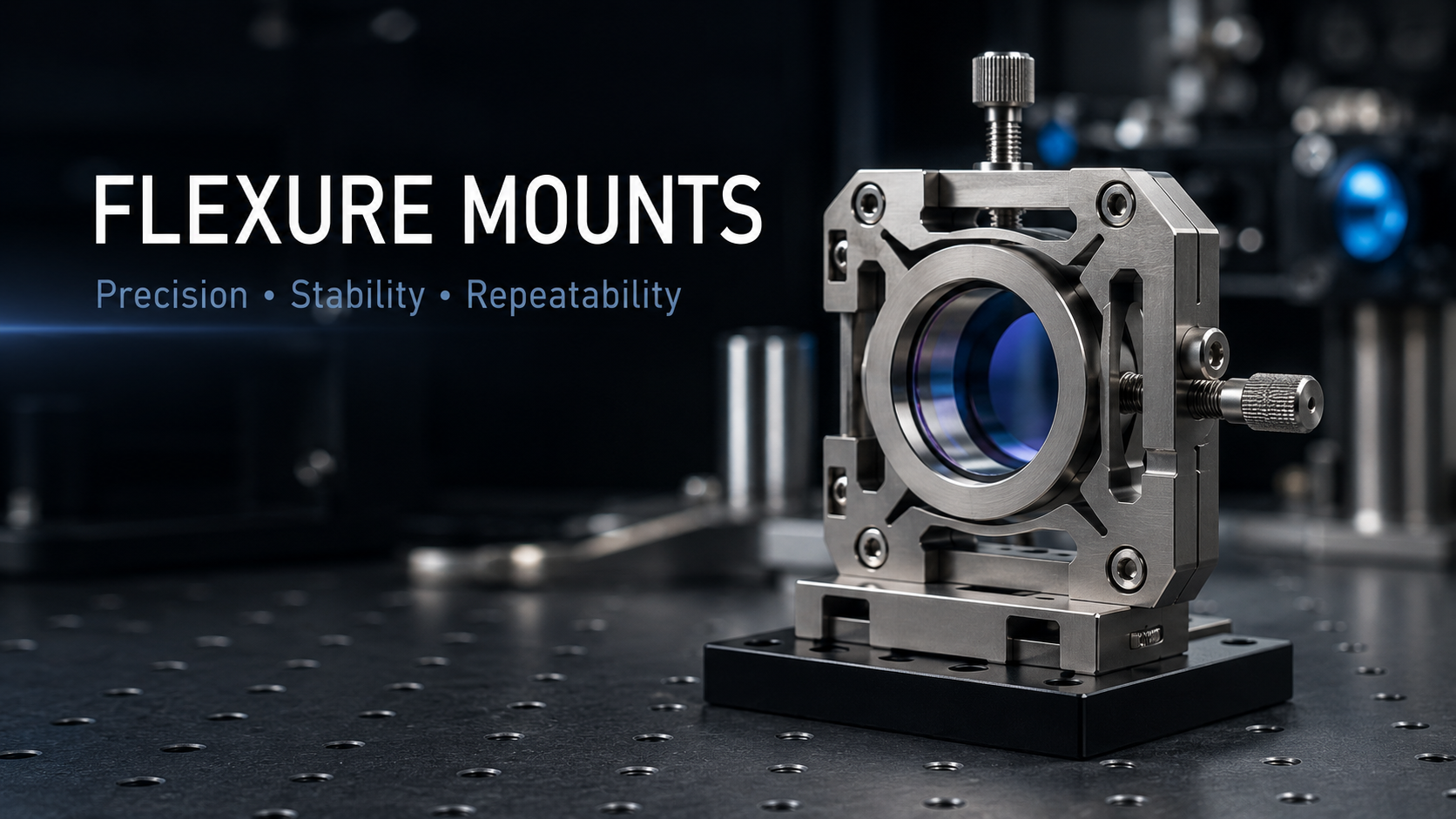
Flexure mounts are widely used in precision optical systems, laser instruments, semiconductor equipment, metrology devices, and compact motion-control assemblies. Unlike traditional mounts that rely on sliding parts, pivots, bearings, or multiple mechanical joints, a flexure mount uses controlled elastic deformation to achieve accurate positioning, alignment, or stress relief.
For engineers working on high-precision assemblies, the value of a flexure mount is not only its ability to move slightly. The real advantage is that it can guide motion in a predictable way while reducing friction, backlash, particle generation, and assembly complexity. This makes flexure mounts especially useful in applications where small displacement, stable alignment, and long-term repeatability matter more than large movement range.
Why Flexure Mounts Are Used in Precision Engineering
In many precision systems, even a small amount of mechanical play can create alignment errors. Conventional mechanical joints may introduce backlash, stick-slip motion, wear, lubrication issues, or inconsistent preload. A well-designed flexure mount avoids many of these problems by allowing the structure itself to bend within a controlled elastic range.
This gives flexure mounts several important advantages:
-
Backlash-free movement for repeatable adjustment
-
Low friction because there are no sliding contact surfaces in the flexure area
-
Compact structure suitable for limited installation space
-
High stability for optical and metrology applications
-
Cleaner operation because there are fewer rubbing parts
-
Reduced assembly complexity when the mount is machined as one piece
These features make flexure mounts common in optical mirror mounts, lens holders, fiber alignment systems, laser beam steering components, sensor positioning devices, precision fixtures, and inspection equipment.

Common Applications of Flexure Mounts
Optical and Laser Systems
One of the most common uses of flexure mounts is in optical alignment. Optical components such as mirrors, prisms, lenses, filters, and fiber interfaces often require fine angular or linear adjustment. A flexure mount can provide controlled pitch, yaw, or translation while maintaining stable contact with the optical element.
In laser systems, alignment drift can directly affect beam quality, power delivery, and measurement accuracy. A stiff, well-machined flexure mount helps maintain optical alignment over time, especially when the system is exposed to vibration, thermal variation, or repeated adjustment.
Semiconductor and Photonics Equipment
Semiconductor tools and photonics systems often require micron-level or sub-micron-level positioning. Flexure mounts are suitable for wafer inspection systems, optical modules, precision stages, micro-positioning units, and packaging fixtures.
Because flexure mechanisms can be designed with predictable stiffness and motion paths, they are often used together with fine adjustment screws, piezo actuators, voice coil actuators, or other precision drive elements.

Metrology and Inspection Devices
Coordinate measuring systems, optical inspection machines, interferometers, and precision test fixtures require stable reference structures. Flexure mounts can be used to hold sensors, probes, mirrors, calibration targets, or workholding components.
For metrology applications, the mount must not only be accurate when new. It also needs to remain stable after repeated use, temperature changes, and small adjustment cycles. This is where material selection, machining accuracy, stress control, and inspection become critical.
Aerospace and Scientific Instruments
In aerospace, astronomy, laboratory instruments, and research equipment, flexure mounts are often used to isolate stress or allow small controlled movement without using conventional bearings. They can help compensate for thermal expansion, gravity-induced deformation, or assembly tolerance differences.
For these applications, engineers usually pay close attention to weight, stiffness, natural frequency, temperature behavior, and fatigue life.

Flexure Mount Design Considerations
A flexure mount may look simple from the outside, but the design work behind it is highly technical. The performance depends on how the thin flexure sections are shaped, how load is transferred, and how the part is manufactured.
1. Motion Direction and Constraint
The first design question is simple: which direction should the mount move, and which directions should it resist?
A flexure mount should allow compliance only where movement is required. At the same time, it should remain stiff in unwanted directions. Poor constraint design can cause parasitic motion, tilting, twisting, or unpredictable alignment changes.
For optical mounts, this is especially important because unwanted angular movement may cause beam shift or optical misalignment.
2. Stiffness and Travel Range
Flexure mounts are usually designed for small displacement. If the required travel range is too large, the flexure may experience excessive stress or nonlinear behavior.
The designer must balance:
-
Required adjustment range
-
Flexure thickness and length
-
Material yield strength
-
Stiffness in the working direction
-
Natural frequency
-
Fatigue resistance
-
Assembly preload
A mount that is too stiff may be difficult to adjust. A mount that is too flexible may vibrate, drift, or fail under load.
3. Stress and Fatigue Life
The flexure area experiences repeated elastic deformation. Even if the mount does not exceed the yield strength during one adjustment, fatigue may become a concern when the part is adjusted frequently or exposed to vibration.
Important checks include maximum stress, stress concentration, edge radius, notch sensitivity, and expected adjustment cycles. Sharp internal corners should usually be avoided in flexure hinge areas because they can increase stress concentration and reduce service life.
4. Thermal Stability
Thermal behavior is another important factor. In optical and metrology systems, temperature changes can cause expansion, contraction, or alignment drift. Material selection and structural symmetry can help reduce thermal sensitivity.
Aluminum alloys are lightweight and easy to machine, but stainless steel, titanium, or special alloys may be preferred when higher stiffness, lower thermal expansion, or better environmental resistance is required.
5. Mounting Interface and Assembly Method
A good flexure mount design must consider how the part will be installed. Mounting holes, dowel pin holes, clamping areas, screw access, and adjustment directions should be designed early.
If the mounting interface is not stable, the flexure mount itself may perform well in testing but lose accuracy after installation. For this reason, custom flexure mounts often require close cooperation between the customer’s engineering team and the manufacturing supplier.
Materials for Flexure Mounts
The best material depends on the load, environment, movement range, weight target, and required stability.
Aluminum Alloys
Aluminum alloys such as 6061 and 7075 are widely used for lightweight optical and mechanical mounts. They are easy to machine and suitable for anodizing. Aluminum is a good choice when weight and cost are important, but thermal expansion should be considered in high-stability optical systems.
Stainless Steel
Stainless steel offers higher stiffness, good corrosion resistance, and stable mechanical properties. It is often used for precision fixtures, optical mounts, and medical or laboratory equipment. Common options include 304, 316L, 17-4PH, and other grades depending on strength and corrosion requirements.
Titanium
Titanium is useful when weight reduction, strength, and corrosion resistance are all important. It is more difficult to machine than aluminum and stainless steel, but it can be a good choice for aerospace, medical, and advanced instrument applications.
Copper Alloys and Special Alloys
Some flexure designs use copper alloys or special spring materials when electrical conductivity, fatigue performance, or specific elastic behavior is required. These materials should be selected carefully based on the working environment and manufacturing process.

Manufacturing Methods for Custom Flexure Mounts
Flexure mounts require precise machining because small changes in thickness, radius, surface finish, or slot geometry can affect stiffness and performance.
CNC Machining
CNC milling and turning are commonly used for flexure mount bodies, mounting interfaces, adjustment features, and precision reference surfaces. For complex parts, 5-axis CNC machining may help reduce setups and improve geometric accuracy.
Wire EDM
Wire EDM is often suitable for thin flexure slots, narrow internal profiles, and high-precision cutouts. It can create consistent flexure geometry with good accuracy, especially for stainless steel or hardened materials.
Grinding and Finishing
Precision grinding may be used when tight flatness, parallelism, or surface finish is required. Surface treatment may include anodizing, passivation, electroless nickel plating, black oxide, bead blasting, polishing, or other finishes depending on the application.
Inspection
For high-precision flexure mounts, inspection is not limited to simple dimensions. Important inspection items may include:
-
Critical slot width and flexure thickness
-
Hole position and datum accuracy
-
Flatness and parallelism
-
Surface finish
-
Burr control
-
Assembly fit
-
Functional movement check
-
CMM inspection for key dimensions
When the part is used in optical or semiconductor equipment, burrs and contamination control may also be important.
Custom Flexure Mounts vs Standard Flexure Mounts
Standard flexure mounts are useful for many laboratory and optical setups. However, custom flexure mounts are often needed when the design has special space limits, unusual optical paths, custom load requirements, specific actuator interfaces, or strict environmental conditions.
A custom flexure mount may be a better choice when:
-
The optical component has a non-standard size or shape
-
The installation space is limited
-
The system needs a special adjustment direction
-
The mount must integrate with an existing machine frame
-
The part requires special material or surface treatment
-
The project has strict stiffness, weight, or thermal requirements
-
The design needs to combine mounting, guiding, and stress relief functions
For OEM equipment, a custom design can also reduce part count, simplify assembly, and improve long-term repeatability.
Custom Flexure Mount Manufacturing Services
XY-GLOBAL provides custom manufacturing services for precision flexure mounts, optical mounts, positioning components, and high-accuracy mechanical parts. We support custom designs based on customer drawings, 3D models, samples, or functional requirements.
Our manufacturing capabilities include CNC machining, turning, milling, 5-axis machining, EDM, grinding, surface finishing, and precision inspection. We can work with aluminum alloys, stainless steel, titanium, copper alloys, and other engineering materials according to your application needs.
For flexure mount projects, we can help review manufacturability, machining risks, material options, tolerance requirements, surface treatment, and inspection methods. This is especially useful when the part includes thin flexure sections, narrow slots, tight flatness, or high-precision mounting features.
Whether you need prototype flexure mounts for testing or production parts for optical, semiconductor, medical, or industrial equipment, XY-GLOBAL can provide a practical manufacturing solution based on your technical requirements.
Information Needed for a Flexure Mount Quotation
To prepare an accurate quotation, please provide the following information when possible:
-
2D drawing with tolerances
-
3D model in STEP, STP, XT, or similar format
-
Material requirement
-
Surface treatment requirement
-
Quantity for prototype and production
-
Critical dimensions and inspection requirements
-
Application or function of the flexure mount
-
Required movement range or load condition
-
Any assembly parts, screws, pins, or optical components involved
If the design is still under development, our team can also review the structure from a manufacturing perspective and provide suggestions before production.
FAQ
What are flexure mounts used for?
Flexure mounts are used to hold, align, or adjust precision components such as mirrors, lenses, sensors, probes, fibers, and small mechanical assemblies. They are common in optical, laser, semiconductor, metrology, aerospace, and scientific instruments.
Are flexure mounts better than traditional mechanical mounts?
Flexure mounts are better when the application needs small, repeatable, backlash-free movement. Traditional mounts may still be suitable for larger adjustment ranges or lower-cost mechanical assemblies.
Can flexure mounts be CNC machined?
Yes. Many custom flexure mounts are CNC machined from aluminum, stainless steel, titanium, or other engineering materials. For narrow slots or thin flexure sections, wire EDM may also be used.
What materials are best for flexure mounts?
Common materials include aluminum alloys, stainless steel, titanium, copper alloys, and special spring materials. The best choice depends on stiffness, weight, thermal stability, corrosion resistance, fatigue life, and cost.
What files are needed for custom flexure mount manufacturing?
A 3D model and 2D drawing are recommended. The 2D drawing should show tolerances, material, surface finish, critical dimensions, and inspection requirements.
Conclusion
Flexure mounts are important components in precision engineering because they provide stable, repeatable, and backlash-free motion through controlled elastic deformation. They are widely used in optical systems, laser equipment, semiconductor tools, metrology devices, aerospace instruments, and other high-precision assemblies.
A successful flexure mount requires more than accurate machining. The design must balance stiffness, movement range, stress, fatigue life, thermal behavior, material selection, and installation method. For custom projects, early manufacturability review can help reduce risk and improve final performance.
XY-GLOBAL supports custom flexure mount manufacturing from prototype to production. If you need precision CNC machined flexure mounts or custom optical mounting components, please send us your drawings and requirements for review.


Share:
Custom Lens Barrel Manufacturer: What to Look for and How the Process Works
Medical Die Casting for Custom Medical Equipment Components