


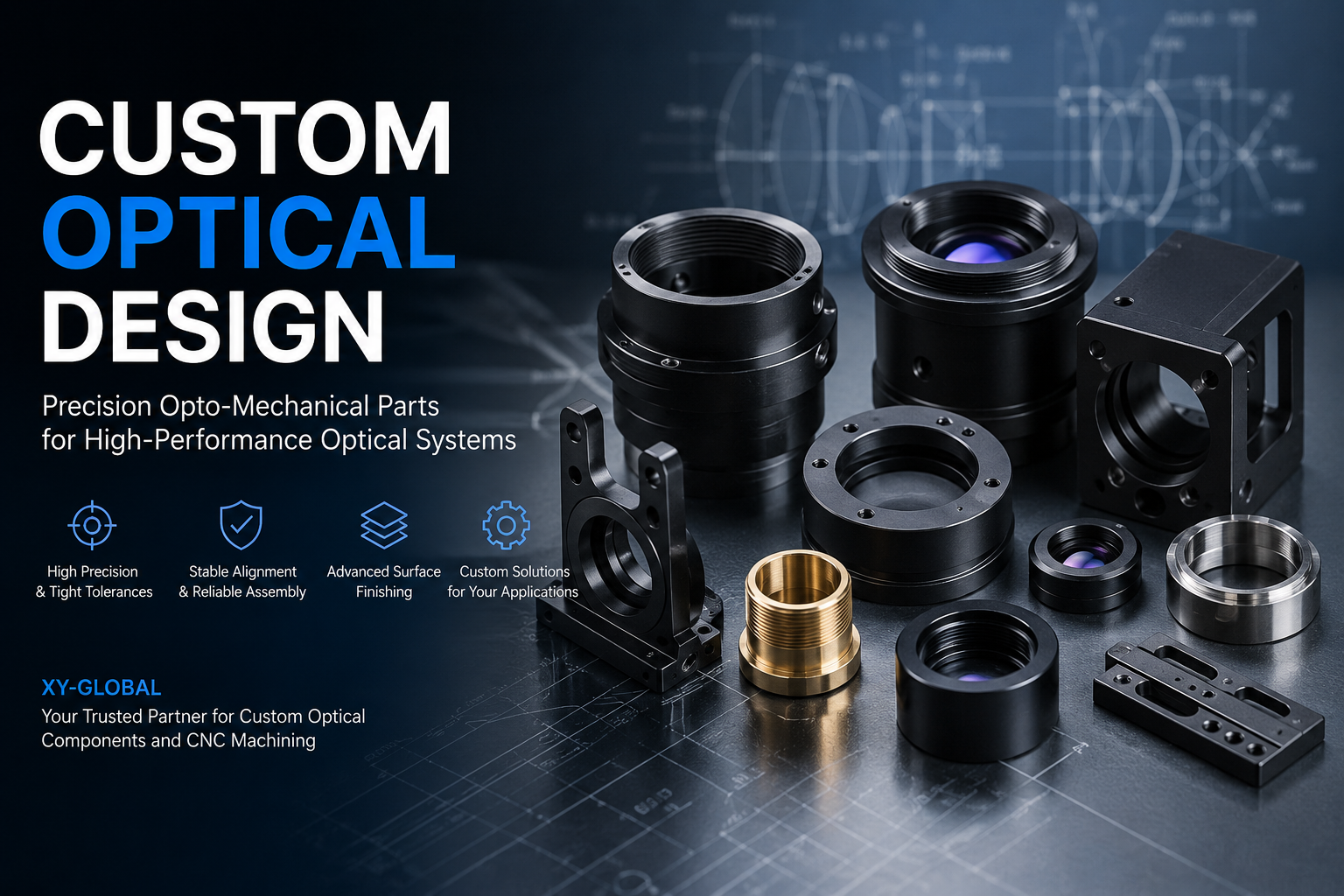
Custom optical design is not only about lenses, light paths, or image quality.
In many optical systems, the mechanical structure determines whether the optical design can perform reliably in real-world use. A lens may be carefully selected, the light path may be well calculated, and the image quality may look good in theory.
But if the mechanical parts cannot hold the optical elements accurately, the final system may still face alignment errors, unstable assembly, stray light, or performance drift.
That is why precision opto-mechanical parts are critical in custom optical design projects.
At XY-GLOBAL, we support custom optical design projects with precision CNC machined opto-mechanical parts. These parts include lens barrels, optical housings, lens mounts, brackets, filter holders, sensor housings, and alignment components.
They are widely used in medical devices, laser scanners, machine vision systems, optical sensors, imaging equipment, and precision instruments.
What Custom Optical Design Means in Real Projects
Custom optical design usually refers to the development of an optical system for a specific application. It may involve lens selection, optical layout, focal length, field of view, illumination, sensor matching, image quality, and system performance requirements.
However, optical design does not stop at the optical calculation stage. To turn an optical concept into a working product, the system also needs reliable mechanical support. Optical components must be positioned, fixed, protected, and aligned inside a stable structure.
For example, a custom optical system may require a lens barrel to hold several lenses in position, an optical housing to protect the module, a lens mount to control alignment, or a filter holder to keep optical filters stable. In some systems, internal black surfaces are also needed to reduce unwanted reflection and help control stray light.
If these mechanical parts are not accurate enough, the optical system may not perform as expected, even when the optical design itself is correct.
Why Mechanical Parts Are Critical in Optical Systems
In optical systems, small mechanical errors can create visible performance problems.
A small dimensional shift may change the distance between lenses. Poor coaxiality may affect the optical axis. Burrs may influence assembly or cleaning. A reflective internal surface may cause stray light. Unstable mounting may lead to vibration, focus shift, or long-term performance drift.
For many optical applications, mechanical parts are not just supporting structures. They directly affect the optical result.
This is especially important in medical imaging, laser scanning, machine vision, optical sensing, and scientific instruments. These systems often require stable alignment, repeatable assembly, controlled surface finish, and reliable inspection.
If the mechanical structure is not stable, the optical system may become difficult to assemble, difficult to adjust, or inconsistent from batch to batch.
That is why custom optical design projects often need close cooperation between optical engineers, mechanical designers, and precision machining suppliers.

Common Opto-Mechanical Parts Used in Custom Optical Design
Custom optical systems often require different types of precision mechanical components. These parts may look simple from the outside, but their dimensional accuracy, surface finish, and assembly stability are very important.
| Component | Typical Function |
|---|---|
| Lens barrels | Hold and position lenses inside an optical system |
| Optical housings | Protect optical modules and provide structural support |
| Lens mounts | Support lens alignment and assembly stability |
| Camera housings | Protect imaging modules and sensors |
| Sensor housings | Maintain the correct position between lens and sensor |
| Filter holders | Fix optical filters in a stable position |
| Laser scanner components | Support laser modules, scanning structures, and optical alignment |
| Optical brackets | Connect optical assemblies with equipment or platforms |
| Alignment rings | Control spacing, positioning, and optical reference features |
| Optical base plates | Provide stable mechanical reference surfaces |
These components are commonly used in medical imaging equipment, laser measuring systems, machine vision cameras, inspection equipment, optical sensors, scientific instruments, and industrial automation systems.
Key Requirements for CNC Machined Optical Components
Opto-mechanical parts usually have higher requirements than general mechanical parts. They need to support accurate assembly, stable alignment, and consistent optical performance.
Tolerance control is one of the most important requirements. For lens barrels, housings, mounts, and alignment rings, key dimensions may affect the position of lenses, sensors, filters, or other optical elements. Inner diameters, outer diameters, hole positions, threads, step heights, lens seats, and reference surfaces often need careful control.
In many optical components, coaxiality and perpendicularity are also important. If the optical axis is not stable, the system may suffer from focus problems, image distortion, or inconsistent measurement results. Flatness and position accuracy may also affect how the part connects with other modules in the final assembly.
For selected critical features, XY-GLOBAL can support tight CNC machining tolerances according to part design, material, geometry, machining process, and inspection method. Before production, we can also review the drawing and 3D model to check whether the tolerance requirements are realistic and manufacturable.
Surface Finish and Stray Light Control
Surface finish is another important factor in custom optical design projects.
Some surfaces need to be smooth for assembly. Some surfaces need to be matte to reduce reflection. Some internal surfaces may require black anodizing or other dark surface treatments to help control stray light. For optical parts, surface finish is not only about appearance. It may also affect function, assembly, cleaning, and optical performance.
Black anodizing is often used on aluminum optical components to reduce unwanted light reflection. In some cases, bead blasting before anodizing may help create a more uniform matte surface. For parts that require both appearance and function, cosmetic requirements should be confirmed before production, especially when the surface will be visible in the final product.
Surface treatment should also be planned together with the part design. Coating thickness, masking areas, thread fit, contact surfaces, and tolerance impact should be considered early. If these details are ignored, the part may pass machining inspection but still create problems after finishing or assembly.
Material Selection for Opto-Mechanical Parts
Material selection depends on the application, weight requirement, strength, thermal stability, corrosion resistance, and surface finish needs.
| Material | Typical Use in Optical Mechanical Parts |
|---|---|
| Aluminum 6061 | Lightweight optical housings, lens barrels, brackets, and general optical structures |
| Aluminum 7075 | Higher-strength optical structural parts |
| Stainless steel 304 / 316 | Corrosion-resistant optical components and structural parts |
| Brass | Precision small parts, threaded components, and optical adjustment parts |
| Copper alloys | Parts with thermal or electrical performance requirements |
| Titanium | Lightweight and high-strength optical applications |
| Engineering plastics | Lightweight, insulating, or non-metallic optical structures |
Aluminum is widely used in optical mechanical parts because it is lightweight, machinable, and suitable for anodizing. Stainless steel may be selected when higher strength or corrosion resistance is required. Brass and copper alloys are sometimes used for small precision parts, threaded components, or special functional requirements.
The best material is not always the strongest or most expensive one. It should match the optical system’s actual working conditions, assembly requirements, surface treatment needs, and production volume.
Applications of Custom Optical Design Parts
Custom optical design is used in many industries. In each application, precision mechanical parts help the optical system stay stable during assembly and use.
In medical devices, optical parts may be used in imaging equipment, diagnostic devices, surgical systems, wearable medical products, or inspection modules. These parts often require stable tolerances, burr control, smooth surfaces, and reliable inspection documentation.
In laser scanner systems, mechanical accuracy can affect laser positioning, scanning stability, and measurement repeatability. Optical housings, brackets, laser module parts, and internal surface treatments all play a role in final performance.
In machine vision systems, camera housings, lens mounts, sensor holders, and optical brackets help maintain stable imaging conditions. If the mechanical structure is not stable, image quality and inspection accuracy may be affected.
In optical sensors and scientific instruments, custom mechanical parts are often designed for compact space, special assembly methods, or small-batch production. These projects may require careful DFM review, precision machining, inspection, and surface finishing.
From Custom Optical Design to Manufacturable Parts
A custom optical design may look good in a drawing or simulation, but manufacturing still needs practical review.
Before machining optical mechanical parts, the key optical reference surfaces should be clearly defined. The supplier also needs to understand which dimensions affect alignment, which surfaces require finishing, and whether coating thickness will influence assembly.
Thin walls, deep cavities, precision threads, small holes, sharp corners, and complex internal features may increase machining difficulty. Some designs may also create inspection challenges, especially when important features are located inside narrow spaces or deep structures.
This is why DFM review is important.
At XY-GLOBAL, we can review drawings and 3D files before production to help identify machining risks, tolerance concerns, surface treatment issues, and assembly-related problems. This helps customers reduce delays and improve the chance of successful production.
How XY-GLOBAL Supports Custom Optical Design Projects
XY-GLOBAL supports customers who need precision CNC machined opto-mechanical parts for custom optical design projects. We work with parts such as lens barrels, optical housings, lens mounts, brackets, sensor housings, filter holders, and alignment components.
Before production, our team can review the drawings and 3D files to check machining feasibility, tolerance risks, surface treatment impact, and assembly-related details. This is especially useful when the part has thin walls, deep cavities, precision threads, optical reference surfaces, or tight alignment features.
For production, XY-GLOBAL can support prototype and small-batch CNC machining using materials such as aluminum, stainless steel, brass, copper alloys, titanium, and engineering plastics. Depending on the project requirements, we can also support bead blasting, black anodizing, chemical conversion coating, and other surface finishes.
When inspection documentation is required, we can provide dimensional reports, CMM inspection, and first article inspection support. Our manufacturing support follows ISO 9001:2015 and ISO 13485:2016 quality management systems.
We do not simply machine parts to shape. We focus on how the part will be assembled, inspected, finished, and used in the final optical system. For optical projects, this is especially important because a small mechanical issue may affect the whole system performance.

Precision Parts Help Optical Designs Become Real Products
Custom optical design needs more than optical theory. It also needs manufacturable, stable, and precise mechanical parts.
Lens barrels, optical housings, mounts, brackets, filter holders, and alignment components all play an important role in the final optical system. They help control position, alignment, protection, assembly, and long-term stability.
For companies developing medical devices, laser scanners, machine vision systems, optical sensors, or precision instruments, working with an experienced CNC machining supplier can help turn custom optical designs into reliable physical products.
At XY-GLOBAL, we support optical design projects with precision CNC machined opto-mechanical parts, DFM review, surface finishing, inspection, and production support.
If you are developing a custom optical system and need precision mechanical parts, you can send us your drawings or 3D files for review and quotation.
Summary
Custom optical design requires more than lenses and light paths. Precision opto-mechanical parts such as lens barrels, optical housings, mounts, brackets, and alignment components help maintain optical alignment, assembly stability, and long-term system performance.


Share:
What Are Laser Scanner Components and Where Are They Used?
CNC Machining for Medical Devices: A Practical Guide to Precision Medical Parts