


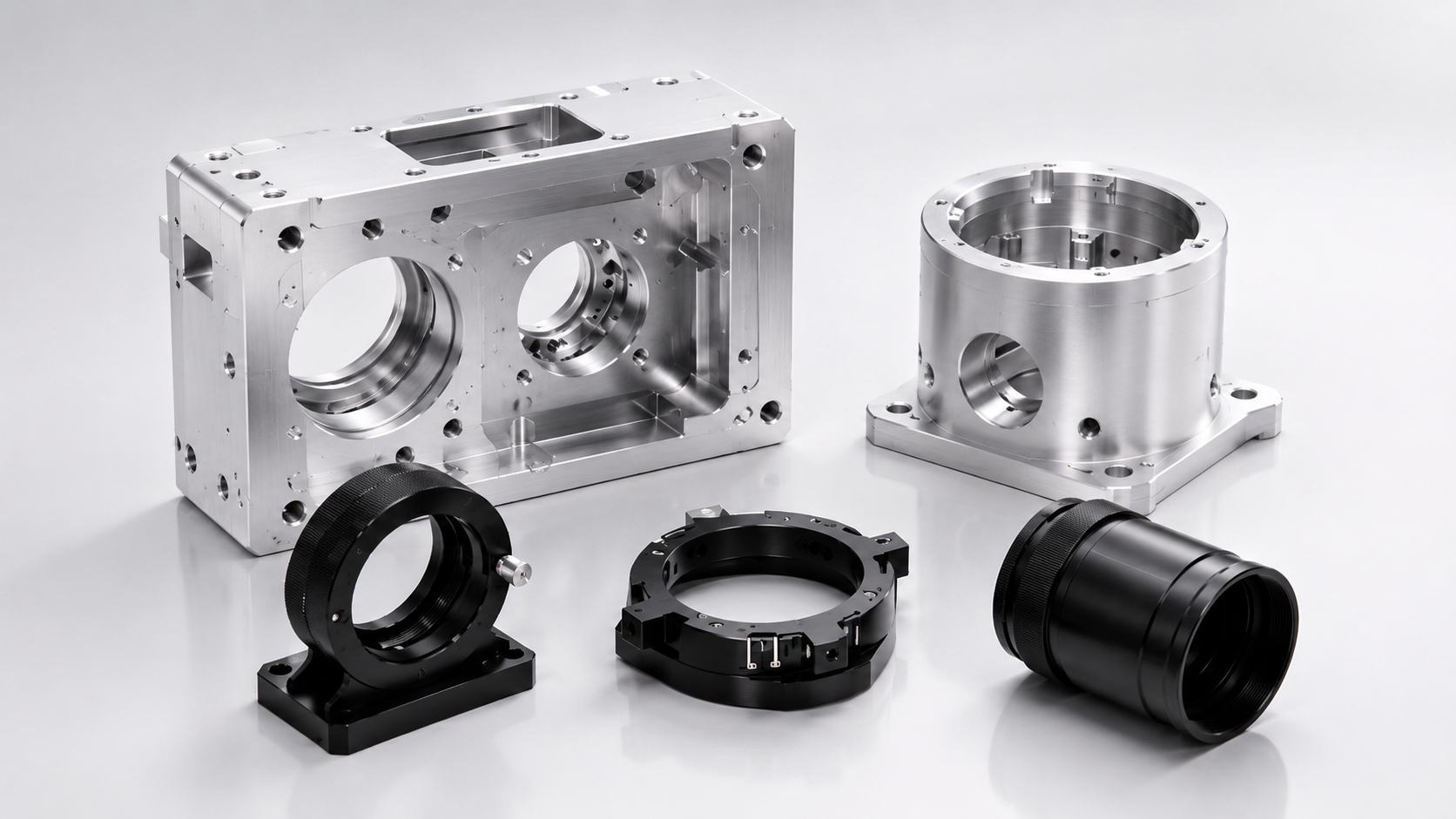
In precision optical device development, mechanical parts do much more than hold components in place. They affect lens positioning, optical alignment, assembly stability, heat dissipation, and long-term performance. Even a small dimensional error in a housing, lens mount, or internal locating surface may influence the way an optical system works.
A CNC optical part prototype helps engineering teams test these details before moving into small-batch or mass production. Instead of waiting until the final production stage to discover assembly issues, engineers can use prototypes to check whether the part fits correctly, supports the optical path, and meets the design intent. For optical instruments, laser systems, and semiconductor-related equipment, the prototype stage is often where design details are adjusted.
Hole positions, wall thickness, internal steps, threaded areas, and surface treatment requirements may all need to be reviewed before the design becomes stable. Accurate prototyping reduces development risk and gives teams a more reliable path from concept to production.
Why CNC Machining Is Suitable for Optical Part Prototyping
CNC machining is well suited for optical part prototyping because it supports high precision, design flexibility, and fast iteration. In the development stage, many optical components are not ready for tooling or molding.
Engineers may still need to change dimensions, adjust mounting structures, or improve internal clearance. CNC machining allows these changes to be tested quickly without the cost and delay of hard tooling.
Another advantage is material flexibility. Optical mechanical parts are commonly made from aluminum, stainless steel, brass, copper, and engineering plastics. Aluminum is especially common for optical housings, lens barrels, and lens mounts because it is lightweight, easy to machine, and suitable for surface treatments such as black anodizing.
Surface treatment is also important for optical applications. Black anodizing, fine sandblasting, polishing, plating, and other finishes may be used depending on the function of the part. For some optical components, surface finish is not only about appearance. It may also help reduce reflection, improve corrosion resistance, or support more stable assembly.
With a CNC optical part prototype, engineers can test both mechanical performance and surface treatment effects before confirming the final production standard.

Common CNC Optical Prototype Parts
Optical Housings
Optical housings are used to protect and position optical modules, lenses, sensors, laser units, or imaging components. In prototype development, housing accuracy directly affects internal space, mounting stability, heat dissipation, and assembly clearance.
A well-machined optical housing needs more than a clean outer shape. Internal cavities, screw holes, positioning bosses, cable exits, mounting slots, and sealing areas may all need careful control. If the housing is used in a laser or imaging system, the relationship between the housing and internal optical components becomes even more important.
For prototype housings, CNC machining allows engineers to test whether the structure is easy to assemble, whether the wall thickness is reasonable, and whether the surface treatment meets the final product requirements.
Lens Mounts and Lens Holders
Lens mounts and lens holders are critical parts in many optical systems. Their main function is to keep the lens in the correct position and maintain stable alignment during use. In some applications, even a small shift in lens position may affect focusing, imaging quality, or measurement accuracy.
These parts often require precise inner diameters, threaded features, positioning steps, and reference surfaces. The design may also need to consider how the lens is fixed, whether there is enough clearance for assembly, and whether the structure can avoid stress on the optical element.
CNC machining is suitable for producing lens mount and lens holder prototypes because it can handle complex geometry, small features, and tight tolerance areas. It also allows engineers to verify the design before committing to a more stable production plan.
Lens Barrels
Lens barrels are commonly used in cameras, optical instruments, laser devices, and imaging systems. They may include internal threads, stepped bores, thin walls, grooves, and black surface treatment. These features require stable machining control because the barrel often determines the position and spacing of multiple optical elements.
A lens barrel prototype can help engineers verify internal diameter accuracy, lens spacing, thread fit, assembly method, and surface finish. For some designs, the inside surface may require black anodizing or other treatment to reduce unwanted reflection.
When producing a CNC optical part prototype such as a lens barrel, it is important to review the relationship between machining accuracy and post-processing. Surface treatment may slightly affect dimensions, so critical areas should be considered carefully during the design and machining planning stage.
Key Design Considerations for CNC Optical Part Prototypes
Before producing a CNC optical part prototype, the design should be reviewed from both machining and optical assembly perspectives. The drawing should clearly define critical dimensions, tolerance requirements, surface finish areas, threaded features, and reference surfaces. If all surfaces are marked with unnecessarily tight tolerances, the part may become more difficult and expensive to produce without improving actual performance.
Wall thickness is another important factor. Very thin walls may deform during machining or surface treatment. Deep cavities, long small-diameter holes, sharp internal corners, and complex undercuts may also increase machining risk. These features should be reviewed before production begins.
Surface treatment should also be considered early. For example, if a part requires black anodizing, the design may need to account for coating thickness and color consistency. For optical mechanical parts, some areas may need cosmetic finishing, while other areas may need precise contact or positioning surfaces. Separating these requirements clearly can help improve both quality and cost control.
At XY-GLOBAL, we support DFM review before prototype machining. Our team can review drawings, material selection, tolerance requirements, surface finish needs, and assembly risks to help customers reduce problems during the prototype stage.
From Prototype to Small-Batch Production
A prototype is not only a sample. It is often the first step toward a more stable production process. After the first CNC optical part prototype is approved, the machining program, fixture method, inspection plan, and surface treatment standard can be optimized for small-batch production.
This is especially important for optical device companies that need to move from R&D testing to pilot production. During this stage, the goal is not only to make one correct part, but to make the part repeatable. The approved prototype can become the reference for future production control.
For small-batch optical parts, CNC machining remains a practical choice because it supports design flexibility and relatively fast delivery. If the product is still being adjusted, CNC machining allows customers to make controlled updates without changing expensive tooling.
Quality Control for Optical Prototype Parts
Quality control for optical prototype parts is not limited to checking the overall size. Critical features such as mounting surfaces, inner diameters, hole positions, flatness, perpendicularity, coaxiality, and threaded areas may directly affect assembly and optical performance.
For high-precision optical components, inspection should focus on the features that matter most to the final application. Some dimensions affect only appearance, while others determine whether lenses, sensors, or laser modules can be aligned correctly. Understanding this difference helps make the inspection process more practical and useful.
Depending on project requirements, XY-GLOBAL can support dimensional inspection, first article inspection, CMM inspection, and inspection reports. This helps customers confirm prototype quality before moving into the next stage of development or production.

Applications of CNC Optical Part Prototypes
Optical Instruments
Optical instruments often require precise mechanical structures to support lenses, mirrors, sensors, and adjustment modules. These systems may be used in testing equipment, laboratory devices, inspection instruments, or measurement systems. Prototype parts help engineers verify optical layout, assembly space, and mechanical stability before finalizing the product design.
Laser Systems
Laser systems require stable positioning and reliable heat management. CNC-machined housings, brackets, mounting plates, and alignment components can help keep laser modules in the correct position. In laser-related applications, mechanical stability is important because vibration, thermal changes, or poor assembly can affect performance over time.
Semiconductor Optical Equipment
Semiconductor optical equipment often involves inspection, measurement, laser processing, or precision positioning. The mechanical parts used in these systems may need high accuracy, stable material performance, and clean surface finishing. CNC machining is suitable for producing prototype and small-batch components for these demanding applications, especially when the design is complex or still under development.
Conclusion
A well-made CNC optical part prototype helps engineers verify design, assembly, alignment, and surface finish before production. For precision optical device development, this stage can reduce risk, shorten design iteration time, and improve confidence before moving into small-batch manufacturing.
Whether your project involves optical housings, lens mounts, lens holders, lens barrels, laser system components, or semiconductor optical equipment parts, XY-GLOBAL can support custom CNC machining from drawing review to prototype production, surface treatment, and inspection.
If you need precision optical prototype parts for your next project, our team can help review your design and provide a practical manufacturing solution.


Share:
Custom Aluminum Die Casting Parts for Industrial Applications
Medical Device Machining Process: Precision That Saves Lives