


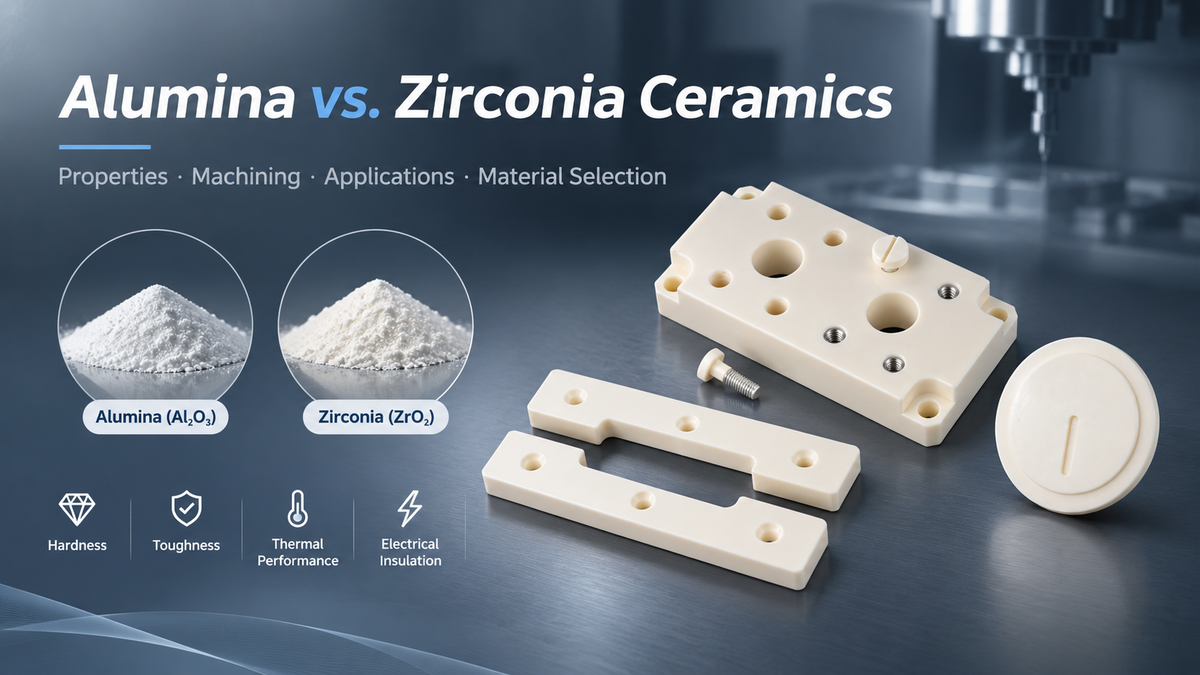
Alumina and zirconia are two common material options for custom ceramic parts.
Both offer high hardness, good wear resistance, and excellent corrosion resistance. However, they differ quite a bit in fracture toughness, mechanical strength, thermal properties, and machining costs.
Choosing a material based only on price or hardness can lead to problems. Parts may chip, crack, or wear out too quickly, and customers might end up paying more.
As a precision ceramic manufacturer with over 15 years of experience, XY-GLOBAL helps engineers and buyers select the most suitable material based on part load, wear conditions, tolerance requirements, electrical insulation needs, thermal environment, and cost targets.
In this article, we will compare their material properties, machining challenges, applications, and costs to help choose the right material.

1. What Is Alumina Ceramic?
Alumina ceramic (Al₂O₃) is an advanced oxide ceramic made mainly from aluminum oxide. It's one of the most widely used technical ceramics in industrial applications.
Its main advantages include high hardness, good wear resistance, excellent electrical insulation, and strong chemical stability. Alumina is also relatively affordable because its raw materials are widely available and its manufacturing processes are well established.
Alumina ceramics mainly consist of the stable α-Al₂O₃ crystal phase. Depending on the alumina content, common industrial grades include:
-
95% Alumina: Commonly used for industrial wear parts, insulating components, ceramic tubes, and mechanical parts.
-
96% Alumina: Often used for electronic substrates, electrical insulation, and industrial structural components.
-
99% Alumina: Suitable for parts that need higher purity, corrosion resistance, or better electrical properties.
-
99.5% and 99.9% Alumina: Commonly used for high-purity insulating parts, semiconductor equipment, and specialized industrial applications.
Different alumina grades vary in more than just price. Alumina content, sintering additives, porosity, and microstructure all affect their mechanical, electrical, and thermal properties.
2. What Is Zirconia Ceramic?
Zirconia ceramic (ZrO₂) is an advanced oxide ceramic known for its high strength, fracture toughness, and wear resistance. Compared with alumina, zirconia is generally better at resisting crack growth, making it suitable for parts exposed to mechanical stress or repeated loading.
Pure zirconia has three main crystal structures: monoclinic, tetragonal, and cubic. To improve its stability and mechanical properties, manufacturers add stabilizers such as yttria (Y₂O₃) or magnesia. One common grade used for precision components is 3Y-TZP (3 mol% Yttria-Stabilized Tetragonal Zirconia Polycrystal).
Because of high toughness of Zirconia, zirconia is often used for precision valve components, ceramic shafts, wear-resistant sleeves, and other parts that need good mechanical strength and crack resistance.
However, zirconia can still crack under excessive loads or poor machining conditions. Some stabilized grades may also experience low-temperature degradation in hot, humid environments, so choosing the right material grade is important for long-term use.

3. Alumina vs. Zirconia: Key Material Properties Compared
The table below compares typical properties of alumina and zirconia.
| Property | Alumina Ceramic (Al₂O₃) | Zirconia Ceramic (ZrO₂) |
| Common grades | 95%, 96%, 99%, 99.5% Al₂O₃ | 3Y-TZP |
| Density | 3.7–3.98 g/cm³ | 6.0–6.1 g/cm³ |
| Vickers hardness | 1,300–1,800 HV | 1,100–1,400 HV |
| Flexural strength | 250–400 MPa | 800–1,200 MPa |
| Fracture toughness | 3–5 MPa·m¹/² | 5–10 MPa·m¹/² |
| Young's modulus | 300–390 GPa | 190–220 GPa |
| Thermal conductivity at room temperature | 20–35 W/(m·K) | 2–3 W/(m·K) |
| Thermal expansion coefficient | Approx. 6–8 × 10⁻⁶/K | Approx. 10–11 × 10⁻⁶/K |
| Electrical insulation | Excellent | Generally good at room temperature |
| Weight | Relatively light | Relatively heavy |
| Material cost | Generally lower | Generally higher |
| Main advantages | Hardness, insulation, thermal stability, cost | Toughness, flexural strength, crack resistance |
(These are representative ranges for common industrial grades. Actual values depend on purity, stabilizers, sintering conditions, porosity, grain size, and test methods. )
Actually, neither ceramic is better in every category.
Alumina is generally harder, lighter, and more thermally conductive. It also tends to cost less. Zirconia, while slightly softer, usually offers much higher flexural strength and fracture toughness.
That's why hardness alone isn't enough to make the right choice. The type of load a part will experience matters just as much.
4. Hardness vs. Toughness: The Biggest Difference Between Alumina and Zirconia
4.1 Alumina Has Higher Hardness and Good Abrasive Wear Resistance
Alumina has high surface hardness, which helps it resist scratches from hard particles, friction-related wear, and certain corrosive environments.
In industrial equipment, for example, alumina is often used for wear liners, guide components, insulating sleeves, and wear-resistant supports.
For applications with relatively stable loads and little impact, alumina can provide good wear resistance without driving up material costs.
But high hardness doesn't necessarily mean good impact resistance.
Sharp corners, thin walls, interference fits, and concentrated contact loads can all create stress points where alumina may crack.
If a part needs to handle repeated impacts or bending loads, its fracture resistance deserves closer attention.
4.2 Zirconia Has Higher Toughness and Handles More Complex Mechanical Loads
Zirconia usually has much higher fracture toughness than alumina. Under comparable test conditions, it can better resist the growth of existing cracks.
This can be especially useful for small precision shafts, valve components, ceramic sleeves, and thin-walled parts.
Take a precision valve component as an example. During operation, it may repeatedly contact the valve seat while experiencing pressure changes, friction, and localized impacts.
In this case, wear resistance alone isn't enough. The material also needs good crack resistance and dimensional stability.
Zirconia is often a better candidate for applications that require both strength and toughness.
However, zirconia isn't automatically more wear-resistant than alumina in every situation.
Actual wear performance depends on contact pressure, the mating material, lubrication, surface roughness, temperature, and the type of wear involved.
Under certain abrasive wear conditions, harder alumina may perform better. For critical wear parts, material selection should be based on the actual operating conditions.
5. Thermal and Electrical Properties: How Do They Compare?
5.1 Thermal Conductivity
Alumina and zirconia have very different thermal conductivities.
High-purity alumina typically has a room-temperature thermal conductivity of around 20–35 W/(m·K). For common 3Y-TZP zirconia, it's only about 2–3 W/(m·K).
This makes alumina a good choice for components that need both electrical insulation and some heat transfer, such as insulating supports, ceramic substrates, and certain thermal management parts in electronic equipment.
Zirconia has much lower thermal conductivity, making it useful for some components designed to reduce heat transfer.
However, low thermal conductivity also means heat may build up locally. Whether zirconia is suitable for thermal cycling or rapid temperature changes depends on the part's design and thermal stress.
5.2 Thermal Expansion
Alumina typically has a linear thermal expansion coefficient of about 6–8 × 10⁻⁶/K, while 3Y-TZP zirconia is around 10–11 × 10⁻⁶/K.
Zirconia's thermal expansion is closer to that of certain metals, which can be helpful in some metal-ceramic assemblies.
Even so, engineers still need to consider the specific metal alloy, operating temperature, joining method, and stresses caused by differences in thermal expansion.
5.3 Electrical Insulation
Both ceramics generally provide good electrical insulation at room temperature, but high-purity alumina is more widely used for industrial electrical insulation.
Alumina has a long history in electronic substrates, insulating tubes, electrical isolation components, and high-temperature insulating structures.
Zirconia can also work as an electrical insulator at room temperature. However, some stabilized zirconia materials become good oxygen-ion conductors at high temperatures. This property makes them useful in oxygen sensors and solid oxide fuel cells.
For high-temperature electrical insulation, it's important to check the material's electrical properties at the actual operating temperature rather than relying only on room-temperature resistivity.
6. Alumina vs. Zirconia: Machining Challenges
The differences in material properties also affect how these ceramics are manufactured.
For custom precision ceramic parts, machinability, chipping risk, achievable tolerances, and the amount of finishing work required all influence the final cost.
6.1 Machining Challenges for Alumina Ceramic
Alumina is both hard and brittle. Once fully sintered, it usually requires processes such as diamond grinding, precision drilling, lapping, or polishing.
Common machining challenges include:
-
Edge chipping around holes and outer profiles
-
Microcracks near small holes, thin walls, and sharp corners
-
Diamond tool wear
-
Part breakage caused by excessive machining forces or improper clamping
-
Additional grinding needed to achieve tight dimensional and geometric tolerances
For relatively simple parts produced in larger quantities, manufacturers may use dry pressing, isostatic pressing, or ceramic injection molding to create near-net-shape blanks.
Critical surfaces can then be finished through precision machining.
This approach reduces the amount of material that must be removed after sintering.
6.2 Machining Challenges for Zirconia Ceramic
Zirconia is also a difficult-to-machine ceramic.
Although its higher fracture toughness may reduce crack growth under certain conditions, that doesn't mean zirconia is always easier to machine than alumina.
Fully sintered zirconia still requires suitable diamond tools, carefully selected grinding parameters, and proper cooling.
Because zirconia differs in composition, strength, thermal behavior, and phase stability, machining also requires attention to grinding heat, surface damage, and possible local phase transformations.
For precision valve components, ceramic shafts, and sealing parts, surface roughness, roundness, concentricity, and dimensional consistency are often more important than appearance alone.
The machining process therefore needs to be selected according to the part geometry and functional requirements. Precision grinding, lapping, and polishing are commonly used.
7. Typical Applications of Alumina and Zirconia Ceramics
Alumina and zirconia are two most common options for ceramic parts and widely used across applications like optical, electrical, semiconductor, medical industries.
7.1 Common Applications of Alumina Ceramic
- Electrical Insulation Components: Alumina offers excellent electrical insulation and is commonly used for insulating tubes, spacers, electronic substrates, insulating supports, and electrical isolation components.
- Wear-Resistant Mechanical Parts: In applications with abrasive wear and limited impact, alumina can be used for wear liners, guide components, ceramic nozzles, and wear-resistant sleeves.
- High-Temperature Industrial Components: Alumina has good chemical stability at elevated temperatures. Common applications include furnace tubes, heat-treatment fixtures, high-temperature supports, and certain furnace components.
- Semiconductor and Electronic Equipment: High-purity alumina is used for insulating structures, equipment supports, selected components in vacuum environments, and other electronic equipment parts.
Different applications may have different requirements for purity, surface contamination, porosity, and machining quality. The material grade should be chosen accordingly.
7.2 Common Applications of Zirconia Ceramic
- Precision Shafts and Sleeves: Zirconia's high flexural strength and fracture toughness make it suitable for certain small ceramic shafts, guide sleeves, and moving mechanical components.
- Pumps, Valves, and Fluid Control Parts: Zirconia can be used for valve components, valve seats, plungers, and sealing parts in some precision pumps and valves. It's especially useful when corrosion resistance, surface quality, and crack resistance are all important.
- Medical and Dental Applications: Certain medical-grade zirconia materials are widely used for dental restorations and some medical device components. Medical applications require materials that meet the relevant standards and product requirements. Ordinary industrial zirconia should not be used directly for implantable products.
- Precision Instruments and Automation Equipment: Zirconia is also used for precision positioning components, wear-resistant contact parts, miniature structural parts, and selected automation equipment components.
In these applications, dimensional stability, surface quality, and mechanical reliability are often key considerations.
8. Alumina vs. Zirconia: Cost Comparison
In general, alumina ceramic costs less than zirconia ceramic because of raw material prices, stabilizer requirements, powder preparation, sintering processes, and supply chain maturity.
Alumina is widely available, and manufacturing processes for common industrial grades are well established. This usually gives it a cost advantage.
Zirconia requires more attention to stabilizers, powder quality, sintering control, and finishing requirements. Its raw materials are also generally more expensive.
For custom ceramic parts, though, the final price depends on much more than material cost.
| Cost Factor | How It Affects the Price |
| Material grade | High-purity and special formulations generally cost more |
| Part size | Affects material consumption and blank preparation |
| Geometric complexity | Deep holes, thin walls, and complex profiles increase machining difficulty |
| Tolerance requirements | Precision grinding, lapping, and inspection add costs |
| Surface finish | Very smooth surfaces may require additional polishing |
| Production quantity | Affects how tooling, programming, and setup costs are spread across parts |
| Inspection requirements | Full dimensional inspection and special documentation add costs |
For example, a simple alumina insulating spacer usually doesn't need to be made from more expensive zirconia just to gain extra toughness.
On the other hand, a precision valve component that tends to crack under impact or localized stress may benefit from zirconia.
If testing confirms that zirconia significantly improves reliability in the intended application, its higher material cost may be justified.
The better approach is to compare the total cost of ownership, including part price, service life, maintenance, and downtime risk, rather than looking only at the unit price.
9. ZTA Ceramic: Balanced Alternative to Alumina and Zirconia
If alumina is too brittle for an application but zirconia is too expensive, ZTA may be worth considering.
ZTA stands for Zirconia Toughened Alumina. It's a composite ceramic made by adding zirconia particles to an alumina matrix.
Through particle-related toughening and transformation toughening mechanisms, ZTA can offer better fracture resistance while retaining much of alumina's hardness and wear resistance.
Depending on its composition and manufacturing process, some ZTA grades can achieve flexural strengths of around 400–700 MPa or higher. Their fracture toughness can also be noticeably better than that of conventional alumina.
ZTA may be suitable for wear-resistant structural parts, mechanical sealing components, industrial guides, and certain parts exposed to complex mechanical loads.
However, ZTA doesn't simply combine every advantage of alumina and zirconia.
Its actual performance depends on zirconia content, particle size, phase stability, sintered density, and machining quality.
If conventional alumina doesn't provide enough crack resistance, while full zirconia presents cost or other material limitations, ZTA can be considered as a third option.
10. Case Study: Alumina vs. Zirconia for a Precision Ceramic Sleeve
One of our customers needed a precision ceramic guide sleeve for a pump module operating in an abrasive, water-based environment. The sleeve required a 12.00 mm bore with a +0.010 / -0.000 mm tolerance, an outer diameter of 25.00 mm within ±0.010 mm, and an inner-bore surface finish of Ra ≤ 0.2 µm.
The customer initially considered 99% alumina because of its excellent wear resistance, electrical insulation, chemical stability, and lower material cost. However, the thin 1.5 mm wall and press-fit assembly into an aluminum housing raised concerns about edge chipping and cracking during installation.
XY-GLOBAL reviewed the CAD model and application requirements, then recommended producing prototype sleeves in both 99% alumina and 3Y-TZP zirconia using the same design. After a DFM review, a small edge chamfer and revised corner radius were added to reduce stress concentration at the housing interface.
XY-GLOBAL manufactured 10 alumina and 10 zirconia prototypes through precision CNC machining, diamond grinding, and internal-bore finishing. The customer then completed press-fit assembly trials and a 500-hour accelerated wear test.
| Test result | 99% Alumina | 3Y-TZP Zirconia |
| Assembly cracking or edge chipping | 2 minor cases | None |
| Bore wear after 500 hours | 0.018 mm average | 0.006 mm average |
| Bore roughness after testing | Ra 0.34 µm average | Ra 0.19 µm average |
| Shaft alignment deviation | 0.025 mm | 0.008 mm |
| Relative material cost | Baseline | About 2.1x higher |
Although zirconia had a higher material cost, the customer selected 3Y-TZP because it eliminated assembly-related edge chipping, reduced bore wear by approximately 67%, and improved shaft alignment stability. The validated design was then transferred to repeat production.
Alumina and zirconia should be selected based on the complete application—not hardness or cost alone. Alumina remains a strong choice for insulation, chemical resistance, and cost-sensitive applications, while 3Y-TZP zirconia is often more suitable for thin-wall, press-fit, and high-wear structural components.
(Based on NDA policy, this case study is for illustrative purposes only.)
11. Conclusion: How to Choose Between Alumina and Zirconia?
Alumina and zirconia are both useful technical ceramics, but they serve different needs.
Alumina is often the better starting point for electrical insulation, abrasive wear resistance, thermal conductivity, and cost-sensitive industrial parts.
Zirconia is worth considering when higher flexural strength and fracture toughness are needed, especially for precision moving parts, valve components, and ceramic shafts.
ZTA offers another option when a part needs high hardness with improved crack resistance.
For custom ceramic components, material selection should also account for geometry, machining requirements, tolerances, and inspection.
12. How XY-GLOBAL Helps with Material Selcetion for Your Parts?
Choosing between alumina and zirconia is not only a material decision—it directly affects the service life, reliability, and operating stability of your precision component.
Founded in 2010, XY-GLOBAL has been a trusted one-stop on-demand manufacturer and partner for customers worldwide with capabilities like cnc machining, die casting, ceramic injection molding, and more. Drawing on more than 15 years of hands-on experience in precision ceramic manufacturing, our engineering team helps customers select the most suitable ceramic material based on operating temperature, corrosion, mechanical load, wear conditions, assembly method, tolerance requirements, and budget. We support custom alumina and zirconia components from early prototyping to precision machining, grinding, polishing, and volume production.
What we provide:
Tailored material selection: Receive practical advice on whether alumina or zirconia best matches your application requirements.
Prototype-to-production support: Manufacture the same CAD design in alumina or zirconia to compare assembly fit, wear resistance, dimensional stability, and real-world performance before full-scale production.
Lower total cost of ownership: The right material choice can reduce assembly issues, and extend service life.
If you're developing alumina, zirconia, or other technical ceramic parts, send us your STEP file, 2D drawing, material requirements, estimated quantity, and operating conditions. We provide free DFM reviews and competitive quotations.
If you're developing alumina, zirconia, or other technical ceramic parts, click here to visit our ceramic cnc machining page and send us your STEP file, 2D drawing, material requirements, estimated quantity, and operating conditions. We provide free DFM reviews and competitive quotations.
13. Frequently Asked Questions
1. How do I decide between alumina and zirconia if both meet the basic requirements?
When both materials appear suitable, compare them through a controlled prototype test rather than relying only on datasheet values. XY-GLOBAL can help you evaluate assembly yield, dimensional stability, surface retention, wear behavior, breakage risk, and total cost per usable part.
2. Is zirconia more wear-resistant than alumina?
Not always. Zirconia generally has higher fracture toughness, but wear resistance depends on the operating conditions. Under some abrasive wear conditions, harder alumina may perform better.
3. Which material is better for thin-walled parts?
Zirconia's higher fracture toughness may reduce cracking risks in some designs. However, wall thickness, geometry, machining methods, and workholding are just as important.
4. Is zirconia always more expensive than alumina?
Generally, zirconia material and machining costs are higher than alumina, but the final cost per usable part depends on geometry, tolerances, surface finish, scrap rate, assembly yield, and service life. A higher-cost zirconia part may be more economical if it reduces breakage, maintenance, or replacement frequency.
5. What information should I provide to receive an accurate material recommendation?
Please share your CAD drawing, material preference, operating environment, mating components, load or speed conditions, temperature range, electrical insulation requirements, tolerance, surface-finish specification, expected annual volume, and target cost. This information helps XY-GLOBAL assess whether alumina, zirconia, or another technical ceramic is more appropriate.

Share:
3-Axis vs 5-Axis CNC Machining: Which Process Is Best for Your Custom Parts?
Ceramic Pump Plungers for Medical Metering: Materials, Tolerances and Manufacturing