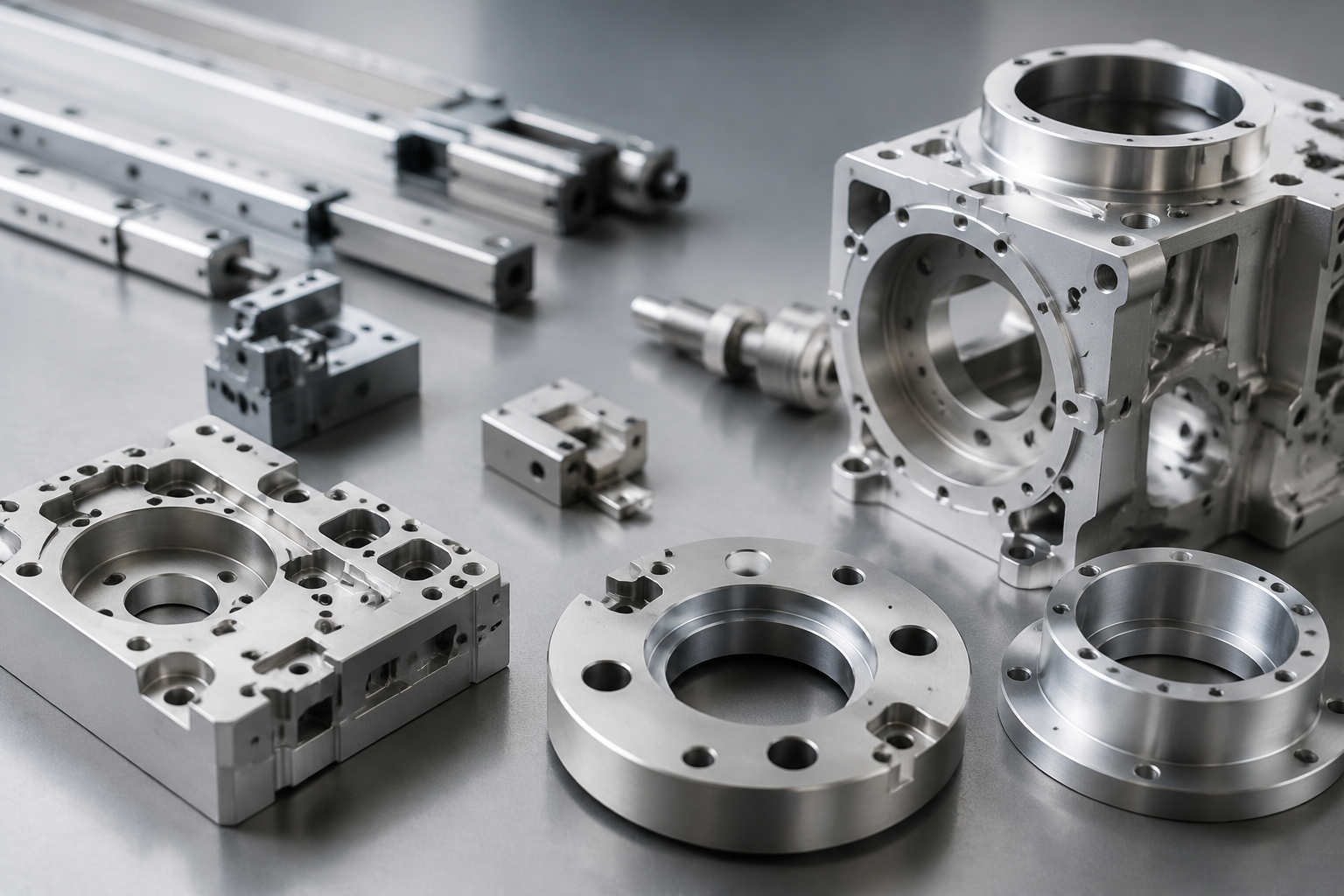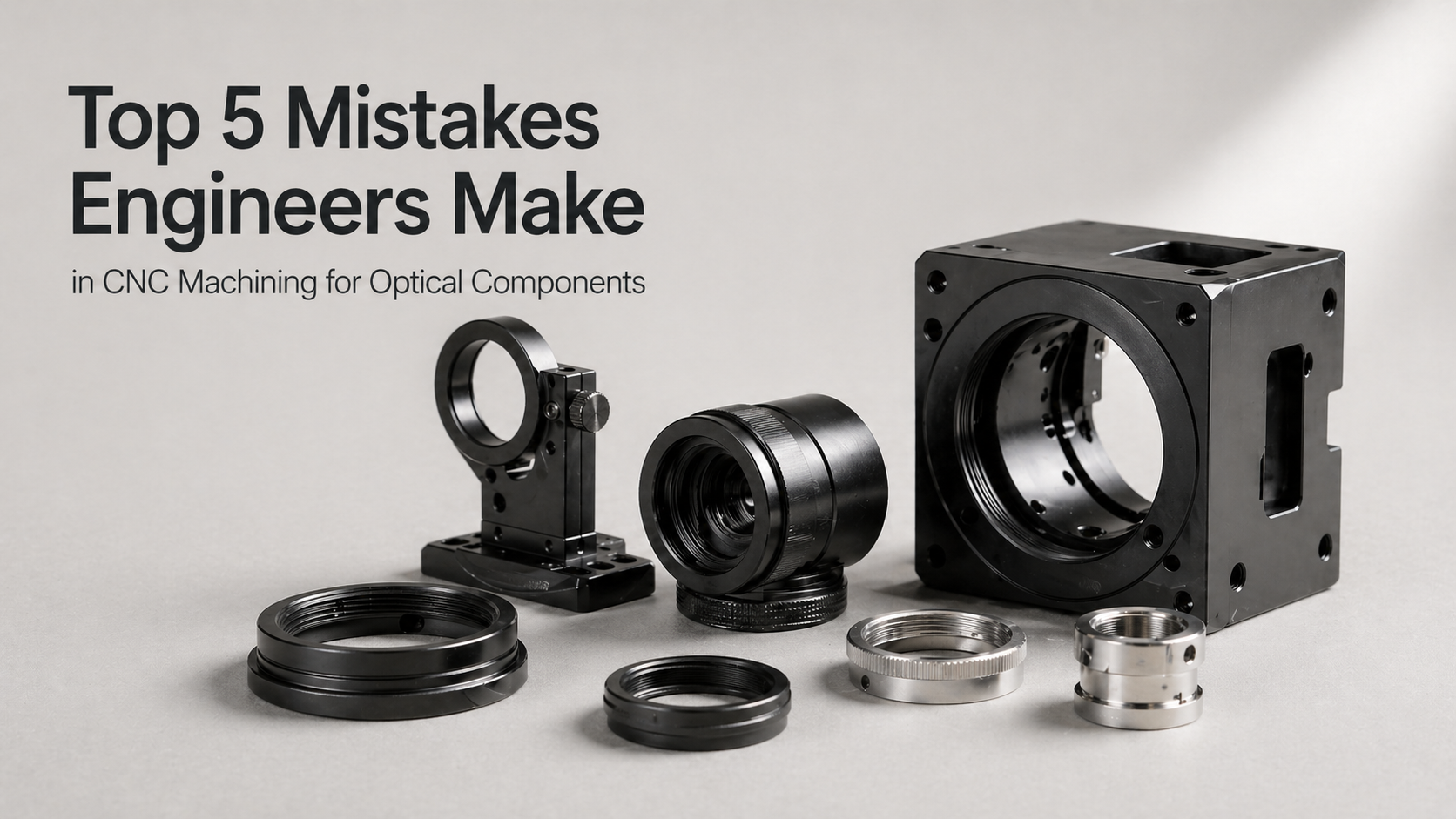
CNC machining has become a standard for manufacturing optical components due to its high precision, repeatability, and versatility. Components such as optical housings, lens barrels, and optical mounts require not only dimensional accuracy but also precise surface finishes and proper material selection. However, engineers frequently make mistakes that can compromise performance, assembly, and overall system reliability.
In this article, we explore the top 5 mistakes engineers commonly make when dealing with CNC machined optical components and provide practical solutions to avoid costly errors.

1. Ignoring Material Properties
Choosing the wrong material is one of the most common mistakes. Materials behave differently under thermal changes, mechanical stress, or chemical exposure. For instance, aluminum expands faster than stainless steel under temperature changes, which can cause misalignment in optical assemblies.
Similarly, selecting a material prone to corrosion may result in surface degradation over time, affecting light transmission and mechanical fit.
Solution: Engineers should carefully evaluate material properties, including thermal expansion, hardness, corrosion resistance, and machinability. Commonly used materials for optical components include aluminum, brass, and stainless steel. Each material must be selected according to its mechanical behavior and how it will interact with surface treatments, coatings, or assembly processes.
2. Neglecting Tolerance and Concentricity
Precision is critical in optical systems. A minor deviation in lens barrel concentricity or the placement of mounting holes can lead to misalignment, resulting in poor optical performance or assembly issues.
Engineers sometimes underestimate the importance of tolerances, assuming standard CNC machining will automatically produce acceptable results.
Solution: Clearly define tolerances in your CAD designs and use coordinate measuring machines (CMM) or other metrology tools to verify critical dimensions before mass production. Pay special attention to concentricity, flatness, perpendicularity, and positional tolerances on features that interact with lenses or mounting surfaces.
3. Overlooking Surface Finish Requirements
Surface finish plays a significant role in optical component performance. Rough surfaces can scatter light, interfere with lens alignment, or affect mechanical mating.
Many engineers assume a standard CNC finish is sufficient, but optical housings and mounts often require Ra ≤ 0.8 μm or better, especially on mating surfaces or internal bores.
Solution: Specify surface finish requirements explicitly for each critical surface. Communicate these requirements to the machining team and consider additional finishing processes like polishing, deburring, or anodizing. Ensuring consistent surface quality across batches is essential for repeatable optical performance.
4. Failing to Account for Post-Processing
Post-processing steps, including anodizing, powder coating, or blackening, can alter part dimensions slightly due to material growth or shrinkage. Engineers frequently overlook these changes, which may result in parts that no longer fit correctly into assemblies.
Solution: Include expected dimensional changes in CAD designs and factor them into tolerance allocations. Collaborate with finishing specialists to understand how coatings or treatments affect critical surfaces and plan for minor adjustments to maintain assembly precision.
5. Skipping Sample Validation
Assuming that the first batch of CNC machined parts will meet all specifications is a risky approach. Engineers sometimes bypass sample validation due to tight schedules or budget constraints. However, skipping this step can result in production errors, assembly issues, or functional failures.
Solution: Produce prototypes or small batches first, and thoroughly inspect them for dimensional accuracy, surface finish, and assembly compatibility. Functional testing should verify that components meet optical performance criteria. This proactive validation helps prevent costly rework and ensures smooth transition to full-scale production.
Conclusion
Designing and manufacturing CNC machined optical components demands attention to detail, precision, and collaboration across design, machining, and finishing processes.
By avoiding these common mistakes—ignoring material properties, neglecting tolerances, overlooking surface finish, failing to account for post-processing, and skipping sample validation—engineers can ensure that optical housings, lens barrels, and mounts perform reliably and assemble seamlessly.
Investing time in proper material selection, dimensional planning, and sample verification not only improves the quality of optical systems but also reduces production costs and avoids assembly delays.
Whether you are working on medical devices, imaging equipment, or industrial optical assemblies, these best practices are essential for achieving high-precision results.
Explore our precision CNC machined optical components, including optical housings, lens barrels, and mounts, for high-performance assemblies.


공유하다:
A Practical Guide to High Pressure Aluminum Die Casting: From Design to Mass Production
Precision Carbon Fiber CNC Machining and Cutting Services