


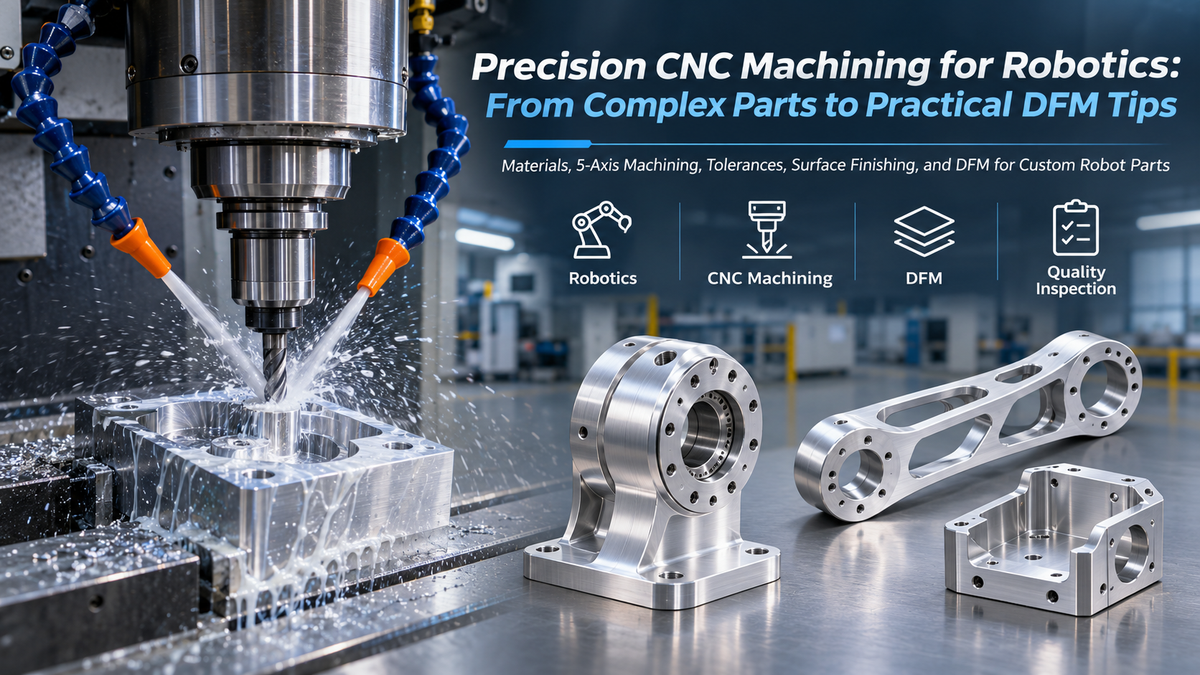
Imagine a robot joint that binds after assembly, or a mounting surface that throws off the alignment of the entire structure. These problems may start with a small machining error, but they rarely stay small. They can add extra assembly work, delay testing, and affect the robot's movement and repeatability.
For robotics components, precision CNC machining is about more than meeting the dimensions on a drawing. Each part needs to fit properly with bearings, shafts, motors, gearboxes, and other mechanical components. It also needs to maintain its performance under repeated movement and changing loads.
In this guide, we'll look at common CNC machined robot parts, suitable machining processes, material options, design considerations, and what to look for when choosing a CNC machining supplier.

Key Takeaways
-
Common Robot Parts: CNC machining is widely used for robot joints, arm links, bearing housings, shafts, grippers, sensor mounts, and mobile robot components.
-
Machining Processes: 3-axis, 4-axis, and 5-axis milling, CNC turning, wire EDM, and precision grinding are used for different part geometries and requirements.
-
Material Selection: Aluminum, stainless steel, alloy steel, titanium, and engineering plastics are common choices for robotic components.
-
Precision & DFM: Functional tolerances, alignment, wall thickness, tool access, and assembly requirements should be considered before production.
-
Quality Control: CMM inspection, dimensional reports, and material documentation help verify part quality and consistency.
-
Production Support: A capable machining partner should support projects from prototypes and design changes to repeat and volume production.
Why Precision CNC Machining Matters in Robotics?
Robotic and automation systems contain many moving parts that need to work together. Bearings, shafts, motors, gearbox housings, sensors, and structural components all rely on accurate dimensions and proper alignment.
Unlike some static mechanical products, robot components keep moving. They face repeated motion, acceleration, vibration, and changing loads. So performance depends not only on whether each part matches the drawing, but also on how well the parts fit and work together after assembly.
For example, a robot joint housing needs accurate bearing seats, motor interfaces, and locating features. If these features are not aligned, the joint may run with extra friction, vibration, or uneven wear. Over time, that can affect positioning consistency, repeatability, and component life.
Precision CNC machining helps prevent these problems by controlling the features that matter most: bearing bores, mounting faces, datum surfaces, locating holes, and mating interfaces. It turns design intent into parts that assemble predictably—and perform predictably.
Weight is another important factor. Robot arms, cobots, and mobile robots need lightweight structures without losing stiffness. CNC machining makes it possible to add pockets, ribs, thin walls, and complex geometries while keeping material where structural support is needed.

Common CNC Machined Parts Used in Robotics
CNC machining is used in many areas of robotic systems. The part design and machining requirements depend on its position and function.
| Robot Components | Typical CNC Machined Parts | Key Manufacturing Requirements |
| Robot Arms & Joints | Joint housings, arm links, actuator mounts, bearing carriers | Alignment, stiffness, dimensional accuracy |
| Motion & Drive Systems | Shafts, couplings, spacers, bearing sleeves, motor housings | Concentricity, roundness, fit, surface finish |
| End Effectors & Grippers | Gripper fingers, jaws, mounting plates, tool adapters | Repeatability, dimensional consistency |
| Mobile Robots & AMRs | Chassis plates, wheel hubs, motor brackets, suspension mounts | Load capacity, structural strength, alignment |
| Sensor & Vision Systems | Camera brackets, LiDAR mounts, sensor housings | Mounting accuracy, stability, positioning |
Robot Arms and Joint Components
Robot arms need to be strong enough to carry loads while remaining lightweight. Their joints also require accurate interfaces for bearings, motors, and reducers.
Common CNC machined parts include arm links, joint housings, bearing carriers, and actuator mounting plates. Aluminum alloys are often used for structural components because of their low weight and good machinability.
For these parts, machining accuracy, flatness, concentricity, and stiffness all matter. The relationship between different mounting surfaces can be just as important as the dimensions themselves.
Motion and Drive Components
Shafts, pins, couplings, bushings, and bearing sleeves are common parts in robotic motion systems.
These components transfer force and support rotational movement. Their diameters, runout, surface finish, and fit with other components need to be properly controlled.
CNC turning is often suitable for cylindrical parts, while milling and grinding may be needed for additional features or tighter surface requirements.
End Effectors and Gripper Components
End effectors are the parts that interact directly with objects. They may be used for gripping, picking, placing, assembling, or handling products.
Custom gripper fingers, jaws, mounting plates, and tool adapters are often CNC machined to match a specific application.
Some designs need lightweight structures, while others require wear resistance or precise contact surfaces. The material and machining process should be selected according to the actual working conditions.
Mobile Robots and AMR Components
Autonomous mobile robots rely on a stable mechanical structure to support their drive systems, sensors, and payloads.
CNC machined components may include chassis plates, wheel hubs, motor mounting brackets, suspension components, and sensor supports.
For these parts, dimensional accuracy is important, but structural stiffness and mounting alignment should not be overlooked. A poorly positioned motor mount or wheel assembly can affect the movement of the complete vehicle.
CNC Machining Processes Used for Robotics Parts
Different robotic components require different machining methods. A simple mounting plate does not need the same process as a complex joint housing or precision shaft.
Choosing the right process helps control cost, machining time, and dimensional accuracy.
3-Axis CNC Milling
3-axis milling is commonly used for flat and prismatic components, such as mounting plates, brackets, covers, and basic housings.
The cutting tool moves along the X, Y, and Z axes. It works well for parts with accessible surfaces, pockets, slots, and drilled holes.
For relatively simple robot components, 3-axis machining is often the most economical choice.
4-Axis CNC Milling
4-axis machining adds a rotary axis, allowing the workpiece to rotate during machining.
This is useful for components that require machining on multiple sides or around a cylindrical surface. It can reduce manual repositioning and help maintain the relationship between different features.
Typical applications include mechanical housings, mounting components, and parts with holes or features distributed around an axis.
5-Axis CNC Machining
Some complex robotic components have angled surfaces, curved profiles, deep cavities, or multiple mounting faces, so it's better to use 5-axis cnc machining to save time and improve efficiency wihtout fewer setups by apporaching the part from different directions.
At XY-GLOBAL, we have 3+2 Axis Machining and Simultaneous 5-Axis Machining. The former is useful for multi-face machining, angled holes, and components with several mounting surfaces and the latter is especially useful for complex curved surfaces, compound angles, and geometries that require continuous tool movement.
For robotics applications, 5-axis machining is particularly useful for joint housings, complex actuator interfaces, lightweight arm structures, and custom components with multiple functional surfaces.
However, 5-axis cnc machining is not automatically the best choice for every part. Simple brackets and flat plates may still be more economical on a 3-axis machine. The right process depends on the geometry, tolerances, and production requirements.
CNC Turning and Mill-Turn Machining
CNC turning is commonly used for cylindrical robotic components such as shafts, pins, bushings, sleeves, spacers, and wheel hubs.
The workpiece rotates while the cutting tool removes material to achieve the required diameter, length, grooves, and other features.
For parts that also require cross-holes, slots, flats, or threaded features, live-tooling and mill-turn machining can combine turning and milling operations. This can reduce the number of setups and improve production efficiency.
Wire EDM and Precision Grinding
Some robotic components have narrow slots, internal profiles, or detailed features that are difficult to produce with conventional milling. Wire-cut EDM can be used to create these features with high dimensional accuracy. It is particularly useful for conductive materials and certain hardened components.
Precision grinding is another important process, especially for shafts, bearing surfaces, and components requiring controlled diameter, roundness, or surface finish.
In many cases, grinding is used after heat treatment or turning to achieve the final dimensions and surface quality.
Drilling, boring, reaming, and tapping are also common supporting operations for creating accurate holes, threads, and assembly interfaces.
Materials Used in Precision CNC Machining for Robotics
Material selection affects more than the strength of a robotic component. It also influences weight, stiffness, machining cost, wear resistance, and service life.
There is no single material that works best for every robotic application. The choice depends on the part's function and operating conditions.
| Material | Common Grades | Typical Applications | Main Advantages |
| Aluminum | 6061-T6, 6082, 7075-T6 | Robot arms, brackets, housings, chassis | Lightweight, good machinability |
| Stainless Steel | 304, 316L, 17-4PH | Shafts, connectors, structural parts | Strength, corrosion resistance |
| Alloy Steel | 4140, 4340 | Drive shafts, pins, load-bearing parts | Strength, toughness, wear resistance |
| Titanium | Grade 5 / Ti-6Al-4V | Lightweight structural and high-performance parts | High strength-to-weight ratio |
| Copper & Brass | C110, C360 | Electrical and functional components | Conductivity, machinability |
| Engineering Plastics | POM, PEEK, Nylon, PTFE | Bushings, guides, insulators, lightweight components | Low weight, low friction, electrical insulation |
Aluminum Alloys
Aluminum is widely used in robotics because it offers a good balance between weight, strength, and machinability.
6061-T6 is a common choice for robot frames, brackets, housings, and mounting plates. It is relatively easy to machine and offers good corrosion resistance.
7075-T6 provides higher strength and is suitable for more demanding structural components, such as highly loaded joints and arm links. However, material cost and machining behavior should also be considered.
Stainless Steel and Alloy Steel
Stainless steel is useful when corrosion resistance and mechanical strength are important. Grades such as 304 and 316L are commonly used for industrial components exposed to moisture or demanding environments.
17-4PH offers higher strength and is suitable for certain precision mechanical components.
Alloy steels such as 4140 and 4340 are often selected for shafts, pins, and other parts exposed to higher mechanical loads or wear. Heat treatment may be required depending on the application.
Titanium and Engineering Plastics
Titanium Grade 5 is suitable for applications that require high strength with relatively low weight. However, its higher material and machining costs mean it should be used where its properties are actually needed.
Engineering plastics such as POM, PEEK, and Nylon are also used in robotic systems. They are suitable for certain bushings, guides, rollers, and insulating components.
Think of material selection as a balance between performance and cost. Using a higher-grade material does not automatically make a component better if the application does not require its properties.
Design Considerations and DFM for CNC Machined Robot Parts
A part may look perfectly designed in CAD, but that does not always mean it is easy or economical to manufacture.
A proper DFM review can identify machining difficulties early and help avoid unnecessary costs, delays, and design changes.
Functional Tolerances and GD&T
Not every dimension on a robotic component needs an extremely tight tolerance.
For example, bearing seats, shaft fits, dowel holes, and actuator mounting interfaces may require tighter control because they directly affect alignment and movement. Other external dimensions may have more flexible tolerances.
It's important to identify these critical features clearly in the engineering drawing.
GD&T requirements such as flatness, parallelism, perpendicularity, position, and concentricity help define how different features relate to each other.
Another point worth considering is tolerance stack-up. A robot joint may contain several connected components. Even if each part meets its individual dimensions, accumulated tolerances can still affect the final assembly.
The machining supplier should understand which features are functionally related, rather than simply checking each dimension separately.
Wall Thickness and Structural Stiffness
Lightweight design is common in robotics, especially for robot arms and mobile platforms. However, removing too much material can make a component less rigid.
Thin walls, deep pockets, and long unsupported sections may cause vibration or deformation during machining. They can also affect the part's stiffness during operation.
Adding ribs, adjusting wall thickness, or changing the pocket layout may improve both manufacturability and structural performance.
Tool Access and Internal Corners
Deep, narrow pockets and sharp internal corners can make machining more difficult.
CNC cutting tools have physical limits. If an internal corner is designed with a radius that is too small, special tools or additional machining operations may be required.
Using practical corner radii and standard hole sizes can simplify machining and reduce tool changes.
For complex components, 5-axis machining may improve tool access and reduce the need for multiple setups.
Assembly and Surface Treatment Requirements
Mounting holes, bearing seats, threads, and locating features should be considered together with the final assembly process.
Surface treatment also needs to be included in the design stage. Anodizing, plating, and other coatings can change final dimensions. Critical holes, bearing fits, and mating surfaces may need machining allowances or masking.
Here’s the thing: a component can meet its machining dimensions before finishing but still fail to fit properly after coating if these changes are not considered.
A good DFM review should therefore cover the complete manufacturing route, from raw material to final inspection.
Surface Finishing for CNC Machined Robotics Components
Surface finishing is not just about appearance. It can affect corrosion resistance, wear, friction, electrical conductivity, and dimensional fit.
Different robotic components have different requirements.
| Surface Finish | Typical Application |
| Anodizing | Aluminum housings, brackets, and structural parts |
| Hard Anodizing | Aluminum parts requiring improved wear resistance |
| Bead Blasting | Uniform matte appearance and surface preparation |
| Electroless Nickel Plating | Components requiring wear and corrosion resistance |
| Passivation | Stainless steel components |
| Electropolishing | Stainless steel parts requiring improved surface smoothness and cleanliness |
| Powder Coating | Protective and decorative treatment for structural components |
| Polishing | Components requiring smoother surfaces or improved appearance |
The finish should be selected according to the material, working environment, and functional requirements. For precision interfaces, coating thickness and dimensional changes must be considered before machining is completed.
Quality Control and Inspection for Robot Parts
Quality inspection is especially important for components that connect moving parts.
A shaft may meet its diameter requirement but still have excessive runout. A housing may pass a basic dimensional check but have a position error between two bearing seats.
This is why inspection should focus on functional features as well as general dimensions.
Common inspection methods include:
-
CMM Inspection: Used to measure critical dimensions, hole positions, flatness, and geometric relationships.
-
3D Scanning: Useful for checking complex surfaces and comparing manufactured parts with CAD models.
-
In-Process Inspection: Helps identify dimensional deviations during machining rather than waiting until final inspection.
-
First Article Inspection (FAI): Verifies that the first production part meets drawing requirements.
-
Surface Roughness Measurement: Checks the surface quality of bearing interfaces, sliding surfaces, and other functional areas.
For projects with stricter quality requirements, buyers may also request material certificates, batch traceability records, and detailed inspection reports.
The inspection plan should be agreed upon before production. This helps ensure that the supplier and customer are working to the same quality requirements.
How to Choose a CNC Machining Supplier for Robotics
Choosing a machining supplier is not just about comparing quotations. The supplier needs to understand the part's function, select a suitable manufacturing process, and maintain quality throughout production.
A few areas deserve particular attention.
Engineering and DFM Support
A good supplier should be able to review 2D drawings and 3D models, identify potential manufacturing problems, and provide practical suggestions. This is especially important for complex joint housings, multi-face components, and lightweight structures.
Actual Machining Capabilities
Check the supplier's available equipment and manufacturing processes. Having 5-axis machines is useful, but the supplier should also know when 3-axis, 4-axis, turning, EDM, or grinding is more suitable.
Inspection and Quality Documentation
Ask how critical dimensions are measured and whether CMM reports, FAI documents, and material records can be provided. A supplier should be able to explain how quality is verified, not just promise that every part will be accurate.
Prototype and Production Flexibility
Robotics projects often go through several design revisions before reaching production. The supplier should be able to support single-piece prototypes, small validation batches, and repeat production without creating unnecessary barriers.
Communication and Confidentiality
Clear communication matters throughout the project. Drawing revisions, material changes, surface treatment requirements, and delivery schedules should be properly confirmed. If your project involves confidential designs, NDA support is also important.
A reliable machining partner should be able to support the project beyond the first quotation and help maintain consistency as the design develops.
XY-GLOBAL Precision CNC Machining Services for Robotics
Founded in 2010, XY-GLOBAL provides custom CNC machining services for robotics, automation, and other precision engineering applications from a wide range of materials, from initial drawing review and prototyping to repeat production and volume manufacturing.
Our CNC capabilities include 3-axis, 4-axis, and 5-axis milling, CNC turning, wire-cut EDM, and precision grinding. Depending on the part geometry and functional requirements, we can select a suitable process or combine multiple operations. And we provide various surface finishing options, from anodizing to powder coating.
For suitable parts, selected critical features can be machined to tolerances down to ±0.005 mm. CMM inspection and 3D scanning are also available for critical dimensional verification.
More importantly, our engineering support starts before machining. Our team can review your drawings and 3D models, evaluate tolerances and machining access, and provide free DFM feedback on material selection, process planning, and manufacturing feasibility.
Have a new robotics project or need a reliable source for custom precision components?
Send your 2D drawings or 3D models to XY-GLOBAL. Our team can review your design, provide DFM feedback, and help you find the right machining process for your parts.
From your first prototype to repeat production, let's make your next robotics project easier to manufacture.
Frequently Asked Questions About CNC Machining for Robotics
1. Do you accept one-piece CNC machining orders for robotics prototypes?
Yes. We support single-piece prototypes and small-batch orders without a strict minimum order quantity. This allows engineering teams to test part fit, function, and assembly before committing to larger production volumes.
2. How long does it take to produce CNC machined robot prototypes?
Simple CNC prototypes can be produced in as little as one day. For suitable 5-axis machining projects, the machining lead time can start from around three days.
However, the actual schedule depends on part geometry, material availability, machining complexity, surface finishing, and inspection requirements. A confirmed lead time can be provided after drawing review.
3. Can you achieve tight tolerances for robotic components?
Yes. For suitable 5-axis machined parts, selected critical features can reach ±0.005 mm. Precision turning can also achieve tight diameter and roundness tolerances on suitable components.
The achievable tolerance depends on the material, part geometry, feature size, machining process, and inspection method. We recommend identifying critical dimensions clearly in your drawings.
4. Can you provide CMM reports and material certificates?
Yes. CMM inspection, 3D scanning, and dimensional inspection documentation can be arranged according to project requirements.
If you need FAI reports, material certificates, or batch traceability records, please include these requirements when requesting a quotation. This allows the inspection and documentation plan to be confirmed before production.
5. Can you sign an NDA before receiving our drawings?
Yes. We support NDA and confidentiality agreements. If your robot design or project information is confidential, we can arrange an NDA before reviewing your drawings and 3D models.

공유하다:
What Is PVD Coating? Process, Benefits, and Applications
Custom Metal Parts Manufacturing Services for OEMs: Processes, Materials, and Quality Control