


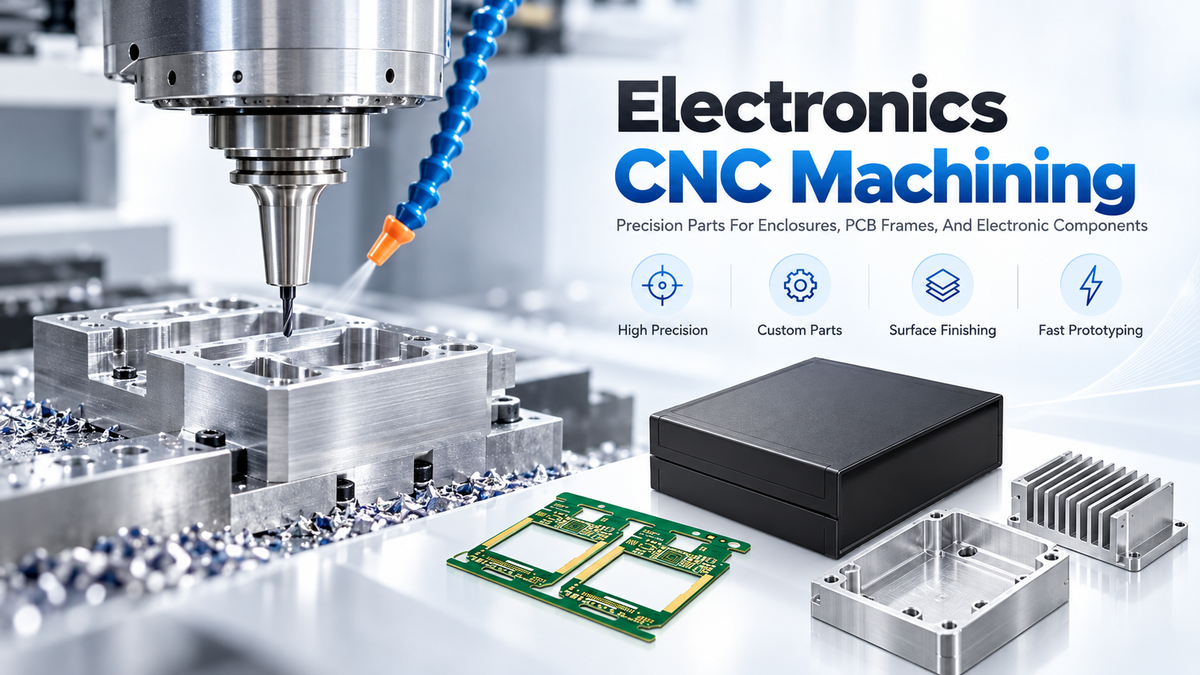
Imagine receiving a batch of aluminum electronic housings that looks perfect at first glance. The dimensions are technically within tolerance, but the PCB mounting holes do not line up correctly. The heat sink base is not flat enough. Anodizing covers the grounding area. Or a connector opening shifts just enough to create stress during assembly.
None of these problems sounds dramatic on a drawing. In an assembled electronic product, however, a small mechanical error can become a thermal, electrical, cosmetic, or reliability problem.
That is why electronics CNC machining involves much more than simply cutting metal to size.
Electronic parts often combine thin walls, small holes, tight positional tolerances, cosmetic surfaces, thermal interfaces, EMI shielding requirements, and multiple assembly features in one compact component. A successful machining process must consider all of them together.
This guide explains how CNC machining is used in the electronics industry, which materials and processes are commonly selected, what engineers should consider during design, and how custom electronic parts can move from prototype to stable production.
What Is Electronics CNC Machining?
Electronics CNC machining refers to the use of CNC milling, turning, drilling, and related processes to manufacture mechanical parts used in electronic equipment.
These parts normally support, protect, cool, position, or connect electronic assemblies rather than forming the electronic circuit itself.
Typical examples include aluminum enclosures, heat sinks, RF and microwave housings, PCB support structures, sensor housings, connector parts, thermal plates, semiconductor fixtures, and test equipment components.
What makes electronics machining different from general CNC work is the number of functional requirements concentrated in a relatively small part. A machined housing may need to maintain connector position, PCB alignment, heat transfer, shielding continuity, and appearance at the same time.
Why CNC Machining Is Widely Used in Electronics?
CNC machining is particularly suitable for electronics because it combines precision with design flexibility.
Electronic products often change several times before the design is finalized. PCB layouts change, connectors move, cooling requirements increase, or the housing needs to become smaller. CNC machining allows these changes to be implemented without modifying expensive production tooling.
It is also well suited to components with complex geometry. An aluminum housing, for example, may contain large internal pockets, threaded bosses, sealing grooves, connector openings, and precision mating surfaces. These features can often be produced from one solid workpiece.
Another advantage is material flexibility. Aluminum is common for enclosures and heat sinks, while copper is often used for thermal or electrical conductivity. Stainless steel may be selected for stronger or corrosion-resistant components, and engineering plastics are useful where insulation is required.
For this reason, CNC machining for electronics is used across product development, low-volume production, specialized equipment, and applications where dimensional accuracy is more important than the lowest possible unit cost.
Common CNC Machined Parts for Electronics
The type of machined part depends heavily on the final application.
Electronic Enclosures and Housings
Machined enclosures are widely used for industrial electronics, communication equipment, sensors, controllers, medical devices, and high-end consumer products.
Although an enclosure may look simple, it often combines several functions. It may hold the PCB, position connectors, protect internal components, assist with heat dissipation, and provide part of the EMI shielding structure.
Machining these parts can become difficult when large internal pockets leave thin outer walls. Connector positions also need to match the PCB accurately, while visible external surfaces may require consistent bead blasting or anodizing.

Heat Sinks and Thermal Components
Heat sinks, thermal plates, heat spreaders, and cold plates are another important group of CNC machined electronic parts.
Aluminum is commonly used because it offers a practical combination of thermal conductivity, low weight, and machinability. Copper is selected when higher thermal performance is needed.
The machining quality of a thermal component is not only determined by fin geometry. Flatness and surface condition at the contact interface can also affect heat transfer. If the base is distorted or uneven, the actual contact area between the component and the heat sink may be reduced.
For this reason, thermal parts often require closer control of base flatness, fin thickness, mounting-hole location, and surface finish.
RF and Microwave Housings
RF housings require good dimensional control because cavity geometry, connector alignment, and conductive contact surfaces can affect the final system.
Surface treatment also needs more attention than on a general mechanical part. If an aluminum housing is fully anodized, the insulating oxide layer may interfere with grounding or shielding at specific contact areas.
These requirements should therefore be considered before machining and finishing are separated into two independent steps.
PCB Frames and Mounting Components
PCB frames, mounting plates, and internal support parts are usually simple in appearance but can be sensitive to positional error.
The relationship between mounting holes, locating features, connector openings, and reference surfaces often matters more than the tolerance of a single dimension.
A part can pass individual measurements and still create assembly stress if the datum structure has not been defined properly.

Connector and Conductive Components
Copper and brass are often machined for terminals, connector bodies, grounding parts, conductive blocks, and thermal components.
Copper offers excellent electrical and thermal conductivity, but it can be more difficult to machine cleanly than aluminum. Burr control becomes especially important around small holes, slots, and contact surfaces.
Brass is generally easier to machine and is widely used for smaller connector and threaded components.
Electronics Industries That Use CNC Machining
Electronics CNC machining is used across many sectors, including consumer electronics, telecommunications, semiconductor equipment, industrial automation, medical electronics, robotics, automotive electronics, optical systems, and data-center hardware.
The parts may be different, but the manufacturing concerns are often similar. Engineers need stable dimensions, reliable assembly, controlled surface finishing, and repeatable quality from one batch to the next.
| Industry | Common CNC Machined Components |
| Consumer electronics | Housings, frames, brackets, thermal parts |
| Telecommunications | RF housings, antenna parts, heat sinks |
| Semiconductor equipment | Fixtures, mounts, frames, precision plates |
| Industrial electronics | Control housings, sensor mounts, panels |
| Medical electronics | Instrument housings, brackets, support structures |
| Robotics | Controller housings, sensor mounts, electronic brackets |
| EV and automotive | Power electronics housings, cooling plates |
| Optical electronics | Camera housings, sensor mounts, optical-electronic structures |
CNC Machining Processes Used for Electronic Parts
CNC Milling
CNC milling is the most common process for electronic enclosures, heat sinks, frames, plates, and fixtures.
3-axis machining is sufficient for many parts, while 4-axis and 5-axis machining are useful when a component has features on several sides or contains geometry that would otherwise require repeated setups.
Reducing the number of setups can also help maintain the relationship between critical features.
CNC Turning
Turning is typically used for cylindrical components such as connector bodies, sleeves, threaded parts, spacers, pins, and sensor housings.
For more complex parts, turn-mill machining can combine turned diameters with milled holes, flats, or slots.
Drilling, Reaming, and Tapping
Electronic components often contain many holes, but they do not all require the same process.
General clearance holes may only need drilling. Locating holes may require reaming, while tighter bores may need precision boring. Threaded holes also need to be designed with suitable engagement depth rather than simply made as deep as possible.
EDM
Wire EDM and sinker EDM can be used for narrow features, hard materials, or geometry that is difficult to reach with conventional cutting tools.
They are normally used as supplementary processes rather than the main method for electronic housings.
Materials for Electronics CNC Machining
Material selection should be based on the electrical, thermal, mechanical, and environmental requirements of the part.
Aluminum
Aluminum is one of the most widely used materials in electronics precision machining.
6061 is common for enclosures, frames, brackets, and heat sinks because it machines well and offers good corrosion resistance, low weight, and useful thermal conductivity.
7075 is used when higher strength is required, although it is normally selected more for structural performance than thermal applications.
Aluminum also works well with anodizing, chemical conversion coating, painting, and other common finishes.
Copper
Copper is mainly selected when thermal or electrical conductivity is important.
It is used for heat spreaders, cooling components, busbars, grounding parts, and some RF components.
Its machining behavior can be challenging because softer copper grades may smear or create burrs if tooling and cutting conditions are not well controlled.
Brass
Brass provides a useful balance between conductivity and machinability.
It is often used for connectors, terminals, threaded inserts, and small precision components.
Stainless Steel
Stainless steel is more suitable when strength, wear resistance, or corrosion resistance is more important than weight.
304 and 316 are common choices for industrial and medical electronic equipment.
Compared with aluminum, stainless steel usually requires more machining time and places greater demands on tooling.
Engineering Plastics
Engineering plastics are used when electrical insulation, low weight, chemical resistance, or dielectric separation is required.
POM, PEEK, PTFE, and polycarbonate are common examples.
These materials behave differently from metals during machining. Heat buildup and excessive clamping pressure can cause distortion, so tooling, cooling, and fixturing need to be adjusted accordingly.
Other Materials
Titanium alloys and industrial ceramics are also used in specialized electronic applications. Titanium provides high strength, low weight, and corrosion resistance, while ceramics such as alumina and aluminum nitride offer electrical insulation, high-temperature resistance, and useful thermal properties. They are commonly found in semiconductor equipment, medical electronics, aerospace systems, and other demanding applications.
| Material | Main Advantage | Typical Application |
| Aluminum 6061 | Good machinability and thermal performance | Enclosures, heat sinks, frames |
| Aluminum 7075 | Higher strength | Structural parts |
| Copper | High thermal and electrical conductivity | Heat spreaders, busbars |
| Brass | Good machinability and conductivity | Connectors, terminals |
| Stainless steel | Strength and corrosion resistance | Industrial and medical hardware |
| POM / PEEK / PTFE | Insulation and special material properties | Supports, fixtures, insulating parts |
| Titanium / Industrial Ceramics | High strength, insulation, heat and corrosion resistance | Semiconductor, medical, aerospace, and high-performance electronics |
Design Considerations for CNC Machined Electronic Parts
Good DFM for electronic hardware is mainly about identifying which features actually affect the final product.
Use Tight Tolerances Where They Are Needed
Applying a very tight tolerance to every dimension increases machining and inspection cost without necessarily improving the product.
Critical features may include connector locations, locating holes, sealing surfaces, thermal interfaces, or precision fits. Less important pockets and exterior features can usually use more practical general tolerances.
The drawing should make this distinction clear.
Build Dimensions Around Functional Datums
Datum selection is especially important when a housing contains a PCB, connectors, covers, or several mating parts.
If related features are dimensioned from unrelated edges, tolerance stack-up can create an assembly problem even when every individual dimension is within specification.
Dimensions should reflect how the component is located and assembled in the real product.
Avoid Unnecessarily Thin Walls
Lightweight electronic housings often use large pockets and relatively thin walls.
As material is removed, the remaining structure becomes less rigid. Cutting forces and clamping pressure can then cause chatter, taper, or distortion.
The risk becomes higher when the wall is tall, unsupported, or combined with large amounts of material removal.
If thin walls are required, the machining strategy may need staged roughing and finishing, lower clamping force, or dedicated fixturing.
Use Practical Internal Corner Radii
Small internal radii require small cutting tools.
Small cutters are less rigid and become even more difficult to use in deep pockets. This increases machining time and can reduce surface quality.
If a mating part does not require a sharp corner, a larger radius normally makes the feature easier and more stable to machine.
Consider the Final Surface Treatment During Design
Surface treatment can change dimensions and functional behavior.
Anodizing, plating, powder coating, and painting all affect the finished surface to some extent. Threads, bores, fits, grounding surfaces, and connector interfaces may therefore require masking or allowance.
The drawing should also make clear whether critical dimensions apply before or after finishing.
Pay Attention to Thermal Contact Surfaces
For heat sinks, thermal plates, and cooling components, contact surfaces deserve separate consideration.
Flatness and surface finish should match the actual thermal requirement rather than being specified arbitrarily. Excessive flatness requirements increase machining cost, while insufficient control can reduce thermal contact.
Define Grounding and EMI Contact Areas Early
Anodized aluminum is electrically insulating.
If a machined enclosure also needs to provide grounding or EMI shielding continuity, conductive contact areas should be identified during design.
Depending on the application, these areas may use masking, chemical conversion coating, bare metal, electroless nickel, or another conductive finish.
This is easier to control when the electrical and mechanical requirements are defined together.
Separate Cosmetic and Functional Surfaces
Visible surfaces often require more careful handling than internal areas.
If the entire part is treated as a Class-A cosmetic surface, unnecessary handling and inspection costs can be added.
Marking visible areas clearly on the drawing allows the manufacturer to focus cosmetic control where it actually matters.
Custom CNC Machining Components for Electronics Industry
Many electronic products require custom mechanical parts built around a specific PCB layout, connector position, thermal design, or enclosure structure. CNC machining makes it possible to customize the material, geometry, tolerance, surface finish, mounting features, and cosmetic appearance according to the actual product requirements.
For example, a custom aluminum enclosure may include PCB mounting bosses, connector openings, heat-dissipation surfaces, threaded holes, laser marking, and selected grounding areas that need masking during anodizing. These requirements should be considered together during DFM review so that the finished part works correctly after machining, surface treatment, and assembly.
Common Machining Challenges in Electronic Parts
Thin-Wall Distortion
Large internal pockets are common in aluminum housings, but they can leave the remaining walls too flexible.
The part may move during cutting or change shape after unclamping. This can affect wall thickness, flatness, and the position of nearby features.
Machining sequence and fixturing therefore matter as much as the nominal wall thickness.
Connector and Mounting Misalignment
Electronic assemblies often contain several parts that must align at the same time.
If PCB holes, connector openings, and housing datums are not controlled from a consistent reference system, stack-up error can cause difficult assembly or place stress on connectors.
GD&T and a clear datum strategy are often more useful than simply tightening every linear dimension.
Burrs Around Small Features
Small holes, slots, and connector openings can leave burrs that interfere with assembly or damage wires and nearby components.
Burr control is especially important on copper, brass, and small precision features.
Deburring should remove sharp edges without changing critical dimensions.
Flatness Loss on Thermal Surfaces
Heat sinks and thermal plates can distort during heavy material removal.
If the thermal interface loses flatness, the final component may not contact the heat source evenly.
The manufacturing process may therefore include staged machining or final finishing of the contact surface after major material removal is complete.
Surface Finish Affecting Electrical Contact
Coatings can create problems when they cover a grounding or conductive contact area.
This is particularly common with anodized aluminum housings.
Masking and finish specifications should clearly identify which areas need electrical conductivity.
Cosmetic Variation
Visible electronic parts may show differences in color, texture, machining marks, or blasting appearance between batches.
These differences are not always dimensional defects, but they can still be unacceptable for consumer-facing products.
Consistent raw material, surface preparation, finishing, handling, and visual inspection all contribute to better cosmetic consistency.
CNC Machining vs Other Manufacturing Methods for Electronics
CNC machining is not the best manufacturing method for every electronic part, especially at very high volumes.
| Process | Suitable Applications | Main Advantage | Main Limitation |
| CNC machining | Precision housings, prototypes, low-medium volume | High flexibility and accuracy | Higher unit cost at very high volume |
| Die casting | Higher-volume metal housings | Good cost efficiency at scale | Tooling investment |
| Sheet metal | Panels, chassis, cabinets | Efficient for thin structures | Limited solid geometry |
| Injection molding | Plastic housings | Low cost at high volume | Mold cost and design restrictions |
| 3D printing | Early prototypes, complex low-volume parts | Fast design changes | Material and finish limitations |
CNC machining is usually preferred when the part has precision interfaces, the design may still change, production volume does not justify dedicated tooling, or the geometry is difficult to achieve through forming or molding.
For higher-volume products, CNC machining can also be combined with die casting or other processes. A cast housing may still require CNC finishing on connector locations, sealing surfaces, threads, or other critical features.
Electronics CNC Machining at XY-GLOBAL
At XY-GLOBAL, we support precision electronic components from prototype development through production. As a one-stop manufacturing partner certified to ISO 9001 and ISO 13485, we provide DFM support together with CNC milling, turning, 5-axis machining, secondary machining, die casting, surface finishing, and assembly services.
Our capabilities cover aluminum, stainless steel, copper, brass, engineering plastics, and other materials commonly used in electronic hardware. Finishing options include anodizing, plating, bead blasting, laser marking, painting, and other project-specific treatments. We also use CMMs and other precision inspection equipment to verify critical dimensions, hole positions, flatness, mating features, and other CTQ requirements.
More importantly, electronic parts are not treated as standard CNC components. Our engineering team reviews factors such as thin-wall stability, connector and PCB alignment, thermal contact surfaces, grounding areas, coating allowance, and cosmetic requirements before production.
Send us your 2D drawing, 3D model, material, quantity, and surface-finish requirements. We can review the project, provide DFM feedback, and prepare a quotation based on your actual application.
Conclusion
Electronics CNC machining is used where mechanical accuracy directly affects how an electronic product fits, cools, seals, connects, or performs.
The main challenge is usually not one difficult feature. It is the interaction between geometry, tolerance, material, finishing, and assembly requirements within the same part.
Good results therefore depend on reviewing these requirements together before machining begins, especially for thin-wall housings, thermal components, RF enclosures, and parts with critical connector or PCB interfaces.
For custom electronic hardware, CNC machining remains one of the most flexible ways to produce accurate components while keeping design changes, material options, and surface-finishing requirements under control.
FAQs About Electronics CNC Machining
1. Can thin-wall electronic housings be machined without distortion?
Yes, but the machining sequence, fixture design, and wall thickness need to be considered carefully. Large pockets and thin walls are more likely to deform during or after machining.
2. Can CNC machined parts meet both cosmetic and functional requirements?
Yes. Visible surfaces can be controlled for appearance while critical areas such as grounding surfaces, thermal interfaces, and precision fits are handled according to their functional requirements.
3. Can you machine electronic parts with both metal and plastic components?
Yes. Aluminum, copper, stainless steel, brass, and engineering plastics are all commonly used in electronic assemblies, depending on thermal, electrical, and mechanical requirements.
4. How do you keep production batches consistent?
Consistency depends on stable machining parameters, controlled fixtures, inspection of critical dimensions, and consistent surface-finishing standards. For cosmetic parts, approved samples can also be used as a reference.
5. Can machining and secondary processes be handled by one supplier?
Yes. At XY-GLOBAL, we can integrate CNC machining with anodizing, plating, laser marking, hardware installation, inspection, and assembly, helping simplify sourcing and keep quality more consistent across the project.
6. What information is useful when requesting a custom electronics CNC machining quote?
A 3D CAD model and 2D drawing are normally the most useful files. The drawing should identify material, tolerance, surface finish, threads, critical dimensions, and any special cosmetic or inspection requirements.


공유하다:
Understanding CNC Machining for Optics Industry