In medical endoscope assemblies, small CNC machined components often play a larger role than their size suggests. A distal tip component, bending section part, stainless steel sleeve, connector, working channel fitting, lens holder, or camera housing may look like a small mechanical part, but it can affect articulation, sealing, imaging stability, cable routing, tool access, and final assembly quality.
XY-GLOBAL supports custom CNC machining for medical endoscope components based on customer drawings, 3D CAD files, samples, and application requirements. Before quotation or production, our team can review thin walls, small holes, control wire holes, fine threads, inner bores, burr-sensitive areas, surface finish, and critical fitting surfaces to evaluate machining feasibility, material selection, tolerance control, burr control, and inspection requirements.

Small Endoscope Components Can Affect The Whole Medical Device Assembly
In compact endoscope systems, internal space is limited and assembly tolerance is often tight. A small dimensional deviation may affect how a lens, sensor, tube, cable, control wire, connector, or working channel component fits into the final assembly.
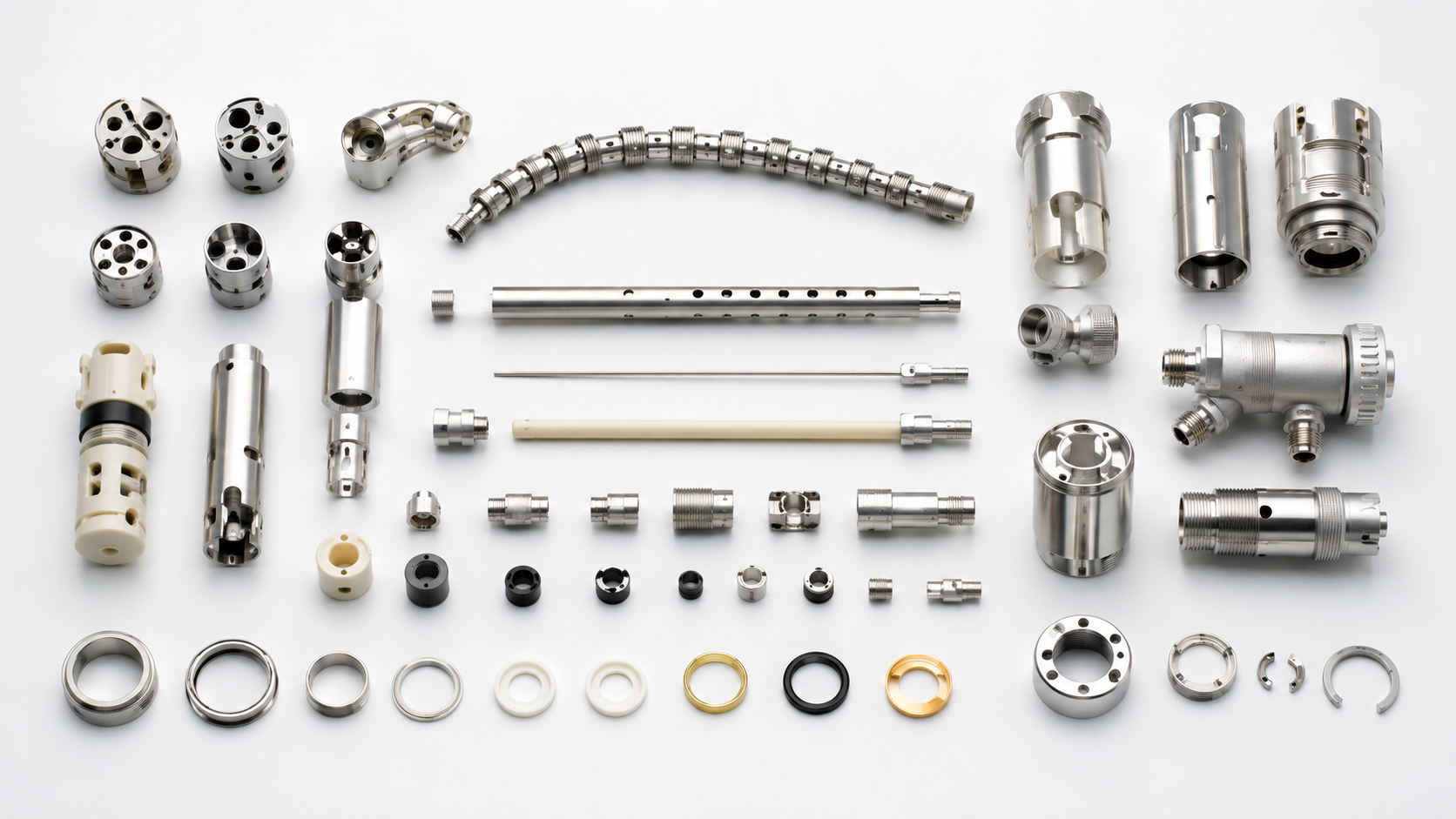
For example, a distal tip component may need to support lens, light, sensor, and channel integration in a very limited space. A bending section or snake bone component may require clean edges and accurate small holes to support stable articulation. A working channel fitting may need controlled inner bore quality to support tool access, flushing, suction, or internal passage connection.
These details are not only machining details. They can influence articulation stability, assembly efficiency, imaging performance, sealing reliability, cleanliness, and long-term device reliability.
This is why endoscope-related components should not be treated as ordinary small metal parts. Drawing review, tolerance planning, edge condition, material choice, and inspection feasibility should be considered before machining starts.
Custom Medical Endoscope Components We Can Machine
XY-GLOBAL can manufacture different types of custom CNC machined parts used in medical endoscope assemblies, minimally invasive devices, medical camera modules, compact imaging systems, and small medical device structures.
| Component Type |
Typical Function |
| Distal Tip Components |
Supporting front-end structure, lens, light, channel, and sensor integration |
| Bending Section / Snake Bone Components |
Supporting controlled bending and articulation of the distal end |
| Working Channel Fittings |
Supporting tool access, flushing, suction, or internal passage connection |
| Control Wire Guide Parts |
Guiding or supporting control wires in bending mechanisms |
| Stainless Steel Sleeves And Tubes |
Providing structural support, protection, or internal passage connection |
| Connector Components |
Linking different endoscope modules or mechanical interfaces |
| Sealing And Retaining Components |
Supporting sealing, positioning, and assembly reliability |
| Endoscope Camera Housings |
Protecting and positioning camera or sensor modules |
| Lens Holders And Light Guide Holders |
Supporting optical alignment and light transmission |
| Precision Rings And Spacers |
Controlling spacing, fit, and assembly alignment |
Some of these components may look simple from the outside, but their manufacturing requirements are often hidden in the details. Small holes, thin walls, internal edges, tight fitting areas, and surface finish notes should be reviewed carefully before production.
Machining Details That Need Early Review
Endoscope-related CNC machined components often include features that are easy to underestimate during design review.
A small hole near a thin edge may look simple on the drawing, but it can become a burr-sensitive feature during machining and inspection. A thin-wall sleeve may deform during clamping if the machining sequence is not planned correctly. A fine thread may pass basic dimensional inspection, but still create assembly issues if burrs remain around the thread entrance.
For bending section or snake bone components, edge quality and hole accuracy are especially important. Burrs around control wire holes may increase wire wear or create unstable articulation. For working channel fittings or sleeve parts, inner bore quality, wall thickness, and clean internal edges can affect tool access, flushing, suction, or internal passage assembly.
Inner bores, micro chamfers, small slots, fine threads, flat mounting faces, control wire holes, and critical mating surfaces should be reviewed based on how the part will be assembled and used. The key question is not only whether the part can be machined, but whether it can be machined consistently, inspected clearly, and assembled smoothly.
When these details are reviewed early, it is easier to reduce rework, avoid assembly problems, and control production cost.
Materials, Surface Finish, And Clean Edge Requirements
Material selection should be based on the part’s function, assembly environment, surface requirement, and manufacturing risk.
Stainless steel is often used for sleeves, tubes, connectors, working channel fittings, and corrosion-resistant structural parts. Aluminum may be suitable for camera housings, lightweight medical device housings, optical-related housings, and parts requiring anodizing. Titanium can be considered when high strength and low weight are important. PEEK and selected engineering plastics may be used for insulating parts, lightweight structures, or special assembly requirements.
Surface finish should also be defined by function, not only appearance. An internal fitting surface, an external cosmetic surface, a lens-related surface, a sealing area, and a working channel surface may require different finishing standards.
Depending on the drawing and application, XY-GLOBAL can support as-machined finish, polishing, bead blasting, passivation for stainless steel, anodizing for aluminum, black anodizing for optical or camera housings, and cleaning or packaging support.
For medical endoscope components, clean edge quality is especially important. Burrs, sharp edges, or uncontrolled surface defects may affect assembly, cleaning, sealing, cable routing, control wire movement, or internal passage reliability.
When surface finish and inspection requirements are confirmed before quotation, the manufacturing route, cost, and lead time can be evaluated more realistically.
Inspection Planning For Small Medical Endoscope Components
For small medical endoscope components, inspection is not only about checking overall size. Critical features may directly affect assembly fit, articulation, alignment, sealing, surface condition, and final device performance.
An endoscope component may require inspection of hole size, thread quality, inner bore tolerance, concentricity, flatness, surface roughness, burr condition, edge quality, or mating surface accuracy. If these features are not clearly defined before production, it may be difficult to judge whether the part is truly suitable for assembly.
Depending on the drawing requirements, XY-GLOBAL can support CMM measurement, optical inspection, thread gauge inspection, surface roughness measurement, first article inspection, critical dimension reports, and burr or edge condition checks.
For prototype and small-batch projects, inspection planning is especially useful. It helps customers verify design feasibility and adjust critical requirements before moving to larger production.
From Drawing Review To CNC Machined Medical Endoscope Parts
At XY-GLOBAL, custom endoscope components are reviewed from both design and manufacturing perspectives. Before production, we can check the drawing for material choice, small feature risks, wall thickness, burr-sensitive areas, tolerance strategy, surface finish, and inspection points.
This review does not mean changing the function of the part. It helps identify whether the design can be manufactured more reliably, inspected more clearly, and produced with fewer risks.
For example, if a thin wall may deform during machining, it should be discussed early. If a small hole is close to an edge, the machining and burr-control method should be reviewed. If an inner bore is critical for assembly, the inspection method should be confirmed before production. If a snake bone component includes control wire holes, edge quality and burr control should be reviewed before machining.
With ISO 9001 and ISO 13485 quality management system support, XY-GLOBAL can help you develop custom endoscope components with controlled machining, inspection, and documentation processes.
What To Send For A Quote
To help us evaluate your custom CNC machined endoscope components accurately, please send your 2D drawings, 3D CAD files, material requirements, quantity, surface finish requirements, critical tolerances, and application background.
If you have samples, reference photos, assembly requirements, or inspection standards, these details can also help our team better understand the part function.
After receiving your files, XY-GLOBAL can review machining feasibility, material options, burr control requirements, surface finish, critical inspection points, and production cost before quotation.




공유하다:
Stainless Steel CNC Machining Services: From Material Selection to Precision Manufacturing
Black Anodise Finish For CNC Machined Aluminum Parts