


Ceramic CNC Machining Services
One-stop high-precision ceramic CNC machining for custom parts across a wide range of technical ceramics, delivering micron-level tolerances and consistent quality from prototype to production. Get a Quote Today.
- Up to ±1 μm Precision Capability
- 3-Day Fast Prototyping & Free DFM
- ISO 9001 & ISO 13485 Certified
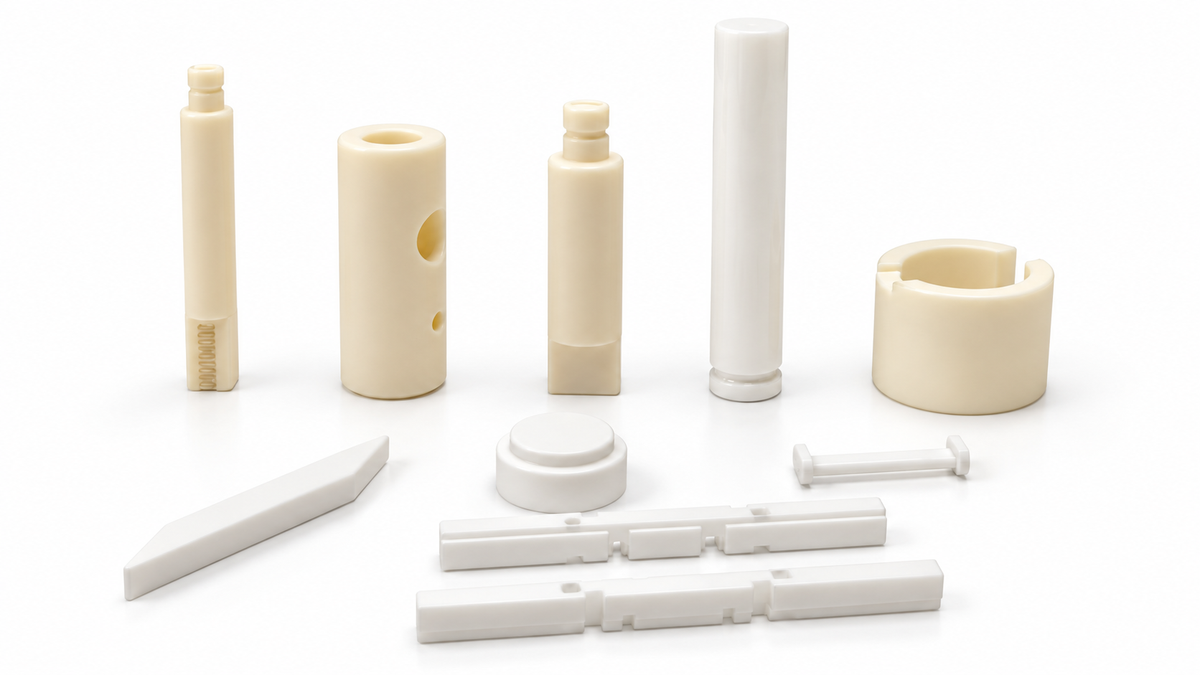
CNC Ceramic Machining
Ceramic CNC machining is a computer-controlled subtractive manufacturing process used to create complex and precise parts from technical ceramics such as alumina, zirconia, etc. Common processes include CNC milling, drilling, grinding, and precision finishing.
Unlike metals, technical ceramics are hard and brittle, so machining usually requires diamond tools and grinding wheels under strictly-controlled cutting forces and cooling conditions to reduce chipping, cracking, and surface damage.
It is suitable for ceramic parts used in semiconductor, electronics, medical, and industrial applications where wear resistance, heat resistance, corrosion resistance, or electrical insulation is required.
Ceramic CNC Machining Capabilities at XY-GLOBAL
XY-GLOBAL provides precision ceramic machining from prototype to production, combining CNC machining, grinding, finishing, and inspection for complex technical ceramic parts.
| Capability | XY-GLOBAL Support |
|---|---|
| Machining Processes | CNC milling, grinding, drilling, hole finishing, chamfering, and precision finishing |
| Tolerance Capability | Up to ±1 μm for suitable ceramic materials and part geometries |
| Secondary Processing | Grinding, lapping, polishing, edge treatment, and other finishing operations |
| Inspection Capabilities | Dimensions, flatness, parallelism, hole position, surface roughness, and visual defects |
| Quality Documentation | Inspection reports and material certificates available upon request |
| Prototype Lead Time | Typically 3–7 days, depending on material and part complexity |
| Production Support | No MOQ, from 1-piece prototypes to low-volume and repeat production |
| DFM Support | Free DFM analysis for geometry, tolerance, and machining feasibility |
| Quality Certifications | ISO 9001:2015 and ISO 13485:2016 |
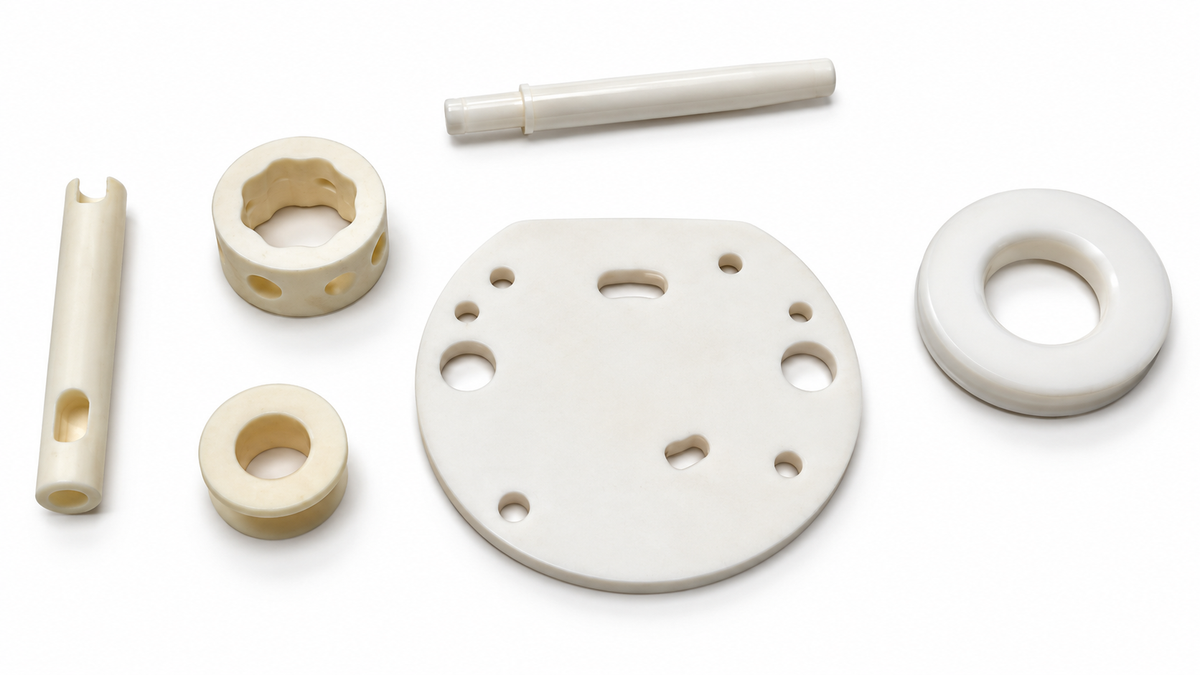
Advantages of Ceramic CNC Machining
CNC machined ceramics are often selected where conventional metals cannot provide the required combination of hardness, thermal stability, insulation, or corrosion resistance.
- High hardness and wear resistance
- Excellent electrical insulation
- Good dimensional stability
- High-temperature performance
- Strong corrosion and chemical resistance
- Low thermal expansion for selected ceramic grades
- Long service life in demanding environments
CNC ceramic parts can also provide stable performance where metal components may deform, wear, or conduct electricity.
Common Ceramic CNC Machining Materials
Material selection has a direct impact on the performance, machinability, and service life of ceramic parts. As an experienced ceramic parts CNC machining manufacturer, we work with diverse technical ceramics, from alumina and zirconia to special materials such as Macor and cordierite, to meet different mechanical, thermal, electrical, and wear requirements.
Alumina (Al₂O₃) Ceramic
- Advantages: High hardness, excellent wear resistance, good electrical insulation, and strong chemical stability, while remaining relatively cost-effective.
- Best for: Semiconductor fixtures, electrical insulators, wear plates, bushings, nozzles, precision spacers, and industrial ceramic components.
Zirconia (ZrO₂) Ceramic
- Advantages: High strength, excellent fracture toughness, good wear resistance, and a smooth surface finish.
- Best for: Medical components, precision sleeves, valve parts, ceramic shafts, wear-resistant parts, and small mechanical components.
Silicon Carbide (SiC) Ceramic
- Advantages: Extremely high hardness, excellent wear and corrosion resistance, high thermal conductivity, and strong dimensional stability at elevated temperatures.
- Best for: Semiconductor equipment, mechanical seals, wafer-handling parts, high-temperature fixtures, and heavy-wear industrial components.
Aluminum Nitride (AlN) Ceramic
- Advantages: High thermal conductivity, excellent electrical insulation, low thermal expansion, and good thermal stability.
- Best for: Semiconductor components, heat spreaders, electronic substrates, insulating plates, laser equipment, and power electronics.
Silicon Nitride (Si₃N₄) Ceramic
- Advantages: High mechanical strength, good fracture toughness, excellent thermal shock resistance, low density, and strong wear resistance.
- Best for: Bearings, rollers, aerospace components, high-speed mechanical parts, welding fixtures, and wear-resistant components.
Macor / Machinable Glass Ceramic
- Advantages: Good machinability, electrical insulation, dimensional stability, and thermal resistance, making it suitable for complex prototypes and low-volume parts.
- Best for: Electrical insulators, vacuum components, laboratory equipment, semiconductor fixtures, precision supports, and prototype ceramic parts.
Other Technical Ceramics
Boron Nitride (BN) Ceramic
- Advantages: Excellent electrical insulation, high-temperature resistance, low friction, good thermal shock performance, and relatively good machinability.
- Best for: High-temperature insulators, furnace parts, crucibles, semiconductor equipment, vacuum components, and electrical insulation parts.
Quartz
- Advantages: Very low thermal expansion, high purity, good thermal shock resistance, and strong optical and thermal stability.
- Best for: Semiconductor equipment, optical parts, laboratory components, high-temperature fixtures, and precision thermal applications.
ZTA
- Advantages: High hardness and wear resistance with improved fracture toughness compared with standard alumina.
- Best for: Wear parts, precision mechanical components, valve parts, liners, and structural ceramic components.
Cordierite / Mullite
- Advantages: Low thermal expansion, good thermal shock resistance, and strong high-temperature stability.
- Best for: kiln furniture, thermal fixtures, insulation parts, furnace components, and other high-temperature industrial applications.
*For other ceramic grades, send us your requirements and we’ll recommend a suitable machining solution.
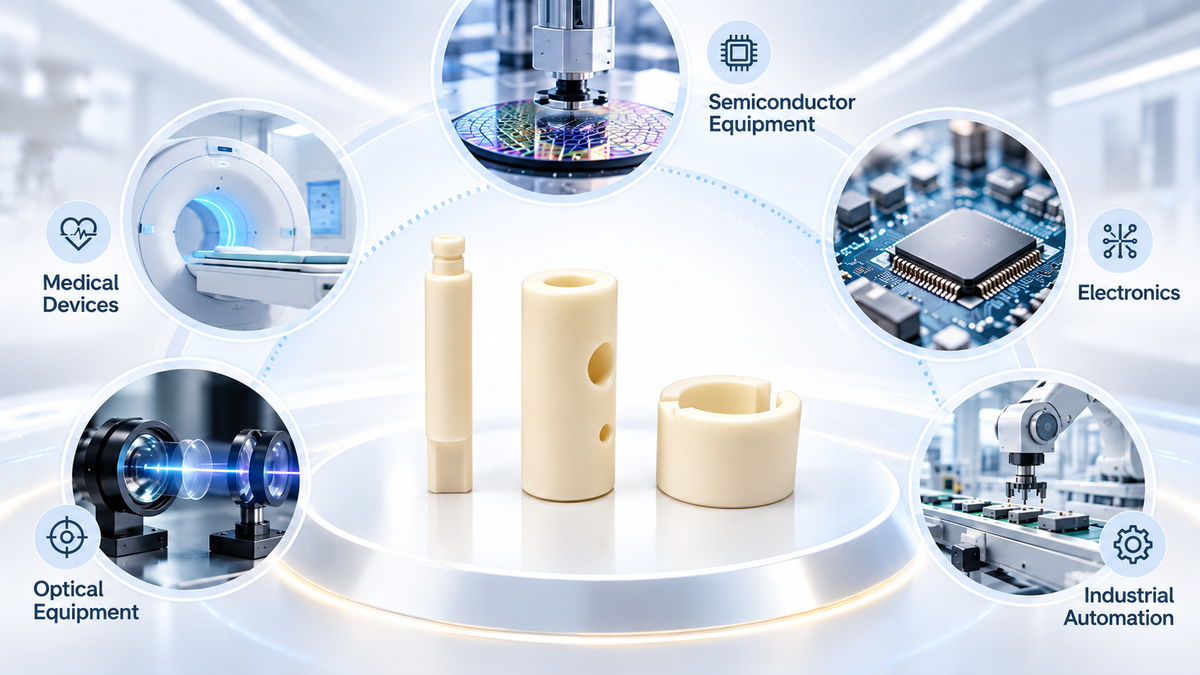
Applications of Ceramic CNC Machining
Ceramic CNC machining services are widely used for precision parts:
- Semiconductor Equipment: Used for wafer handling parts, insulating fixtures, precision supports, and thermal management components.
- Medical Devices: Suitable for wear-resistant, chemically stable, and electrically insulating ceramic components.
- Electronics: Used for insulators, heat spreaders, substrates, spacers, and precision electronic parts.
- Optical Equipment: Applied in precision mounts, supports, fixtures, and other dimensionally stable components.
- Industrial Automation: Used for guides, bushings, sleeves, nozzles, spacers, and other wear-resistant mechanical parts.
Cermamic CNC Machining Approaches
Green Machining
Green machining is performed before sintering, when the ceramic is still relatively soft and easier to cut. It offers faster machining, lower tool wear, and lower cost, making it suitable for completing most of the part geometry and complex features. However, the part will shrink during sintering, so dimensions must be compensated in advance and very tight final tolerances are harder to control directly.
Sintered Machining
Sintered machining, also known as hard machining, is performed after the ceramic has reached full density and hardness. At this stage, machining requires diamond tooling, slower cutting speeds, and tighter process control, so the cost is higher. It is mainly used for critical dimensions, precision holes, flat surfaces, and tight tolerances that cannot be reliably maintained through sintering alone.
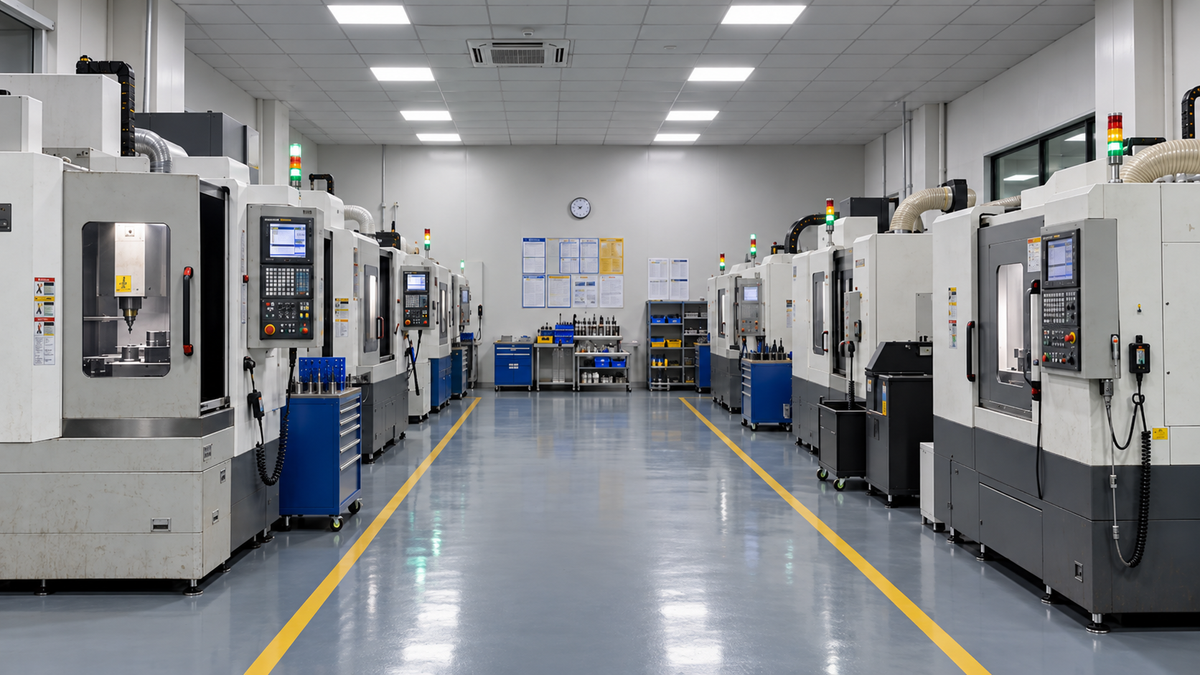
Why Choose XY-Global for CNC Machining Ceramic Components
- Precision Ceramic Machining: Support CNC milling, grinding, drilling, lapping, and polishing for various technical ceramics, with tolerances up to ±1 μm for custom ceramic parts.
- Fast & Flexible Production: Free DFM analysis and fast prototyping and lead time help shorten development time.
- Strict Quality Control: Under ISO 9001:2015 and ISO 13485:2016, all parts undergo final inspection, with CMM measurement and detailed inspection reports available when required.
- One-Stop On-Demand Manufacturing: Manage the full process with no MOQ from material selection and machining to secondary finishing, inspection, and delivery.
Ceramic CNC Machining FAQs
1. What is the difference between ceramic CNC machining and CIM?
Ceramic CNC machining removes material from ceramic stock or preforms to create precise features and is well suited to prototypes, low-volume production, and tight-tolerance parts. Ceramic Injection Molding (CIM) is better suited to higher-volume production of small, complex parts after tooling is developed.
2. Should ceramic parts be machined before or after sintering?
Both methods are possible. Green machining before sintering is generally faster and more economical, while machining after sintering provides better control of final dimensions and critical tolerances.
3. What design features make ceramic parts difficult to machine?
Very thin walls, sharp internal corners, deep small-diameter holes, narrow slots, and abrupt section changes can increase the risk of chipping or cracking. Small design adjustments can often improve manufacturability.
4. Is there a minimum order quantity for ceramic CNC machining?
No. We support one-off prototypes, low-volume production, and repeat orders based on your project requirements.
5. Can we sign an NDA before sending ceramic part drawings?
Yes. We can sign an NDA before reviewing your drawings, CAD files, or other confidential project information.
6. What files should I provide for a ceramic CNC machining quotation?
A 3D CAD file and 2D drawing are preferred. The drawing should clearly show material, tolerances, surface finish, critical dimensions, quantity, and any inspection requirements.
7. Can ceramic CNC machining replace metal parts?
In some applications, yes. Technical ceramics are often selected when metal parts cannot provide enough wear resistance, electrical insulation, corrosion resistance, or high-temperature stability.
8. What secondary finishing processes are available for ceramic parts?
Available processes include precision grinding, lapping, polishing, chamfering, edge treatment, and other finishing operations based on the part requirements.