


One-stop Custom Precision CNC Turning Service
Access high-tolerance CNC turned parts with our on-demand CNC turning service. From single prototype runs to large batch orders, we offer 2-hour quotes and delivery as fast as 1 day—all without compromising on quality or accuracy.
CNC Turning Materials
XY-GLOBAL supports CNC turning of a wide range of metals and engineering plastics for precision shafts, bushings, pins, fittings, and other rotational components. Material selection can be customized based on your mechanical, functional, and application requirements, with additional materials available upon request.
| Material Category | Common Grades | Characteristics |
|---|---|---|
| Aluminum | 6061-T6, 6063, 6082-T6, 7075-T6, 2024, 5083 | Lightweight, excellent machinability, good corrosion resistance, and suitable for high-speed machining. |
| Stainless Steel | 303, 304, 316, 316L, 17-4PH, 420, 440C | High strength, excellent corrosion resistance, and good durability in demanding environments. |
| Carbon & Alloy Steel | 1018, 1045, 4130, 4140, 4340, 40Cr, 42CrMo4 | High strength, toughness, and wear resistance for mechanical applications. |
| Tool Steel | D2, A2, O1, S7, M2 | High hardness and wear resistance after heat treatment. |
| Titanium | Grade 2, Grade 5 (Ti-6Al-4V) | High strength-to-weight ratio, excellent corrosion resistance, and reliable performance in harsh environments. |
| Copper | C101, C110, C145, C172 | Excellent electrical and thermal conductivity with good machinability. |
| Brass & Bronze | C360, C260, C464, CuZn39Pb3, C932, C954 | Excellent machinability, corrosion resistance, and good wear performance. |
| Engineering Plastics | POM (Delrin), PEEK, PTFE, Nylon, PC, ABS, UHMW-PE | Lightweight, chemical-resistant, electrically insulating, and easy to machine. |
CNC Turning Surface Finishes
Surface finishing helps improve the appearance, corrosion resistance, wear resistance, and functional performance of CNC turned parts. At XY-GLOBAL,we also provide custom finishing options based on material selection, application requirements, and desired surface performance.
As-Machined
Maintains the original CNC turning marks without additional treatment. Suitable for functional components where surface appearance is not the primary requirement.
Anodizing
Commonly used for aluminum turned parts to improve corrosion resistance, surface hardness, and appearance with various color options.
Bead Blasting
Creates a uniform matte finish and removes minor machining marks, improving surface appearance and consistency.
Polishing
Improves surface smoothness and creates a brighter finish for applications requiring better appearance or reduced surface friction.
Electroless Nickel Plating
Provides a uniform coating with excellent corrosion resistance, wear resistance, and dimensional stability for precision components.
Passivation
Commonly applied to stainless steel parts to improve corrosion resistance without significantly changing part dimensions.
Powder Coating
Provides a durable protective coating with various colors and textures for improved appearance and environmental resistance.
Black Oxide
Creates a black protective finish with minimal dimensional impact, commonly used for steel shafts, fasteners, and mechanical components.
Customize
Custom surface finishes are available based on your material, application requirements, and specific project needs.
What is CNC Turning
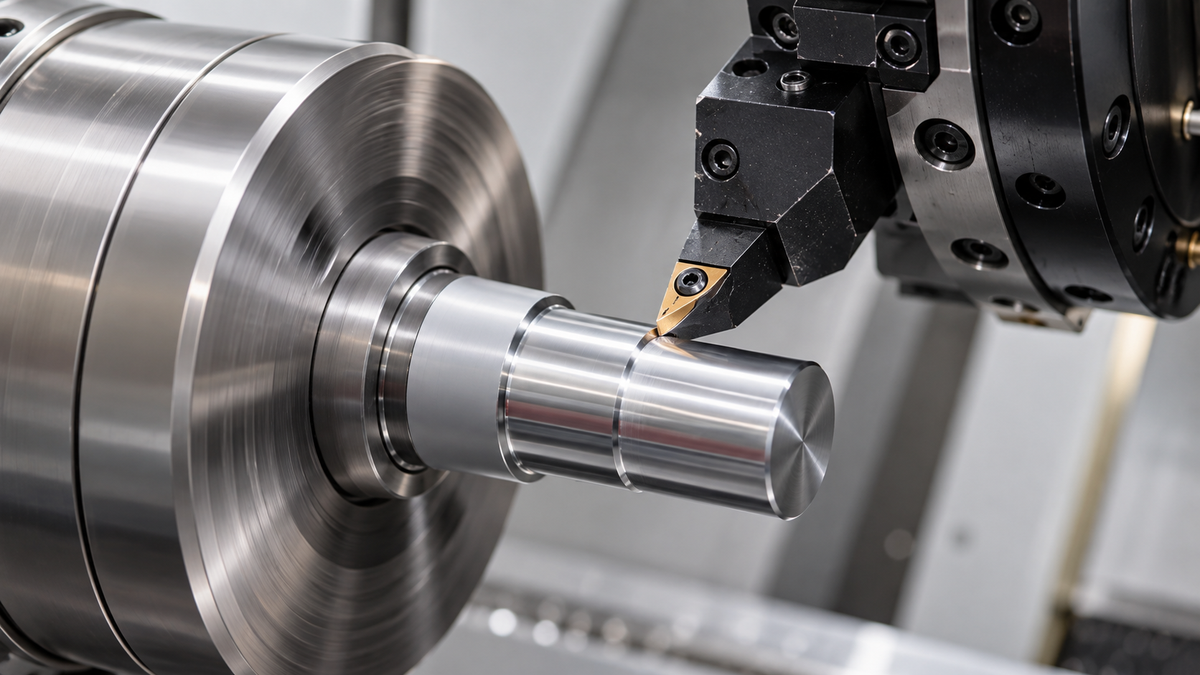
CNC Turning is a subtractive manufacturing process used to produce axially symmetric parts by engaging a fixed or moving cutting tool with a workpiece that is rotating at high speed.
At XY-Global, we offer high-tolerance, on-demand turning services, powered by our advanced multi-axis CNC Lathes and Mill-Turn Centers including Mazak and DMG Mori. We are capable of achieving ultra-high precision up to 0.005 mm on critical features. Additionally, we provide end-to-end surface treatment solutions, ranging from low Ra value as-machined finishes to secondary post-processes like anodizing and plating, ensuring your parts meet all functional requirements and desired aesthetics.

How Does CNC Turning Work?
CNC Turning is a subtractive manufacturing process where the cylindrical workpiece rotates at high speed while a single-point cutting tool moves linearly along the X (diameter) and Z (length) axes, precisely removing material to create parts with rotational symmetry .
The entire operation is governed by the CNC controller reading G-code, ensuring high precision and repeatability. Advanced Multi-axis CNC Lathes and Mill-Turn Centers integrate live tooling, allowing them to perform milling and drilling operations, thereby completing complex, non-symmetric features on a rotating part in a single, highly efficient setup.
Why Choose XY-GLOBAL for CNC Turning Services
XY-GLOBAL provides precision CNC turning for custom cylindrical and rotational parts, from simple shafts and bushings to more complex components with threads, grooves, and internal features.
- Precision CNC Turning: Tight-tolerance machining for complex rotational parts, including critical diameters, threads, and grooves, with reliable dimensional control throughout production.
- Live Tooling Capability: Milling, drilling, slots, flats, and other secondary features can be completed with fewer setups to improve machining efficiency and accuracy.
Materials & Surface Finishes
A wide range of metals and engineering plastics can be machined, with customized finishing options available for appearance, corrosion resistance, and functional requirements.
Engineering & DFM Support
Our engineers review drawings, tolerances, threads, wall thickness, and critical features before machining and provide practical DFM recommendations where needed.
Reliable Quality Control
Critical dimensions, runout, threads, and other turning features can be verified with appropriate inspection methods under ISO 9001 and ISO 13485 quality systems, supporting consistent quality from prototypes to repeat production.
CNC Turning FAQs
What is the difference between CNC Turning and CNC Milling?
The key difference lies in the motion: CNC Turning involves the material (workpiece) rotating rapidly against the tool, making it highly efficient for circular parts. Conversely, CNC Milling involves the tool (cutter) rotating, which is better suited for producing complex, non-symmetric, prismatic shapes.
What are the standard tolerances your CNC turning can achieve?
While our standard tolerances adhere to industry norms, we offer ultra-high precision for critical features, achieving diameter and roundness tolerances as tight as ±0.005mm.
Do you require a Minimum Order Quantity (MOQ)?
We provide on-demand and flexible production, supporting the full range of orders from single prototype runs to scalable high-volume production, with no strict MOQ limitations.
What is your typical lead time for CNC turned parts?
Generally, prototypes and small batch orders can be delivered in as fast as 1 day. The specific lead time depends on part complexity, material, and required post-processing.
Do you provide secondary surface finishing services?
Yes, we offer a one-stop solution that includes services like Anodizing, Plating, Laser Engraving, and Passivation, ensuring your parts meet all functional and aesthetic requirements.