


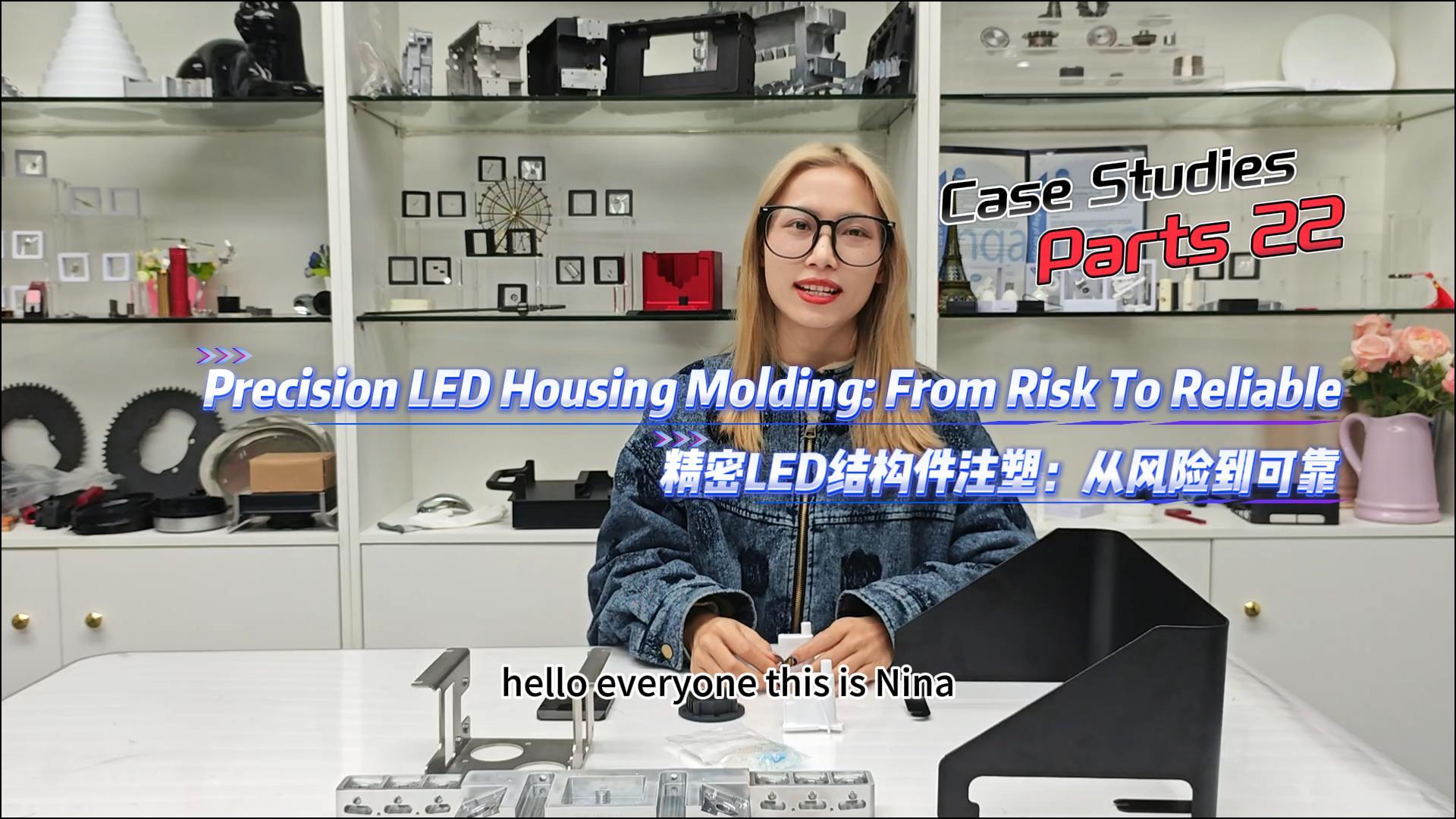
📺 Project Video:
Project Background
This project was developed for a U.S.-based manufacturer of high-performance LED lighting systems used in architectural and commercial environments.
In these applications, two things are non-negotiable:
-
Structural stability
-
Appearance consistency
Even internal structural parts must meet strict dimensional and visual standards to ensure reliable assembly and long service life.
The Component We Supplied
We supplied a precision injection molded structural part used inside the LED lighting assembly for support and positioning.
Although it is not an external decorative part, the customer required:
✅ Stable dimensions
✅ Smooth assembly fit
✅ Clean molded surface
✅ No visible cosmetic defects
This placed high demands on both mold design and injection molding process control.
Material Selection: Why PC Injection Molding
The part is produced using PC injection molding (polycarbonate) due to its balanced performance:
-
High mechanical strength
-
Good heat resistance
-
Strong dimensional stability
-
Suitable for long-term structural support
For LED system components exposed to heat and continuous operation, PC material provides reliable performance over time.
Customer Requirements — Clear And Strict
From the beginning, the customer defined detailed acceptance standards for the molded LED structural parts:
Dimensional Requirements
-
Stable critical dimensions
-
Controlled tolerance for assembly features
-
Consistent repeatability between batches
Appearance Requirements
-
No flow lines
-
No sink marks
-
No color variation
-
Uniform surface quality
Production Requirements
-
Predictable delivery schedule
-
Stable process window
-
Low defect rate
This was not just a molding job — it was a process stability challenge.
The Core Challenge
The main difficulty was balancing:
Structural performance vs. cosmetic consistency
In PC injection molding, improving strength and fill behavior can sometimes increase the risk of:
-
Flow marks
-
Surface variation
-
Internal stress
-
Visual defects
That meant early process strategy was critical.
How We Solved It
We addressed risks early through a structured injection molding development approach:
✔ Early Mold Trials
Multiple mold trials were conducted to validate filling behavior and gate performance.
✔ Process Optimization
We optimized:
-
Injection speed profile
-
Melt temperature window
-
Packing pressure control
-
Cooling balance
✔ Critical Feature Verification
Key structural and assembly features were measured and verified during early runs to prevent later-stage risk.
This reduced adjustment cycles during mass production.
Production Results
After process tuning and validation, the final injection molded parts achieved:
✅ Stable dimensions
✅ Reliable assembly fit
✅ Clean and consistent appearance
✅ No visible molding defects
✅ Batch-to-batch consistency
Both functional and cosmetic requirements were met.
Customer feedback was positive, and the project progressed into continued cooperation.
Why This Injection Molding Project Matters
This case shows that successful precision injection molding for LED structural components is not only about making parts — it is about controlling the process.
When appearance, tolerance, and reliability must exist together, early engineering involvement and process discipline make the difference.
Need Custom Injection Molded Structural Parts?
We support customers with:
-
PC injection molding
-
Precision structural plastic parts
-
Appearance-controlled molded components
-
LED and electronics structural parts
-
Custom injection molding based on drawings
📩 If you have a similar project, feel free to send us your drawings or specifications.
Our engineering team will review and support your production plan.


Share:
A Story of Integrity Behind a Small Sample
Engineering Services: Capability & Production Control for Precision Manufacturing